
Everyone into the mountain! Nan Shepherd’s enduring legacy

Shepherd’s continuing influence can be seen in several contributions to There She Goes, a new book of travel writing by women, writes Roger Cox
When Nan Shepherd’s dazzling hymn to the Cairngorms, The Living Mountain, was first published in 1977, shortly before the author’s death in 1981, it made very little impact. In the years since it was rescued from obscurity by Edinburgh publisher Canongate in 2011, however, and republished with a glowing introduction by Robert Macfarlane, it has made a significant mark, not just on the booming genre of New Nature Writing, but also on attitudes towards outdoor recreation more generally.


How much of a mark? It's impossible to say exactly. Academics use citations to track the importance or otherwise of a piece of research; literary writing, by contrast, doesn’t require the citing of sources, so while an author might be heavily influenced by Shepherd and her thinking, they might never say so explicitly. What we can do, however, in an attempt to apportion Shepherd some kind of non-scientific impact score, is to look at her most important ideas and assess how often these seem to crop up in the work of contemporary writers; and judging by a new book of new travel writing by women titled There She Goes, edited by Esa Aldegheri, her philosophy is alive and well and having a major influence on some of the leading non-fiction writers of today.
Perhaps the best-known aspect of Shepherd’s worldview, and certainly the most frequently quoted, is her preference for walking “into” mountains rather than walking “up” them. In The Living Mountain she explains how, in later life, she learned to ignore the summit fever she experienced as a young woman – “the tang of height” as she calls it – and instead just enjoy the feeling of being in the mountains – “merely to be with the mountain as one visits a friend, with no intention but to be with him.”
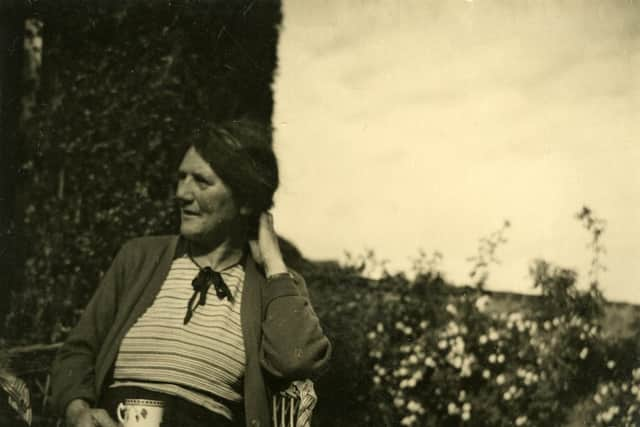
Clearly this presents a challenge to the vast majority of existing (and mostly male-produced) mountain literature, which typically casts mountain-going as an ego-driven slog to “conquer” peaks, during which the hero (occasionally the heroine, but usually the hero) must endure great suffering and overcome seemingly impossible obstacles in order to prevail. Shepherd undercuts all this at a stroke by effectively asking: “does getting to the top ever really matter?”
One of the most thought-provoking pieces in There She Goes is written by Lee Craigie – a former mountain bike champion who applies this same logic to the hard-bitten world of endurance cycling. “After a career of full-time mountain bike racing,” she writes, in “Rewriting the Hero’s Journey”, I felt compelled to stop and consider whether my life-long passion was now serving me. Only when I took this step back from the intense focus on timed laps and beating others over a finish line did I find the space to remember the reason I fell in love with riding bikes in the first place: I had always loved the journey.”

Craigie could of course have reconnected with her love of the journey simply by setting off on a long-distance bike ride by herself. Instead, however, she and a group of female friends decided to enter a (male-dominated) 500km race called Further Elements, starting and finishing at Corrour Station on Rannoch Moor, but forgoing much of the required suffering by not sleeping outside and riding in a group as opposed to solo. At the end of it all, they announce that they want to be disqualified from the race standings. “This ride had not been a race to the bitter end for any of us,” Craigie writes. “It had been a test of empathy, mutual care and respect for our surroundings.” Inevitably, perhaps, when they post their story on social media they draw a fair bit of flack – “Why did you enter a race and not race?”; “Did you not feel you had undermined the spirit of the event?” – but this had been the point; in a sense, their ride was The Living Mountain in performative form. Rather than respond to their critics, Craigie writes, “we preferred to leave these questions hanging in the air for others to reflect on.”
There’s a similar, Shepherd-inspired conclusion to Marjorie Lotfi’s contribution to the book, “How Far My Body Can Go”. Ostensibly it’s an essay about her preparations to run the New York Marathon; however, the real moment of revelation comes not from completing the race, but from her realisation that, in the process of training for it, she has come to feel very much at home in the Pentland Hills near her adopted home of Edinburgh. “Up there[...], miles from the nearest road, I felt more at home than I'd ever felt in Edinburgh,” she writes. “I felt like myself in those woods, and in the reservoir where I would go on to dip and stretch at the end of my run.”
This not only chimes with Shepherd’s “into the mountain” philosophy, but also her emphasis on the value of coming to know a place intimately – visiting the mountain “as one visits a friend.” And surprisingly, perhaps, for a book of travel writing, this idea of returning again and again to the same, often local corner of the natural world until it feels like part of us crops up multiple times in There She Goes. In her essay “Stay At Home,” Sarah Thomas writes of how her daily journeys to a heronry during lockdown allowed her to both “travel deep and stay at home”. Shepherd herself could hardly have put it better.
There She Goes: New Travel Writing by Women, edited by Esa Aldegheri, Saraband, £14.99
Comments
Want to join the conversation? Please or to comment on this article.