
Edinburgh's Lost Shore resort to offer 'sci-fi' surf coaching

The latest development at the Scottish surf centre will take coaching to a new level thanks to an innovative collaboration with Napier University’s Surf Lab, writes Roger Cox
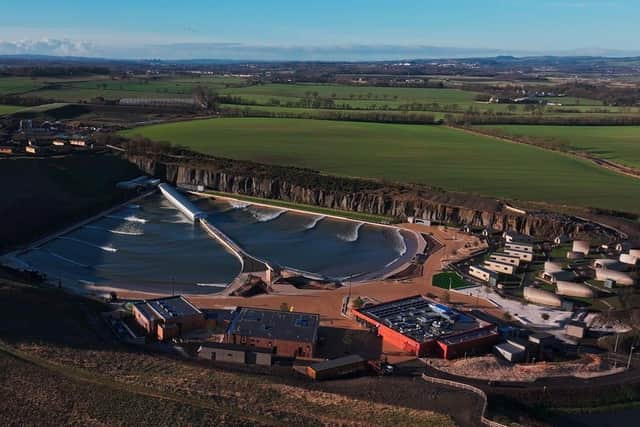
In the autumn of 2024, with the Lost Shore wave pool at Ratho due to open to the public in a matter of weeks, I spoke to its founder Andy Hadden about his hopes for the £60 million project, and in particular about how he thought the facility might be used to train people to become better surfers.


Initially we discussed the possibilities for using Lost Shore’s endless supply of perfect, identical waves to train elite athletes. Surf coaches at Lost Shore, he said, would be able to observe surfers much more easily in the pool than they can in the ocean, and as a result “would be able to get really detailed and nuanced about the exact movements they’re making.” However, Hadden was just as enthusiastic about the potential for using the pool as a place where average Joes could work on upping their game. “The better you get, the adventure only gets bigger,” he said, “because you can start looking around the coast and things really open up.”
From its opening back in November 2024, Lost Shore has offered surf lessons for recreational surfers, both individually and in groups. However, later this spring it will be taking its coaching offering to a whole new, some might say sci-fi level, thanks to an innovative collaboration with the Surf Lab at Edinburgh Napier University.
First cooked up by Hadden and Napier academic Dr Brendon Ferrier in 2017, the Surf Lab was conceived as a multi-disciplinary surf research centre, able to draw on expertise from departments right across the university and beyond. One of its earliest projects involved testing a variety of different wetsuits on behalf of Lost Shore to enable the new surf resort to buy in the warmest and most environmentally-friendly suits available (and having worn one of the Gul Yulex wetsuits they selected in the pool at the chillier end of the year, I can confirm they nailed their brief). Whereas that piece of research took place behind the scenes, however, the latest Lost Shore-Surf Lab collaboration will be very much public-facing.
Ferrier explains the concept: “Later this month we’re going to be launching a new surf science visitor experience at Lost Shore,” he says. “I’m going to be doing some physical testing at the beginning with the client, so we’ll measure their strength, mobility, those sorts of things, all related to surfing performance.
“They’ll then get a surf session on their preferred setting, and they’ll be wearing sensors, so they’ll be able to look at the distance they paddled, the distances they surfed and even the speed of their surfing.
“After that, I’ll sit down with them and we’ll look at their physical testing and at their surfing experience, and I’ll be able to inform them that, from the data of that testing, these are the things that impacted on their surfing performance, and then they can go away and work on their mobility or their strength or other factors. So it’ll be a high-end product – they’ll get what an elite athlete would get with regards to sports science, but relating to their own surfing experience.”
In addition to offering this new, bespoke visitor service, Ferrier has various other Surf Lab projects on the go – and one three-way collaboration, in particular, which could potentially revolutionise how surfers surf and how they train. The first part of this ongoing piece of research involves being able to make precise measurements of how a board moves through the water, as Ferrier explains.
“I’ve been working with a guy from Portugal called Dr Marcio Borgonovo-Santos,” he says, “and he’s created a surfboard with GPS and an inertial measurement unit, and he’s also created and patented a thing called a fluid flow sensor. It’s a little sensor that sits underneath the board and measures the direction and speed of flow of the water under the board, so we can now measure what the board does on the water, and as the surfer moves around we can follow the board.”
Borgonovo-Santos’ research is cutting edge in its own right, but via the Surf Lab Ferrier has partnered him up with another academic, Alex Weiss, who is a PhD candidate at Friedrich Alexander University in Germany. He’s in the process of creating a system, using sensors fitted to a surfer’s body, that makes it possible to create a 3D model of that surfer.
“We’re now busy fusing these two systems together,” says Ferrier, “to allow us to look at a surfer’s body movements whilst surfing, and how this affects the surfboard. We’re working together as a collective group towards Alex’s PhD, and hopefully we’re going to be able to use the Surf Lab and Lost Shore for the two systems working together.
“We’re breaking surfing down into its component parts,” he adds, “so we’re going to look at the bottom turn first. What’s the best bottom turn? What do different elements of the bottom turn do in regards to acceleration of the board and board dynamics?”
Surfing has experienced various sudden leaps forward over the last 100 years or so, from the switch from wooden boards to foam and fibreglass in the 1960s to the shortboard revolution of the early 1980s. But who knows? The next big step in that progression might take place, not in California or Australia, but in a former quarry just outside Edinburgh.
For more details, see www.lostshore.com
Want the latest Scottish headlines sent directly to your phone? Sign up to our new WhatsApp channel here
Comments
Want to join the conversation? Please or to comment on this article.