
Author and gardener Arthur Parkinson on how to raise happy hens


Arthur Parkinson’s new book is a celebration of hens, with each chapter devoted to a different breed. The author talks to Cat Thomson about his obsession and the joy his flock brings.
Author, illustrator, gardener, and florist, Arthur Parkinson, is a confessed chicken obsessive who is happiest hanging out with his flock on a half-acre of land near his home in the picturesque village of Filkins, in Oxfordshire.
He trained as a gardener at Royal Botanic Gardens, Kew, then podcasted with Sarah Raven before becoming the head gardener at the Emma Bridgewater factory in Stoke-on-Trent, and has published several best-selling books about his twin passions for flowers and hens.
If he had to choose between gardening and poultry keeping, he tells me that the hens would always win; he adds, “with gardening, everybody’s got an opinion.” In his latest book, Hen Party, A Celebration, he explores the history, heritage and peculiar quirky characteristics of more than 50 different types of hens.
It turns out that he is not a fan of keeping indoor chickens, pointing out that, “Their droppings do not do well with seagrass carpets. I much prefer them outside; they need to be outside scratching around, but if they choose to come in for a peck round the kitchen, that’s fine.”
Instead, he enjoys seeing his flock free ranging; “I love watching them all go in the nesting boxes and bustling about, all their movements and seeing them all clean, happy and jolly. They have a very interesting routine and know when to go to bed. They’re very straightforward if you understand them. I think it’s lovely that hens want to be amongst humans. They’re very happy to be part of our lives. They’re very endearing animals.”
Fortunately for him, his interior designer partner, James Mackie, is also a fan of his feathered friends. When I ask Arthur, ‘If you were a chicken, what type would you be?” He replies. “I would probably be quite a grumpy little silkie, while James would probably be a very gregarious Burford Brown.”
When Arthur is away, James steps in to look after the hens. “James is also a very good cook, so loves the eggs, and it’s helpful for him if he’s got London social events to go to, to be able to take a nice box of colourful eggs as a present.”
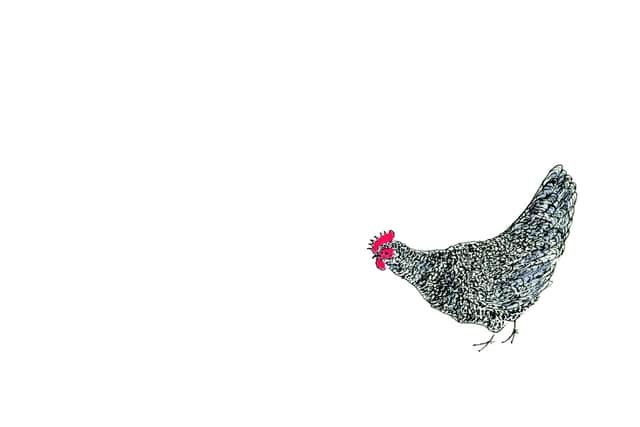
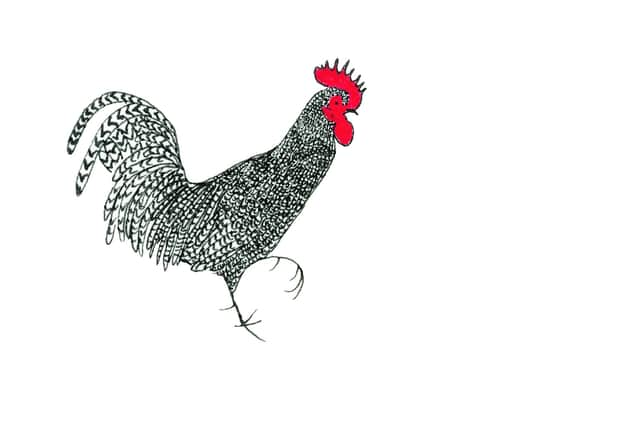
As well as having green fingers and a keen eye for flower arranging, Arthur is an accomplished artist. Each chapter in the latest book focuses on a single hen breed and is beautifully illustrated by him. He says, “I really love trying to capture the personalities for a drawing. I continue to enjoy progressing my style of drawing them, because I don’t like making them look cartoony, but at the same time, I want them to have expressions and capture the different movements of each breed.”
A lifelong fan of hens, one of his earliest memories is of seeing them in the allotment plots near his childhood home, as his mum pushed his little brother to nursery. He says, “They were very friendly and curious and of a similar height to me, so I just wanted them.”
Arthur now breeds Buff Cochins, which were also the hen of choice of the late Duchess of Devonshire, who kept a flock of them in the garden at Chatsworth House in Derbyshire. Arthur became a pen friend with the hen-keeping aristocrat as a child, bonding over their shared passion for poultry.
The rare Cochins hens are just one of the UK’s native poultry breeds that are currently at risk of disappearing, due in part to changing fashions and the impact caused by avian influenza restrictions and rising costs. He explains, “I hope people remember all the different chickens by looking at them in my book.”
Arthur likes to do his bit for conservation and regularly transports his flock’s fertile eggs by train to be hatched at Chatsworth Farm, and adds, “I think Debo (the late Duchess of Devonshire) would be happy with me doing that.”
He currently owns around 45 birds, and explains that, “They are in one big flock with everybody kept together at this time of year, but in the spring, I keep the cockerels separate from the hens because you don’t want the cockerels overburdening the hens – the sex is quite rough on them.” He adds, “treading them is the correct expression.”
The “fluffy pyjama” wearing Cochins chicks are hatched in incubators from March to the end of June before being fostered by Arthur’s broody hens. Cochins are slow-growing birds that take time to mature. “In autumn, I have a lot of growers – young cocks and hens, and it’s then a kind of a rush to get them all to suitable homes before the weather turns. As people don’t want to keep chickens in the winter.”
To keep his pampered poultry in tip-top condition and to combat the damp winter conditions, all his hen houses are raised off the ground. He says, “The hens don’t like the wind, and they don’t like the rain.”
Hens have helped him through low points throughout his life and admits, “If I didn’t have to work, I’d be with them all day. All the gardening and floristry work that I do helps pay for the hens. They cost a lot of money.” He is about to invest in a new expensive recycled plastic shepherd hut-style hen house, and explains, “This summer the red mites have been such a pain with the wooden houses and even though I keep them very clean, it’s been a problem. So enough’s enough.”
As his flock numbers have increased, he no longer gives individual birds names, saying, “That’s a sad thing when you start breeding, that you have to be quite ruthless and a little bit detached.” But he is pragmatic and believes that if you’re going to rear birds, you need to be able to dispatch your spare cockerels. “I'm not afraid of saying it either. There’s nothing nicer than an old cockerel for chicken soup stock. If only we all understood the amount of time it takes to rear them, we’d have a lot more respect for them,” he says.
He adds, "I think it’s important to have a connection to farm animals. It wasn’t so long ago that we all would have had a pig and some hens. And it’s about going back to our ancestral habits, having these animals as part of our lives, I don’t think we’re meant to be going to the supermarket and not being connected to what produces our food.”
Next month like-minded Scottish poultry keepers can meet Arthur as he heads north on a Hen Party publicity book tour.
He is looking forward to meeting his flock of fans, saying, “To my shame, I’ve not been to Scotland much at all in my life, but I love Scottish heritage poultry. The Scots Dumpy and Scots Grey have both got tartan-esque plumage.” Researching the book, he discovered that historically, Scots Dumpies were used as watchdogs, “They would cock a doodle doo in the middle of the night to warn the Celtic warriors of the approaching armies.”
He ends by saying, “It’s lovely that people want to come along and listen to me talking away about chickens. It’s a privilege to be able to celebrate something that I love, and it helps to support rare breeds.”
Tickets for Arthur’s November hen parties at Biggar Library hosted by Atkinson-Pryce Bookshop at 7pm on 19 Nov, £7.59; St Peter’s Church Linlithgow, hosted by Far From The Madding Crowd Bookshop at 2pm on 20 Nov, £8, and at The Edinburgh Bookshop, Bruntsfield, at 7pm on 20 Nov, from £5, are still available. Hen Party: A Celebration by Arthur Parkinson, published by Particular Books in hardcover, is out now, priced £13.59