
A history of Scotland’s only native oysters from Loch Ryan
September 1 marks the start of the UK oyster season, with the only wild native oyster bed located in Stranraer, which has built up a festival to celebrate this ancient seafood.
Over the last few centuries native oyster stocks have plummeted in Britain, and all over Europe, due to factors such as over-harvesting, disease and pollution. For instance, there were once oyster beds in the Firth of Forth which covered an area of 50 square miles and were the most productive in Scotland, landing up to a staggering 30 million oysters per annum at peak production. By the 1950’s they were essentially extinct.
Native oysters are on the OSPAR List of Threatened and/or Declining Species and Habitats so careful management is needed to preserve this precious resource. Despite this, there are several locations around the Scottish coast alone, where native oysters can be found, even if these populations are sparse. Most of the oyster beds are found on the west coast, with the biggest population in Loch Ryan. There are also some in Loch Sween, Loch Scridain and Loch Eishort.
The Loch Ryan Oyster Company have worked hard to carefully manage their stocks, with the aim of increasing the extant population. They only take oysters that are fully grown, leaving the younger ones time to reproduce and grow to their proper size.
In these cold waters the oysters grow slowly, so by the time we get to eat an oyster from Loch Ryan it can be up to eight years old. Loch Ryan oysters have been protected by Royal Charter since 1701.
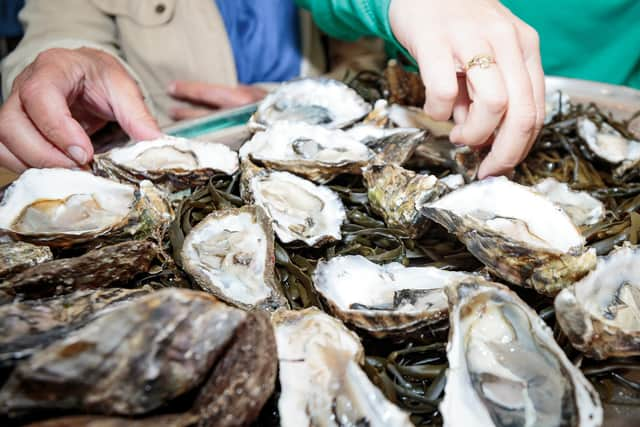

The oyster bed is managed sustainably, with 95% of each catch carefully relaid to grow the population, which now comprises an estimated 23 million oysters. The Loch Ryan oyster bed is one of Europe's most important, with native oysters from Loch Ryan used to seed restoration projects across the UK and Ireland. The UK's native oyster season runs from 1 September to the end of April.
Native oysters, Ostrea edulis, are quite different from the teardrop shaped, farmed rock oysters, with which we are now more familiar with in Britain.
In order to celebrate the native oyster and bring more tourism to Stranraer following the removal of the ferry services, the Stranraer Oyster Festival was launched in 2017.
The festival was created by community organisation Stranraer Development Trust to change the story of Stranraer from one of economic decline to a story of destination potential
The festival has generated more than £12 million in local economic impact since its inception in 2017, and has catalysed an ambitious programme of community-led regeneration in Stranraer.
We visited the festival in 2023 to record an episode of Scran and followed the fishermen on the Vital Spark boat to harvest the first oysters of the season. Rab Lamont has been harvesting oysters for over 18 years and told us how the majority are shipped to London for restaurants while a number are for conservation.
Alan Jenkins Stranraer Development Trust explained that the Oyster Festival has grown year on year and that it is a ‘wonderful event’. This year will see Outlander star Sam Heughan join celebrity and local chefs as part of the line-up.
It is amazing to think that the Roman soldiers who built the Antonine wall in the 2nd century AD ate oysters just like the ones from Loch Ryan. Shells have been found at the remains of the forts which once lined the Antonine wall. Going further back still, there are records of oyster eating from some of the earliest evidence of humans in Scotland.
Oyster middens have been found at West Voe in Shetland, dating from around six thousand years ago, and from Cramond, a choice location for oysters where the Forth estuary meets the river Almond, dating to around 8,500 BC.
Comments
Want to join the conversation? Please or to comment on this article.