
Suzuki eVitara AllGrip-e review: 'A happy place to be'
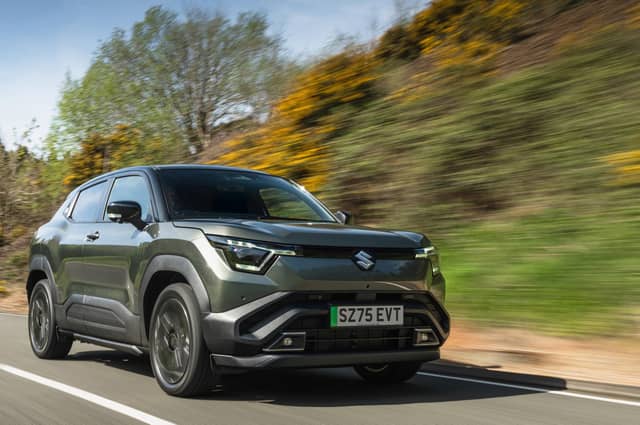

Suzuki has taken a straightforward approach to the eVitara writes Jim McGil – it’s practical and comfortable
The automotive world, as we know, is doing its best to turn electric and in the UK the drive to EVs is being powered in no uncertain way by the government’s ZEV Mandate. In simple terms, manufacturers need to sell a certain percentage of electric cars in their annual UK sales figures or they get hit by financial penalties. So it’s naturally imperative that every manufacturer has at least one EV in its range.
Up until late last year, that wasn’t the case for Suzuki, which had initially taken a slow, measured approach to the route it wanted to go down regarding EVs. Fair to say the ZEV Mandate sped proceedings up a tad. Hence we now have the eVitara, the first of what will be five electric cars from the Japanese manufacturer by 2030. Suzuki has been clever. Rather than launching a new name into the EV arena, it has simply taken the Vitara – which has been a success in various forms for around close on 35 years – and prefixed it with a lowercase ‘e’. Simple, eh! And from a cost-efficiency perspective, it has also piggybacked with Toyota. Under the bodywork, which not surprisingly differs very little from the design of the combustion-engined versions, is an entirely new architecture that has been developed by Suzuki. But this joint venture with its Japanese partner has also resulted in the appearance of the practically identical Toyota Urban Cruiser.
Ok, tell me more: There’s a track record between Suzuki and Toyota. The Suzuki Space and Across share platforms with the Corolla and RAV4. But this time Suzuki took the lead in designing. The eVitara sits on the all-new ‘Heartect-e’ architecture designed specifically for electric cars. Not only that but it can also accommodate single- and dual-motor configurations, meaning 4WD – something Suzuki is renowned for with its AllGrip four-wheel drive technology – can be incorporated into this and future EVs. Suzuki has also taken a straightforward approach to the eVitara’s model range. There’s a choice of two battery sizes, two drive configurations – front- or four-wheel drive – and two trim levels. Size wise it’s almost identical to that of the Vitara Hybrid, which remains on-sale alongside its all-electric sibling. Built in India and with batteries coming from China’s BYD, the eVitara range starts at £26,249.
What are the specs, range and charging? The two battery options are 49kWh and 61kWh, and the default format will be front-wheel drive with a single 142bhp electric motor. If you opt for Suzuki’s 4WD Allgrip-e system, the twin-motor setup adds a second electric motor ratching power up to 181bhp. And it’s that all-wheel drive technology which rather sets the eVitara apart from many rivals in its fiercely competitive sector, including the likes of the Renault 4, Kia EV3, Skoda Elroq and Ford Puma Gen-E. The Suzuki also has a wee bit more ground clearance than many others it’s going head-to-head with. Range? The WLTP figures for the 49kWh 2WD are 214-miles with the 61kWh 2WD managing 267-miles. The 61kWh 4WD manages slightly less with 246-miles. Both batteries get 150kW DC and 11kW AC charging capabilities, and irrespective of which spec you choose your eVitara will come with a heat pump as standard. Charging times using a minimum 70kW rapid DC charger sees a 10-80 per cent recharge take 45-minutes. Using a common 7kW AC home charger will charge the eVitara with a 61kWh battery in 9 hours from 10-100 per cent, and a 49kWh battery in 6hrs 30mins from 10-100 per cent. A 11kW AC fast charger charges a 61kWh battery in 5hrs 30mins from 10-100 per cent and a 49kWh battery in 4hrs 30mins from 10-100 per cent. Buyers can also choose from two trim levels, Motion and Ultra. And the breakdown is simple. Motion gets front-wheel drive but with the choice of both battery sizes, while the Ultra is solely available with the larger battery pack but in either 2WD or 4WD formats.
What’s it like inside? While its exterior chunky design is to be applauded, with its robust plastic cladding and dominant straight edges fitting in perfectly with the rest of the Vitara models, it’s clear the interior has been done to a specific budget. But that’s not to be negative; it’s just a basic fact. Everything in the cabin is well put together, with not even the hint of a squeak anywhere, but aesthetically the material quality looks average. It’s a tad underwhelming and functional, but that’s probably me just being picky. Remember the entry price point. The cabin is dominated by a large digital screen and high-set centre console, while the external chunky design is continued inside through the digital displays and squared-off air vents trimmed in gunmetal grey plastic. It looks pretty funky. My Ultra specced AllGrip-e came with the large fixed sunroof as standard, which certainly adds to the positive ambience. Frustratingly, most of the eVitara’s primary functions – even the heated seats – are controlled via the main 10.1in touchscreen, which houses Apple CarPlay and Android Auto as standard. Thankfully everyday climate functions including aircon, temperature, fan, screen heating and recirculation are controlled via a bank of toggles located between the centre air vents. The volume control is also adjacent to these. The drive selector – which is, by no coincidence, identical to that found in the Lexus RZ I recently drove – sits proudly in the centre console alongside four buttons which allow you to select drive mode, energy recovery and the hill descent control. The driver gets a 10.25-inch screen which, in addition to displaying economy and mapping data, is controlled via the multifunction wheel. The Ultra also gets a 360-degree camera system. The front seats are firm but comfortable, with plenty of space, and come with a comprehensive range of adjustments. There’s a deep-sided storage tray below the high centre console, plus two USB sockets. The rear bench – which splits three ways – slides, which certainly helps with versatility allowing either more rear legroom or additional stowage in the boot. The rear floor is flat, meaning there’s no awkward placing of the feet for a rear-centre passenger, plus there are a further two USB sockets.
And bootspace? In all honesty, it’s on the small side. With its high bootfloor, loading is easy but it can only accommodate 306-litres, which is small for this class. And that’s with the rear bench slid fully forward. Maximise rear legroom and the boot volume shrinks to 238-litres. Fold the rear seats, and storages maxes out at 562-litres. There’s also an under-floor storage but this is really only good for stashing the charging cable and tyre repair kit.
Right, how does it drive; and performance? Pretty well, in a seriously sensible way. If you’re really looking for a car with flair and joie de vivre, this probably isn’t the EV for you. There are certainly more nimble alternatives out there, such as the Ford Puma Gen-E, or even the Volvo EX30. But such perceived criticism is to miss the point. Sure it lacks sparkle, but the eVitara is perfectly adequate for everyday driving needs. As mentioned previously, there are two battery sizes available. The smaller unit is accompanied by a 142bhp/193Nm electric motor, while the 61kWh unit gets a more powerful 172bhp electric motor as standard. Both models share the same 193Nm torque figure. The Allgrip-e I drove obviously has four-wheel drive and the dual-motor set-up, and delivers an attractive 307Nm of torque. As for performance? The 2WD 49kWh covers 0-62mph in 9.6secs, with the 2WD 61kWh shaving 0.9s off that time. The quickest is the AllGrip-e with the 61kWh battery which scampers to 62mph from standstill in 7.4s. It’s plenty quick enough, and much more acceptable off the line than some other EVs which target all-out sprint performance rather than real world drivability. All three versions top out at 93mph. And all have the choice of three driving modes: Eco, Normal and Sport. Perhaps not surprisingly, the biggest change is the quicker throttle response in Sport mode which does make a noticeable improvement to the driving experience. There’s nothing really to criticise in the eVitara’s driving character. It almost falls into that category where “it does exactly what it says on the tin”. It’s a good, sensible electric SUV that will comfortably get you from A to B. But when it comes to fun? Well …. ?? Head into town and the eVitara is a happy place to be. Its 10.4-metre turning circle makes manoeuvring a dawdle, especially when it comes to tight spaces, further aided by the light steering. The tall driving position is also a bonus, plus the standard reversing camera makes for safe parking. It’s also perfectly comfortable, literally, when it comes to country driving aided in no uncertain terms by the soft edge to its suspension. Head out on to the motorway and it’ll sit at the legal max with no stress whatsoever, with the comfortable ride again making progress a comfortable experience.
What about prices? The eVitara Motion starts at £26,249 for the 2WD with the 49kWh battery, rising to £29,249 for the 2WD 61kWh. The AllGrip-e range starts with the Motion spec priced from £31,249 with the Ultra version £32,049. The range-topping Ultra AllGrip-e is priced from £34,049. All prices include the £3750 ‘Suzuki Granted’ offer, which the company supplies as the eVitara does not qualify for the UK government’s EV grant scheme.
Warranty: The eVitara gets Suzuki’s massive 10-year warranty, as long as you trigger it by getting your car serviced at an official Suzuki main dealer. It’s backed by a class-leading 10-year battery warranty.
Verdict: I mentioned previously that this is Suzuki’s first electric car. I’m also conscious I’ve been slightly critical of it in certain aspects within my review. I stand by those thoughts, but despite my criticism there’s a lot to like in the eVitara, especially in AllGrip-e trim. But you REALLY need an EV with four-wheel drive tech to justify buying the car in the first place because 4WD apart, there aren’t really any strong standout features. Plus, my test car was £34,049 after the addition of the Suzuki Granted discount. In a highly competitive sector, that’s a lot of money. And while there are a number of positives with the eVitara, it does feel as though it’s lagging at least a generation behind its principal rivals. Is it worth testing if you’re in the market for an electric SUV? Of course, because it may tick all the boxes you need ticking, including being reasonably practical and comfortable. But probably worth saving yourself almost £5,000 and going for the 2WD eVitara Motion with the 61kWh battery.
The facts: Suzuki eVitara AllGrip-e Price: £37,799 (OTR); £34,049 after Suzuki Granted applied Powertrain: 61kWh battery, two electric motors Power/Torque: 181bhp / 307Nm Transmission: Single-speed auto, all-wheel drive Top speed / 0-62mph: 93mph / 7.4secs Range: 246-miles (WLTP)
Charging: 70kW rapid DC charger, 10-80% in 45-minutes. CO2: 0g/km
Comments
Want to join the conversation? Please or to comment on this article.