
Mazda CX-5 Homura 2WD review: The best car in the sector evolves


While there is much to applaud about Mazda’s new generation CX-5, Jim McGill was ultimately left underwhelmed
It’s a tough call for a manufacturer when it comes to introducing a new generation of the model which, for almost a decade, has been its bestseller not just in the UK, but also across Europe and globally. And that’s the challenge Mazda now faces as it introduces this third-generation of its CX-5 midsize family SUV. Since its launch in 2012 it’s been a roaring success for the Japanese carmaker, with more than five million models leaving showrooms around the world.
So, is the third-gen CX-5 ready to go head-to-head with its main rivals, including the likes of the VW Tiguan, Nissan Qashqai, Toyota RAV4 and Kia Sportage, plus of course numerous challengers from China, including those from Omoda, Jaecoo and Chery? Only one way to find out, so we were amongst a small group of UK journalists to bag a short first drive of the car at its European launch.
Given the CX-5’s core sales position for Mazda, it should come as no surprise that the new model is an evolution of the previous generation rather than a “rip it all up and start with a clean sheet of paper” approach. That has to be applauded, because the second-gen CX-5 was probably THE best model in its sector. As you would expect, there are a few major differences between the second and third generations, some good and some … well, perhaps not so positive.
Ok, so what’s new?
Even as the Spanish rain pelted down on the CX-5s waiting for us at our arrival at Barcelona airport, while the SUV’s lines looked familiar, the new model definitely boasts a more sculpted edge to it. Yes the surfaces have been reshaped, but the designers have managed to combine the established look of the CX-5 with a more modern, robust, muscular and hunkered down stance. It looks good. Pushed later in the day about the new styling, the Mazda designers were keen to emphasise the “design combines crisp lines with calmer, more organic surfaces”. Right: so that clarifies that. You’ve got to love design-speak. New too is something rather more controversial to Mazda aficionados. The majority of physical controls – something which made the previous CX-5 generations so intuitive to operate – have gone, to be replaced by a larger touchscreen-based infotainment system running Google software. I’ll come back to that later. Also, and certainly at launch, buyers will have the choice of only one powerplant: the 140bhp 2.5-litre petrol engine paired with a 24-volt mild-hybrid system. By comparison, in the previous generation, the CX-5’s 2.0-litre petrol engine delivered 165bhp. Good to know though that the third-gen model will still be available in both two- and four-wheel drive variants.
Right, so tell me about the engine and performance
Let me preface this section with the fact, these were early left-hand drive production cars with much of my driving on tight, narrow, undulating and twisty coastal roads. I’ll be driving the new CX-5 again in six weeks or so in Scotland, so it’ll be good to compare my findings then.
On the Spanish roads, the performance of the 2.5-litre naturally aspirated four-cylinder petrol engine – complete with its mild-hybrid assistance and cylinder deactivation to boost efficiency – was, how shall I put it, leisurely. I’d been looking forward to driving the CX-5 with the 2.5-litre unit, as it powered the CX-30 I drove 3,750-miles across the Arctic last March. That combination was sublime. Like the CX-30, in the new CX-5 the engine is mated to a six-speed auto’ box.
However I, as were a number of the others who drove the CX-5, was left a tad underwhelmed by the engine’s performance. Diving deep into the tech spec of the new CX-5 delivered what may well be the reason behind the ‘leisurely’ performance. While the CX-30 AWD tips the scales at 1450-1550kg depending on trim, the 2026 CX-5 AWD weighs between 1670 and 1710kgs. At best that’s the equivalent of carrying an extra two 11-stone passengers in the car.
On the motorway heading west, the engine cruised smoothly enough, But it was when we headed into the hills it began to sound surprisingly busy as it worked harder. Occasionally shifting up a ratio manually to help calm the engine helped, but that very action was at odds with the relaxed nature of the CX-5 I experienced in almost every other driving environment.
Cleverly, boffins have also added cylinder deactivation, which shuts down two cylinders under light loads during steady cruising, in order to improve fuel efficiency. Mazda quotes it’ll return 40mpg. As for performance, it’ll cover 0-62mph in 105-seconds in 2WD form, increasing to 10.9s for the AWD.
Mazda highlights that a choice of other engines will become available in the life-cycle of the new CX-5, and points to the fact it’s working on its own full-hybrid powertrain for the SUV. Fingers crossed that will be more powerful and efficient. No technical details or timelines have been released yet.
What about the interior?
There’s a significant amount of space, and the cabin is certainly still a lovey place to be, in keeping perfectly with the previous model. This third-gen has grown slightly: it’s now 115mm longer, 15mm wider and 30mm taller, plus the wheelbase has been stretched by 115mm. That of course ensures that rear seat passengers have more space. For those who are six-feet tall – that’s definitely not me – they’ll enjoy more rear legroom, bags of headroom, and space under the front seats to tuck their feet.
If you’re ferrying kids around, the rear doors not only open wider, but they’re also bigger. That’s perfect when it comes to fitting child seats in the rear, where you’ll find two sets of Isofix mounting points which are easily accessible behind their plastic covers.
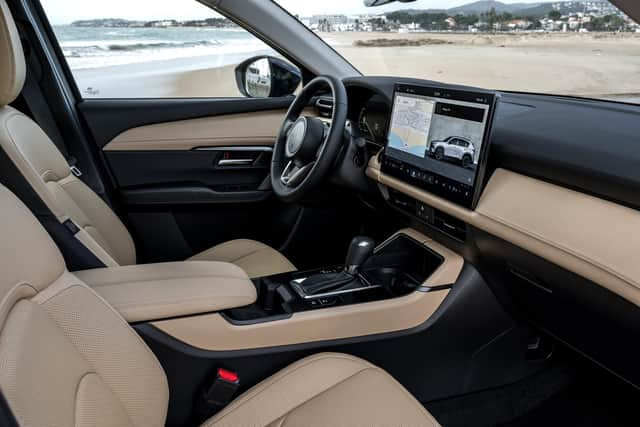
So far, so good. And yes, there is a but. Mazda interiors have always been lauded for their driver efficiency and tactility when it comes to controls. Anyone who has previously driven a Mazda, including the pervious generation CX-5, will know it came with one of the most intuitive infotainment set-ups in the class. Driving, and without taking your eyes off the road, you could rotate the simple rotary controller on the centre console and scroll through menus. In a world which was becoming increasingly dominated by touchscreens, it was a simple, refreshingly simple tool. Well, sadly that has gone. Replaced instead by a touchscreen. Most models come with a 12.9-inch central display, but the range-topping Homura version – which I tested – gets a whopping 15.6in screen. And yes, it dominates the cabin.
Also, there are now no physical climate controls which, at a time when other manufacturers who have previously introduced all-encompassing touchscreens are reintroducing buttons and dials for such frequently used functions, seems to be a step in the wrong direction. Plus, there isn’t even an easily accessible knob to control the sound volume. However, the screen display is sharp and responsive, with the standard-fit Google-based infotainment software working efficiently and smoothly.
One major positive is that the cabin remains as comfortable as it has always been, which is a major plus point. I could easily imagine spending all day cruising motorways and A-roads, clocking up hundreds of miles and climbing out at the end of the journey still feeling relaxed. The driver sits slightly higher up than in many rivals and, thanks to relatively slim front pillars and large rear windows, visibility is good.
When it comes to luggage, you’ll be pleased to learn the bootspace has increased by 61 litres, to 583 litres. That’s more than the Honda CR-V and Nissan Qashqai. What’s more, volume increases to 2,019 litres when you fold the rear seats down
What about prices and trim?
Four trim levels will be available from launch, the Prime-Line, Centre-Line, Exclusive-Line and Homura. Standard kit is excellent, with even the entry-level benefitting from LED headlights, adaptive cruise control and alloy wheels.
Mazda has still to confirm UK prices ahead of its on-sale date towards the beginning of April. The current second-generation CX-5 starts at £31,630 and I wouldn’t expect the third-gen to veer much away from that entry-point, ensuring its remains close to rivals like the Sportage and Qashqai.
Verdict
Anyone who has read my reviews before will know I’ve always had a soft-spot for Mazda models. They generally always “do their job”, cut a very individualistic line when it comes to styling and functionality, and more importantly have always been fun and enjoyable to drive. Hence my surprise at feeling rather underwhelmed by the power unit in the new CX-5. While there is so much to applaud about the new model, I’m genuinely intrigued to see how the 2.5-litre engine performs when I drive it extensively through the Lothians and Scottish Borders for a few hundred miles in May. My fingers are crossed for a positive outcome, and that the Spanish drive was not a fair reflection of the true capabilities of the new CX-5.
Facts and figures
Mazda CX-5 Homura 2WD Price: £37,500 est Powertrain: 2.5-litre 4cyl petrol MHEV Power/Torque: 140bhp / 238Nm Transmission: Six-speed automatic, front-wheel drive Top speed / 0-62mph: 116mph / 10.5secs Fuel Consumption 40.3mpg (WLTP combined) CO2: 158g/km Dimensions (L/W/H): 4690mm / 1860mm / 1695mm On sale: April
Comments
Want to join the conversation? Please or to comment on this article.