
I tried to visit nine countries on a single tank of fuel in the Omoda 9 - here's what happened


Jim McGill and world record-holder Kevin Booker take a flagship Chinese SUV to the limits of its range across Europe
Distance to our final destination? 124km. Fuel available? 101km of petrol and 22km stored up in the battery. Sat outside our hotel in Zurich, about to start the final leg of our ambitious drive, there was genuine range concern.
To mark the new Omoda 9 Hybrid, we’d had this idea of visiting nine countries on a full tank of petrol, and a full EV charge. We just had the final two, Liechtenstein and Austria, to tick off. It was going to be tight.
Omoda 9 first impressions
First things first: the Omoda 9. Following on from the Omoda 5 and E5, the 9 is the Chinese carmaker’s new flagship SUV — complete with intelligent four-wheel drive system — which promises luxury for less than £45,000. Not only that, but it backs up that ambition by having a solid air of authority on the road. It’ll go head-to-head with the likes of the Volvo XC60 and Range Rover Velar, despite costing much, much less.
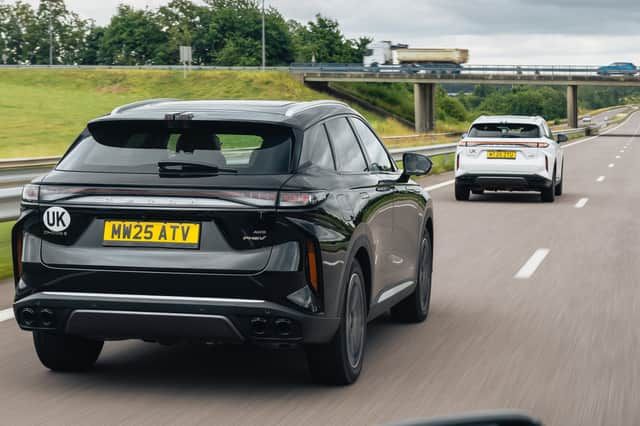
It’s a handsome piece of kit, with strong design lines mirroring those from Land Rover and Lexus at the front and rear respectfully. Its wide-body styling is both handsome and robust-looking. And the coupe-SUV shape is bang on-trend. Plus it’s got quad tailpipes, giving it an almost European look.
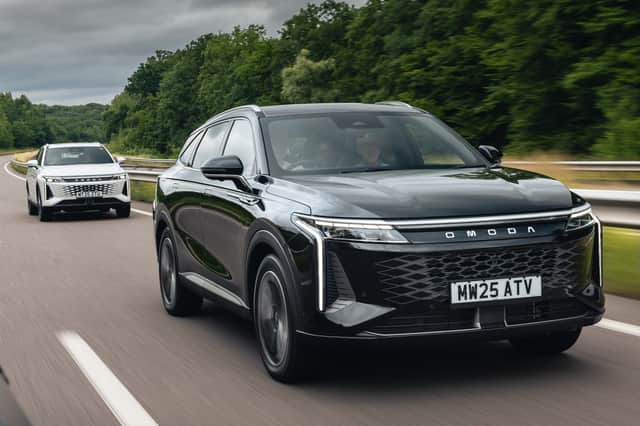
As for power: the Omoda 9 utilises the company’s Super Hybrid System. The clever system works with a 1.5-litre petrol engine combined with a couple of electric motors and a 34.46kWh lithium-ion battery. The result is 443bhp of power, 516lb/ft of torque, a 0-62mph sprint of 4.9secs — despite its size, it’s a very quick car — and a top speed of 124mph.
Importantly for my trip, there’s a full-charge electric range of 93-miles (WLTP) — DC fast-charging can top up the battery in less than 20 minutes — partnered with a 70-litre fuel tank. Omoda says the combo should be good for 700-miles.
Nine countries, one tank
Our ambitious drive, starting at The Pig (a hotel and restaurant near Canterbury), before heading to EuroTunnel, would ultimately take us through France, Belgium, Holland, Germany, Luxembourg, Switzerland, Liechtenstein and Austria. With the UK, that’s nine countries in total.
Immediately, there was a hiccup. Although the Omoda 9 had a full electric charge, we planned to top up the internal combustion engine (ICE) fuel at the nearby Shell filling station. Unfortunately roadworks forced us into a five, or six-mile detour, eating directly into our electric range. That, allied to the actual original distance to the filling station, meant we’d covered around 15-miles. So when we zeroed the trip on the Shell forecourt signalling the ‘official’ start of our trip, despite the full tank of petrol, the battery range was already down 15-miles. Not a big factor at the time, but one which later would prove significant.
Our first leg took us down to the tunnel and under the Channel, arriving at a very wet and soggy France. Lunch was in Lille, then off to our overnight halt in Brussels, a total of 230.8km covered. Range remaining, 19km battery, 896km ICE.
Day two coincided not only with a visit to the Banksy Museum, but also mass demonstrations as 60,000 people flocked into Brussels city centre supporting a trade strike. The result; constant police sirens as the city centre streets were closed off and more detours before we could get to the E490 towards Genk.
After lunch in Maastricht at Harry’s, we had a coffee stop at a Q8 filling station — always good for stocking up on sweeties — before our overnight at the newly-opened and refurbished Villa Petrusse in Luxembourg. So far, all going well. Distance covered, 536km, range left, 524km ICE and 22km battery.
Worth just mentioning here, unlike my recent Arctic adventure, this time I was sharing a car. And I chose well: my compatriot was Kevin Booker, a five-time Guinness World Record holder and eco-driving guru. Over the four days, Kevin took the morning shift, I drove post-lunch. The vast bulk of our driving, certainly over the first three days, was on motorways. Fair to say, we — well, certainly I — never slipped fully into max eco-driving mode. We sat at comfortable motorway speeds, taking advantage of the odd HGV-slipstreaming opportunity, but not being super-focused on economy. It was ‘real world’ driving.
Ok, I’ll be honest. There were times when I was driving that I could sense Kevin glancing over and looking at the speedo and range: the Omoda has a clever readout on the digital instrument binnacle which details the “Average energy consumption” over the last 50km. It combines the L/100km (the metric equivalent of mpg) ICE and the kWh/100km figures, eg 4.7L/100km plus 0.6kWh/100km equals combined 4.9L/100km. It’s that last figure I knew Kevin was being watchful of, because while it improved when he drove, it always dropped when I took the wheel.
By Day three I’d become very settled into my Omoda 9 environment. Not only is there a myriad of simple-to-select settings to maximise fuel efficiency, be it battery or ICE, but despite having nine clever driving modes the SHS system seamlessly shifts between each one.
The ride was sensationally smooth. Ok, we were on beautifully smooth European roads — honestly, why are UK road surfaces to horribly poor? — and with its acoustic double-glazed windows, the cabin was a haven of peace and tranquility. Except when we tried the excellent Sony 14-speaker sound system.
The interior is pretty contemporary. There’s a large, twin-screen display comprising two 12.3-inch screens fused together in a single panel, plus a head-up display. Beneath the central monitor there’s a row of chunky, rotary controls for the drive modes, temperature and fan speed — all of which have a lovely tactile feel and work smoothly — and below that sit dual wireless charging pads. There’s also a whopping 660 litres of boot space.
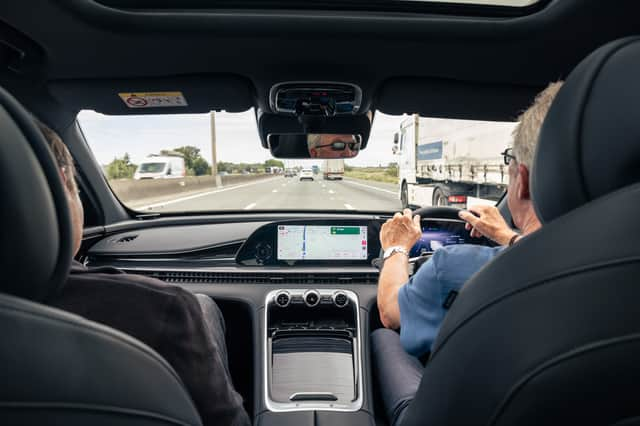
As you would expect, Apple CarPlay and Android Auto are standard. In fact, just about everything is standard, including: a 1.3-metre panoramic sunroof with auto blind, 20in alloys, LED head- and rear lights, double-spoke, environmental leather heated steering wheel, 12-way electrical adjustment front seats, 2 x USB fast charging ports in both the front and rear, 4 x ISOFIX, Automatic Parking Assistant (yes, it will park itself for you) 540-degree panoramic view camera, Adaptive Cruise Control, heated and cooling front seats, and 20 advanced driver-assistance systems (ADAS). Significantly, these ADAS have clearly been tuned to European tastes.
Back to the drive. The third day saw us pop back into France for lunch in Strasbourg before visiting the excellent Vitra Design Museum and shop — I’m still kicking myself for not buying a pair of stunning sunglasses for €125 — in Well am Rhein, Germany, before overnighting in Zurich, Switzerland. Total distance covered, 996km.
Which brings us to the final morning, and our last challenge: 124km of distance, with a combined 123km of fuel remaining.
Faced with such challenge, I embraced the motorsport philosophy of a sportscar qualifying session: put your best man for the job behind the wheel. So I threw the keys to Kevin.
He too shared the jeopardy. We didn’t want to have come all this way then fall at the final hurdle. We were both unsure we’d achieve the goal. But in Kevin I trusted. On a near-deserted motorway we sat at 80km/h rather than the 120km/h limit. Kilometre after kilometre ticked by.
With Kevin’s gentle right foot maximising the regen on downhill sections, within 34km he’d turned a minus-1km situation into a plus-7km. Becoming more confident, we upped the pace to 85km/h. With 78km to the finish, we had a range of 25km battery and 64km ICE. Confidence was growing. We could do this. Over the previous 50km, Kevin had averaged 4.2L/100km: 60mpg. As we continued, he improved that further to 3.7L/100km, 63.5mpg.
Flying blind
But then, as we were monitoring the ICE range, the digital readout clicked over to 60km remaining … then it immediately turned to read ‘LOW’ in red. And the word ‘LOW’ remained. We now had no figure to monitor. We knew the battery range was 24km, but we had no idea of the petrol range. We were into the unknown.
A few kilometres further on, we turned off the E44 heading towards St Gallen With 43km remaining, we still had the 24km of battery range. That’s important because it meant we were still operating on petrol-power: we hadn’t eaten into the battery.
Liechtenstein gets ticked off. A few kilometres later, we crossed the border into Feldkirch, Austria. We had 21km of battery left. After topping up again with Shell V-Power, we realised we’d only had 2.3-litres of fuel left in the tank.
Over nine countries, we’d covered 1120km; that’s 696-miles. Throw in our remaining 21km of battery, equivalent to 13-miles, we could have extended our journey to almost 710-miles. That’s more than Omoda’s quoted range. Plus, remember the 15 all-electric miles we’d covered before we zeroed the trip to start the journey. Add that in and the combined range increases to 725-miles. And don’t forget, only the last 124km were approached with a “must drive economically” approach. The bulk of the journey was in ‘real world’ conditions.
Only one thing remained. Now fully fuelled, we faced a mad dash to the Zurich airport, 136km away. How long did we have? Exactly one hour. Remember the adage: best guy for the job. Kevin threw the keys to me. We made it with minutes to spare. It wasn’t an eco-drive. You do the maths.
The Omoda 9 Hybrid: a car for all reasons.
Comments
Want to join the conversation? Please or to comment on this article.