
Should Scotland do more to celebrate its distinctive UFO history?
From world-famous cases to the Falkirk Triangle, items linked to this bizarre history risk being lost forever
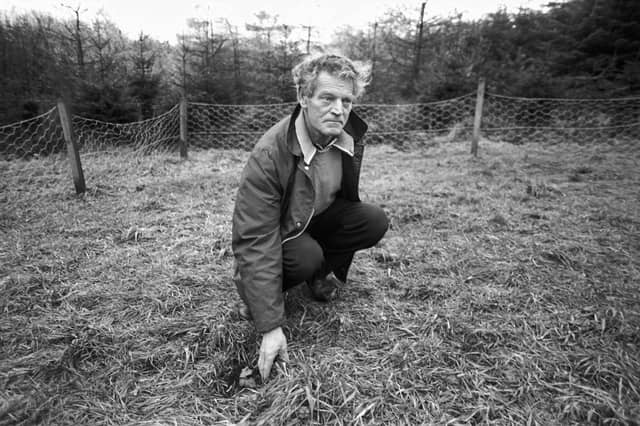


In 1979, an alleged alien encounter in woods near Livingston sparked a police investigation and made headlines around the world.
Robert Taylor, a 61-year-old forestry worker, was left in a state of shock after apparently encountering a large "dome-shaped" craft in a clearing in Dechmont Woods.
He later told officers two spiked spheres had rolled towards him, and he was aware of a strong smell of burning and being grabbed on either side of his legs before passing out.

The case has since become the stuff of legend, not least because of the police involvement. Mr Taylor, a teetotal churchgoer and war hero, was also seen as an honest witness. He died in 2007.
It is undoubtedly the most famous alleged alien encounter in Scotland, but far from the only one.
Dr Gavin Miller, an academic at Glasgow University who has researched the cultural history of UFOs in Scotland, believes more should be done to preserve and celebrate this bizarre history.
The UFO phenomenon has been "remade and reinvented" over the decades, he said. Scotland was initially slow to catch on - some early press coverage was dismissive of what it considered to be American mass hysteria - but this attitude gradually shifted.
In the 1950s, reports were influenced by Cold War anxiety. In November 1957, around the time of the Sputnik spacecraft launches, a group of tattie howkers, or potato pickers, were supposedly pursued by a flying saucer - more likely a weather balloon - while returning from Musselburgh to Edinburgh in a lorry.
An "occult version" of the UFO phenomenon flourished in the 1960s and 70s, Dr Miller said, involving "contactees" who claimed to have communicated with entities or aliens. But a more hard-nosed, investigative approach also emerged, led by groups who were interested in gathering evidence through interviews and physical traces.
They seized on Mr Taylor's story. "They all descend upon his house and his home," said Dr Miller, who is giving a talk on Scotland's history with UFOs as part of the Royal Society of Edinburgh's festival of knowledge in September.
"They quiz him and they interview him and they take photographs and they write up reports. And there's even an official British UFO Research Association report on that encounter. They go to extraordinary lengths.
"They have soil samples tested. He said there was a mysterious smell that made him pass out, so they get examples of gasses and put them under his nose to see if he can identify it, but he can't, and all the rest of it.
"That gave a lot of energy and impetus to Scottish UFO research groups. They start to spring up around this and after this."

In the 1990s, the small town of Bonnybridge became an unlikely hotspot. The so-called Falkirk Triangle attracted international press coverage, and some enterprising locals sensed an opportunity.
"Whatever really happened in Bonnybridge and Falkirk in the 1990s, the locals, in particular Councillor [Billy] Buchanan, who's still with us, were clearly aware of the tourism potential, or the economic potential as they saw it, of having a town associated with UFOs,” Dr Miller said.
He has been working with Bonnybridge library to preserve some of this unique history.
"There's endless stuff - national, international - and you also see just how much TV coverage and radio coverage they were getting,” he said. “It really was enormous at the time." The popularity of The X-Files, first aired in 1993, no doubt helped.
Other alleged incidents attracted press attention. In August 1992, Garry Wood, a 33-year-old ambulance technician from Edinburgh, and 25-year-old Colin Wright were supposedly abducted by aliens while driving on the A70 near the Harperrig reservoir in West Lothian. Billy Boyd was later attached to a mooted movie adaptation of the sensational tale.
But Dechmont Woods remains perhaps the most enduring mystery. "I think the great thing about the Robert Taylor incident is that it is so baffling,” Dr Miller said. "There is an enormous list of possible explanations, but every possible explanation brings its own problems."
Mr Taylor’s ripped trousers were taken by the police for forensic examination and later passed into the possession of UFO investigators.
“They've been called the Turin Shroud of Scottish ufology,” Dr Miller said. “It's this kind of relic. The trousers get exhibited, there's psychic readings, they are shown around, they're passed around.”
The trousers are still in the possession of Scottish UFO investigator Malcolm Robinson. In February this year, it was reported he had offered them to the National Museum of Scotland, which turned them down.
"There is perhaps a moral there about Scottish museums and collections and what they do or don't want, and what they think is respectable and what they should be having, and what parts of history they record,” Dr Miller said. "I think it's a bit of a pity that we don't have a more positive attitude to collecting and preserving this heritage.
"There's an archive in Sweden, Archives for the Unexplained, and they're collecting stuff from all over the world, and I think our UFO heritage is going there, to be honest. It's not being preserved nationally."
There have been high-profile UFO sightings elsewhere in the UK, of course, and Dr Miller does not believe Scotland in itself is a particular hotspot. But it does have its own distinctive history, he argued, and one which plays into wider narratives such as deindustrialisation.
"That's a distinctive story, I think, in Scotland because the Bonnybridge hotspot was so obviously, in some ways, about deindustrialisation,” he said.
"The heavy industry and manufacturing industry have collapsed, the town was in industrial decline, there was quite a lot of unemployment. And so whatever was really going on in the skies, if it could be regenerated as a UFO hotspot, that would do something for the local economy."
A Dechmont Woods UFO trail was launched in 2018. But Dr Miller said more could be done to preserve and promote items relating to Scotland’s UFO history.
"We don't have to naively endorse them, but if we don't get hold of this stuff and collect and preserve and promote it, it will be lost,” he said. “I think that's the problem - it will be lost. Somebody will have all this stuff and it will just go in bin bags and it will be in a skip."
Tickets to Dr Gavin Miller’s talk on Scotland’s history with UFOs can be booked for free via the Royal Society of Edinburgh website.
Comments
Want to join the conversation? Please or to comment on this article.