
Why more witches were executed in Scotland than almost anywhere else
Scotland was afraid, very afraid as the hunt for ‘witches’ swept the country.
The Scottish witch hunts was one of the darkest spells in the nation’s history, with between 2,000 and 5,000 people executed by the state - more than almost anywhere else in Europe.
Just over the border in England, the number of people hanged or burnt at the stake for witchcraft over the same period ran into the hundreds.


As the hunt for those believed to have been in a pact with the devil swept Europe, the suffering inflicted in Scotland between 1563 and 1736 was perhaps only surpassed in some German states.
In Scotland, that persecution was being driven at the very top of society under the reign of James VI.
Dr Steven Veerapen, author of Witches, A King’s Obsession, said: “Why did Scotland get it so bad? It was a national leader saying you have a problem, that this is a national problem and we need national purges.
“No one in charge in England did that. In England, you get very localised outbreaks. But in Scotland , you have the guy at the top of the pile - the King - leading this.”
The witchcraft acts had been introduced in Scotland in 1563 under the reign of James VI’s mother Mary Queen of Scots, and in England under Elizabeth I. The legislation made little impact, however, with a scattering of cases, Mr Veerapen said.
But as James VI sought to enhance his reputation as a scholar and a theologian, the laws were enforced with a new dark fervence as he sought to distinguish between good and evil, and his divine place in that axis.
Dr Veerapen said: “It gave him the opportunity to present himself as God’s champion and the devil’s enemy and that was a really useful part of his identity as King.
“ It gave him the chance to disseminate propaganda and say 'I have been divinely ordained and have been saved by God'. It gave him a chance to pose as a theologian and an academic, which he loved.”

In 1589, the marriage between James VI and Anne of Denmark was almost derailed when violent storms in the North Sea stopped her from sailing to Scotland, with the future Queen holed up in Copenhagen and then Norway due to conditions out on the water.
There, such storms were often blamed on the supernatural and a Danish statesman, far from taking accountability for the state of the ships ahead of voyage, attributed the conditions to the work of a house of Copenhagen witches led by Ann Kolding.
It was said little demons were sent in empty barrels to the ship to cause the storm, with Ann Kolding and 12 others later executed for witchcraft.

Dr Veerapen said: “For the first 20 years of his life, the witchcraft acts weren’t a major thing. It is only when he hears that there are some witches in Copenhagen who have been accused that something switches in him. He thinks they couldn’t have been acting alone and his interest is born, all of a sudden.”
Possibly, his interest was driven by paranoia, Mr Veerapen added.
“Throughout his youth, threats and plots had been manifold against him, and here was the latest and most insidious,” Mr Veerapen said. “For the first time , witchcraft was now under investigation by the king and his Privy Council acting as court, their courtroom no less than James’ magnificent palace of Holyrood house.”
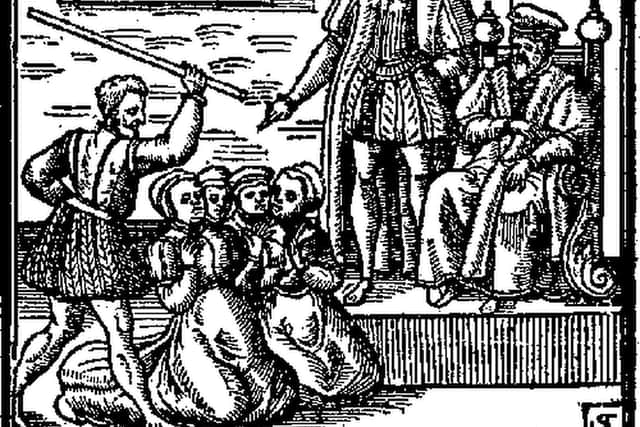
Between 1590 and 1592, more than 70 people were accused of being witches in East Lothian, the first large-scale prosecution of its type in Scotland.
Among those interrogated - and later-executed - were servant Geillis Duncan of Tranent and healer Agnes Sampson of Nether Keith, described as a “respectable healer, widow and midwife”, whose interrogation directly involved the King himself.
Duncan, under torture, confessed to meeting with one of the Copenhagen witches in the Firth of Forth and attended an assembly in North Berwick Churchyard with Sampson and eight others, where ritual dances were performed.
She claimed they had raised a storm that killed courtier Jane Kennedy in the Firth of Forth in 1589, when she had been summoned from Burntisland and Leith to meet Queen Anne on her expected arrival.
Sampson, again under torture, initially denied knowing Duncan, but ultimately corroborated her fractured story after being put on the spot by the King himself. The two women were among those executed at Castlehill in Edinburgh in 1591.
“James was the hero in this story, particularly in the North Berwick witch trials,” Dr Veerapen said.
“It made him look strong, in charge and godly. One of his big goals in Scotland was to be taken seriously as the head of the Kirk and a lot of Presbyterians were against that and regarded that he was just amember of the Kirk, like anyone else.
“But this strengthened his hand. Who better to be head of the Kirk than Satan’s enemy and God’s champion?”
Dr Veerapen spent two years writing Witches, A King’s Obsession after completing his earlier biography of the King.
He said that during the James VI reign, the study of witchcraft was part of “progressive” thinking and study. The King later published Deamonologie in 1597, his treatise on witchcraft and the supernatural, which serves as a defence of the witch hunts.
Dr Veerapen said: “James was putting his theological hat on and saying there is a difference between deluded ‘daft wives’, who had these silly beliefs in herbs and the power of stones, and someone who had a deal with the devil.
“He came down on the argument that if you have a real witch, they have made a deal with the devil, a demonic pact.
“He made a very dangerous point in Daemonologie, which had a long afterlife. He said ‘if you deny the reality of witchcraft, I think you might be of that company’. So it started the denouncement of witchcraft as a real thing, because if you didn’t, people might think you were one.
“Although he didn’t create the witchcraft act, he ramped it up and he saw it as his duty to educate Scotland and Scots to see that there was a problem in this country. That just never happened in England.”
Witches, by Steven Veerapen, is published by Birlinn and available now.
Comments
Want to join the conversation? Please or to comment on this article.