
VJ Day: Family find Scottish veteran's accounts of his 'forgotten war' in attic
The discovery has unpacked the war experiences of one Scottish veteran in the Far East for his family for the first time.
A family’s discovery of a box of papers and photographs in an attic which document their father’s service in the Far East has unravelled the brutal reality of the “forgotten war” that he never spoke about.
The documents were kept by Captain JCT MacRobert, a Paisley lawyer who was evacuated at Dunkirk and then sent to Burma and India, where he described the Japanese in his account of the 1944 Battle of Kohima as “a cruel and fanatical an enemy as the world has ever known”.


Daughter Fiona Garwood, of Edinburgh, said her father never discussed the war, with his ‘Burma hat’, which he bought in Calcutta and wore every summer in Scotland, a constant but silent reminder of his service. The newly discovered papers are, meanwhile, a clear and visceral account of the horrors of jungle warfare.
READ MORE: Ahmadiyya Muslims in Scotland Mark 80th Anniversary of VJ Day with gratitude and prayers for peace
From his own accounts and local maps, it is now known that he was responsible for claiming a hilltop position - known as MacRobert Hill.
The recent discovery made at the former home of her parents in Colintraive in Argyll and Bute had been “huge” for the family, Ms Garwood added.
She said: “They are very much eyewitness accounts of the time. He wrote things down when he had time on the back of army requisition sheets, in pencil.
“Then, he added a bit more when he waited to be repatriated but I really don’t know if he looked at them again, as everything was very hidden away in an attic.
“We didn’t know about it - or his photo album. We didn’t even know he had a camera.
“We didn’t discover the box until earlier this year so it was a huge find.
“I am very proud of him, because he did write it down and I am so glad he did. He didn’t speak about it, but the family now know of his time spent there from his writing.”
READ MORE: The beautifully written war time letter from wife to soldier found hidden behind my fireplace
Captain MacRobert, an officer in the Royal Artillery, part of the British Army 2nd Division, fought in the Battle of Kohima in June 1944, a turning point in the Japanese invasion of India and the war against the Axis powers.
Later, Earl Mountbatten described Kohima, which raged between April and June, as ‘probably one of the greatest battles in history…in effect the Battle of Burma… naked unparalleled heroism…the British/Indian Thermopylae’.
Around 4,000 allied troops and around 7,000 Japanese soldiers were killed at Kohima an important hill station and garrison in Assam on the only road that led from the major British/Indian supply depot at Dimapur to Imphal. The Japanese Army was broken into three different columns to attack it from three different angles.
Captain MacRobert was part of the fighting force of the 2nd British Division, the 161st Indian Brigade and the 33rd Indian Brigade at Kohima, which served alongside Burmese, Australian, American and African troops.
Later, Captain MacRobert, described Kohima as ‘our El-Alamein ’ in reference to the climax of the North African campaign, when the British defeated the Axis army of Italy and Germany.
On the end of the operation at Kohima , he wrote: “At last the hard pressed Kohima Garrison was relieved in after one of the most gallant and bloody defences against as cruel and fanatical an enemy as the world has ever known.”
The garrison itself was held by a small group of Indian and British troops, who fought to defend it with little ammunition, diminishing supplies of food and water, medical supplies and hardly any sleep.
It was finally reached by allied forces by road, with a long column of ambulances shepherded in by grey tanks and their “sharply crackling” guns.
Captain MacRobert wrote of the greenery of Garrison Hill turning to “grey and blackened splintered devastation” as the perimeter was fought over for
He wrote: “From far off, many nights I watched the perimeter battles. Leaping flames and occasional flares cast and revealed moving shadows, some of which were charging infantry men.
“Smoke streamed across that narrow deadly belt . D.F. (Direct Fire) from distant guns, grenades and mortar bombs from closer crashed into it.”
Many wounded were brought out who had “lain in agony and peril for so long in that relentlessly contracting perimeter,” Captain MacRobert wrote.
“Their dead, so soon to be joined by so many more of ours, they left behind,” he added.
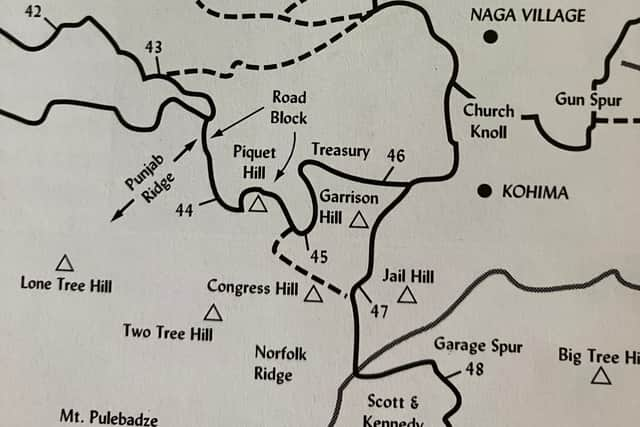
The ordeal continued for several days, much of it across the Deputy Commissioner's tennis court, until desperate attempts to get tanks and six pounders up the steep bank to his garden succeeded. There, the Japanese hid in bunkers under his bungalow.
Ms Garwood said her father, in later life, formed a type of Kohima Veterans Association to connect with others who fought at the hill station.
She added: “That must have been their therapy, to meet up with people you fought with years later when you could face it and talk to them.
“They understood - they knew what you meant. The families didn’t , and perhaps didn’t want to know as it was too painful.”
Captain MacRobert returned to Scotland by early 1946 and spent the rest of his life working as a solicitor in the family firm in Paisley. He married the following year and had three children. He died in 2000.
There was very much a sense that the war in the Far East was a “forgotten war”, Ms Garwood said.
She added: “By the time it got to VJ in 1945, everyone was VE Day’d out and the troops didn’t get back for another year or so.
“There were no ships to get them back, they didn’t know where everyone was, they had Prisoners of War to locate and get out of the camps, get them fit to travel.
“We may have won the war in the Far East, but we did not win the peace.”
Ms Garwood and her sister will travel to Kohima this October with other descendants of veterans to pay their respects to those who never returned and who are commemorated on the Kohima memorial.
“While Dad returned safely, many of his compatriots didn’t,” she added.
The Royal Scots Regimental Trust will hold a VJ Day Memorial Service on Saturday, August 16, at Lauriston Castle, Cramond South Road at 10.30am. All are welcome.
Comments
Want to join the conversation? Please or to comment on this article.