
VE Day in Scotland: Bonfires, searchlights and dancing in the streets
Tens of thousands of people celebrated in Scotland’s streets on May 8, 1945 as victory in Europe was finally declared.
Bonfires were lit, sweeties were thrown and people stood toe-to-toe in Scotland’s street as Victory in Europe was finally celebrated. Music blared, bars were drunk dry and strangers danced into the night.
The build up to VE Day had, at last, broken after days of anticipation. At 9pm on the night of May 7, a BBC newsflash reached a nation that VE Day would be celebrated the following day.
On the night of the announcement, blazes were lit across Edinburgh and in Glasgow, where wooden struts built around tenements were set alight alongwith clothes poles and the doors from outside loos.
In Scotland’s largest city, there had been two nights of false victory dawns given the city’s searchlights were tested in preparation for the official word that war in Europe was over.
Dr Kevin Morrison, who is running VE Day walking tours across Glasgow this week, said: “Peope weren’t sure what was happening and when VE Day was going to take place there was a lot of tension in Glasgow and in other cities.
“People were waiting to get the announcement. People were expecting VE Day during the weekend because of the surrender in north west Europe. When it didn’t come, people were disappointed.
“In Glasgow, the most dramatic shattering of the blackout came late at night on May 3. Floodlights were being tested in preparation for VE Day outside the City Chambers. The whole of the City Chambers was lit up and 450 people witnessed this. They thought this was to celebrate Montogomery’s victory but they didn’t cheer for too long.”
At 3pm on May 8, Winston Churchill spoke to the nation and officially announced the war had ended in Europe.
“We may allow ourselves a brief period of rejoicing; but let us not forget for a moment the toil and efforts that lie ahead.” he said.
May 8 and May 9 were declared public holidays and the streets across Scotland flooded with people, music and cheer. In London, it is estimated that more than one million people gathered around Buckingham Palace and along The Mall.
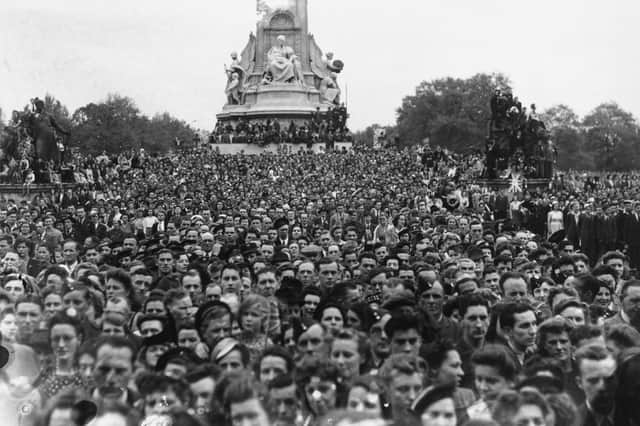

In a rainy Edinburgh, servicemen and women, factory workers and shop workers converged on the city centre with the American Red Cross Service Club in Princes St becoming a focal point.
Thousands gathered outside, with chewing gum and sweets thrown down from the balconies as hats were tossed skywards. At nearby Register House, soldiers and sailors climbed up onto the Duke of Wellington statue to great excitement below.
“If no-one has fallen to his death from the Duke of Wellington’s mute charger, it has not been for want of trying,” a report in The Scotsman said.
A big party gathered near the Ross Fountain in Princes Street Gardens,where a piper jollied the crowds playing eightsome reels. Everybody joined in - including mothers with babies in their arms.
There had been talk of the city pubs staying open all night, but most were closed by 8pm given they had been drunk dry.
Over in Glasgow, it was recalled that the "entire city went a little mad,” according to one account.
Kemsley House, home of the Daily Record, became a focal point for celebrations with loud speakers blaring music from the windows and crowds stretching up Hope Street, Dr Morrison said.

Dancing reels spun throughout the city centre and George Square was surrounded by fairy lights. It is said 100,000 people crammed into the civic space, with just inches to spare.
Dr Morrison added: “On VE Day, everybody is out celebrating. People were also letting go of a lot of emotion following five or six years of war.”
One Glasgow woman, Mrs MacDonald, in her account of VE Day given to the BBC, said: “ It's been right nice to see folks so happy here in Glasgow and I'm sure nobble grudge them as celebration after all these years of hard work and anxiety, but for many a mother in the British Isles, this night must hold sad memories as well as joy maybe more sadness than joy for some.”
Mrs MacDonald’s son, Roy, a medical student, volunteered for the Black Watch and was later killed in Italy. Another son was discharged from the Scots Guards after losing one of his legs. At the time of VE Day, two more of her boys were still serving in the Far East.
She said: “So I joined with other mothers of Britain in remembering our boys who have suffered death and wounds for their country. We will always remember them for what they were to us and are to us still.
“ I am glad that because they fought and won, other boys are going to be spared the sacrifice that they have made, but I can't forget that the war is only half done.
“ On this day of victory, I pray that soon the war in the east will be over two, so that with your sons they will soon return to safety and peace at home until then. God keeps them wherever they may be by land or sea.”
In Stirling, following a Victory Dance, a huge fire was lit in the old cricket ground on New Road with an effigy of Hitler placed on the top
In Inverness, the Lord Provost summed up the conflicting emotions surrounding VE Day.
"We have reached one of the supreme moments in human history. Never, in fact, has there been a moment like it before and pray to God there will never be a moment like it again,” he said.
Comments
Want to join the conversation? Please or to comment on this article.