
'Unusual' collection of animal bones found near Arthur's Seat following wildfires
The bones could date back hundreds of years and hint at the long timeline of human activity in Holyrood Park.
An “unusual and potentially significant” collection of animal bones, including those perhaps of a cat, have been removed from a summit in Holyrood Park after the assemblage was exposed by this summer’s wildfires.
The bones, which could date back hundreds of years, were discovered high on the southern side of Crow Hill on a dramatic spot overlooking Duddingston Loch, close to where a prehistoric fort once stood.
The bones of cattle, horse, sheep or goat, and possibly a cat, were discovered on a routine patrol by a park ranger following wildfires in August which engulfed the hill.
READ MORE: Holyrood Park: Thousands of years of human history but now a fragile future as visitor numbers place the landmark under strain
The remains were found in ash deposits, with analysis to determine if the bones were burnt historically or during the recent fire. Evidence of butchery was also discovered at the site, which sits just below the peak of Arthur’s Seat.
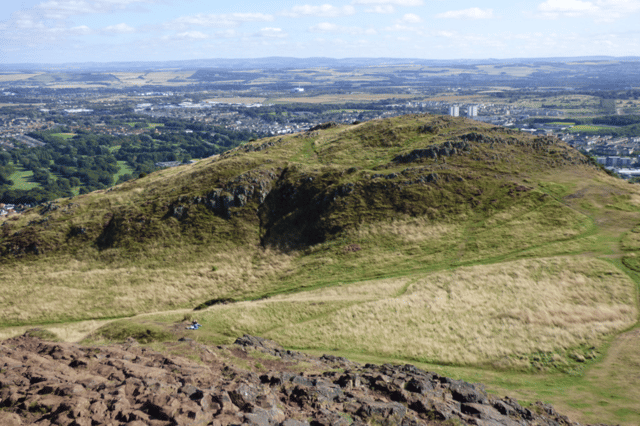

The bones have now been removed by archaeologists on behalf of Historic Environment Scotland (HES), with hopes to determine the date the remains were left behind.
READ MORE: One Day: Arthur’s Seat braced for rise in visitor’s following success of smash Netflix romance
The discovery hints at the long timeline of human activity in Holyrood Park, where people have roamed since at least the fifth millennium BC. It is believed the bones date from the post-medieval period, around 1500 to 1800, at the earliest.
A HES spokesperson said: “A large assemblage of animal bone was discovered by one of the Holyrood Park rangers when carrying out a routine patrol in the aftermath of the fire in August.
“Arrangements were then made to assess, record and sensitively remove the material before it was damaged or disturbed.
“The discovery was made close to the summit of Crow Hill, next to Arthur’s Seat and very close to the remains of a prehistoric hillfort, which once enclosed the summit of both hills and the area in between.
“The assemblage comprised a large number of animal bones of several different species, including cattle, horse, sheep or goat, and possibly even cat.
“The remains do not seem to have been part of a wider feature and are thought to be post-medieval or modern in date. However, the number and variety of bones make it an unusual – and potentially significant – discovery.”

The spokesperson added: “AOC Archaeology, HES’s archaeological call-off contractor, carefully removed the remains and they are now being analysed by specialists. Samples will be submitted for radiocarbon dating, which will tell us more about the age of the bones and why they may have been deposited there.”
Holyrood Park has witnessed human activity from the Mesolithic through to the Bronze Age, the Iron Age and beyond.
Crow Hill was once a hive of human activity and home to some extensive remains of cultivation terraces and the medieval rig-and-furrow ploughing system, which are among some of the best cultivation remains in the Lothians.
In the 16th century, the former monastic lands became a Royal park, which was enclosed with a stone wall by King James V in 1541, as an adjunct to the Palace of Holyroodhouse. The site’s history has close associations with the palace.
This effectively preserved the present Holyrood, or Queens Park, as an area of open ground, with no significant settlement from that time onwards.
The park as seen today is mainly the result of landscaping carried out in the 19th century under the direction of Prince Albert, who added roads and drainage to the landscape and kept the natural landfall as he sought to create a romantic wilderness overlooking the Palace of Holyroodhouse.
Comments
Want to join the conversation? Please or to comment on this article.