
The historic buildings of Scotland fighting for their future - Melrose Abbey, Doune Castle
How we care for Scotland’s historic properties is changing
Some were the homes of bishops, of kings and the once-powerful families of Scotland. Others hold remarkable stories about Scotland’s early residents who forged home here thousands of years ago.
But as time passes, landscape changes and decay accelerates at some of Scotland’s most revered historic sites, tough decisions are set to be taken on the future of properties which have long told the story of Scotland’s past.
Historic Environment Scotland (HES) is embarking on a major piece of work to determine the significance of its properties in the face of finite resources, the pressure of visitor numbers and the impact of climate change.
Propeties will not just be viewed as “museums in the landscape” but as places with social, economic and environmental value.
Decisions will be taken on which ones will be afforded long-term investment and which will warrant new uses, such as rented accommodation or community spaces. Some could fall to managed decline, where the structures are left to the elements in a safe way.
Here The Scotsman looks at a number of properties which reflect the difficult choices ahead.
Melrose Abbey
So revered has this place been, that Robert the Bruce chose to have the abbey as the final resting place for his heart.
The Victorians loved its romantic, crumbling state, which is largely how the structure still stands. But today, parts of its remain sealed off to the public given the risk of falling masonry.
As one of many historic properties without a roof, the abbey is among those posing a real challenge - and a hugely expensive one - for HES as it works to try and keep rain away from its stone fabric.
Dr David Mitchell, director of cultural assets at HES, said: “There is a real conundrum there. Melrose Abbey is a really interesting example. It is wonderful, it is hugely culturally significant, no question, but we are really struggling to manage the rate of deterioration at the structure.”
Buildings under state care by HES have traditionally demanded a “minimal intervention” approach, with properties cared for as found. But going forward, as climate change delivers increased rainfall and storm events, that approach is being severely tested.
Dr Mitchell said: “We are at the point now where that approach isn’t viable any more, this minimal intervention . It is not enough.”
What happens at Melrose Abbey is yet to be determined, but will undoubtedly be a real test for HES and its future strategy for its properties.
Links of Noltland, Westray, Orkney
This family settlement on Westray was occupied between 3,300BC to 800BC. After it was abandoned, the shifting sands led to its protection, leaving the whole place virtually unscathed. But now the changing coastline is putting its future at risk.


It was feared the site, which includes a Neolithic butchery area and an underground sauna, would disappear completely as sand levels fell, exposing it to the elements, with HES carrying out rescue archaeology to record and stabilise what was there.
Dr Mitchell said: “We thought the site was going to be lost, but we have actually managed to stabilise that a bit, which is good. But at what point in the finite resources that we have do we say ‘is that worth that further investment?’ And we are talking about within the next 50 years that we have to make those choices.”
Lochmaben Castle, Dumfries and Galloway
Once an important outpost for the English in hostile territory, Lochmaben withstood several sieges and attacks, before falling to the Scots in 1385. Later, a royal possession, the site was abandoned in the 1700s, with locals using stones for new buildings.

Today, the castle remains sealed off to the public given safety concerns of falling stone. It could be one of the buildings in the HES portfolio that falls to managed decline, which would lead to the property being made safe, sealed off and viewed from afar as it naturally decays into the landscape.
READ MORE: What is Scotland’s oldest castle?
Dr Mitchell said: “Bits of that site are hugely important because they are original fabric, and they are still there. Other bits have been fenced off for ten years, they are dangerous.
“Those parts of that site are not coming back. So for us to do anything there is going to cost millions. It might well be that we have to physically restrict access. It might mean we put in a platform that allows people to still see it - it is as nuanced as that.”
Kilchurn Castle, Argyll
Built in the mid-1400s, this castle on Loch Awe was the comfortable home of the mighty Campbells of Glenorchy for 140 years. After the first Jacobite Rising of 1689, it was converted into a garrison stronghold and is the oldest surviving barracks on the British mainland.

Abandoned by the end of the 1700s, it could attract more investment by HES given its economic potential for both the heritage body and the community.
Dr Mitchell said: “It is a it is a beautiful iconic site. It is is currently not staffed. There is a makeshift car park, people stop there and the visitor numbers are actually quite significant.”
But balanced with this site’s potential are other concerns.
Dr Mitchell said: “From a climate perspective, it is a risk. The water levels will increase, you might find the loch will come back and the castle will be surrounded by water once again, as it was at one point.
“So it is about looking at a property and saying ‘what are the risks and opportunities here?’ and how does that inform where we go next with this property?”
Doune Castle, Stirlingshire
The castle has been a major focus for HES since it got a starring role in television series Outlander, with visitor numbers trebling in just a year. Infrastructure started to strain, with the heritage body working with the local authority to create a new car park an appease local concerns.
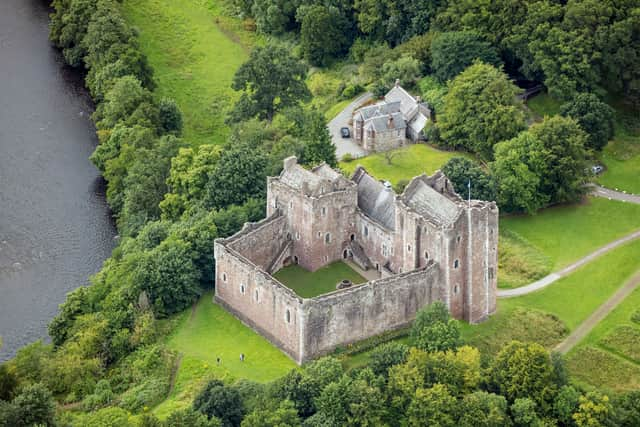
Now, part of the site - an old watermill - could be given a new lease of live under the property strategy.
Dr Mitchell said: “There isn’t a use for us for the mill and it is collapsing into the river, but we can look at what the community needs.
“What community benefit could be delivered there? There have been discussions with the local community about what is could be used for, a place for people to meet up, for example.”
Comments
Want to join the conversation? Please or to comment on this article.