
The festivals of the New Stone Age - how we partied in Scotland in 4,000BC
Festival season is upon us as we come together to celebrate the good times - just as our ancestors did in now Scotland some 6,000 years ago.
A major archaeological discovery has offered new insight into how our ancestors came together for large-scale festivities in Scotland more than 6,000 years ago.
Two giant timber halls built during the Neolithic period in Scotland, the likes of which have never been seen before in Scotland, have unlocked new understanding about the ways people from around the country gathered to celebrate key moments in the seasons around 4,000 BC.
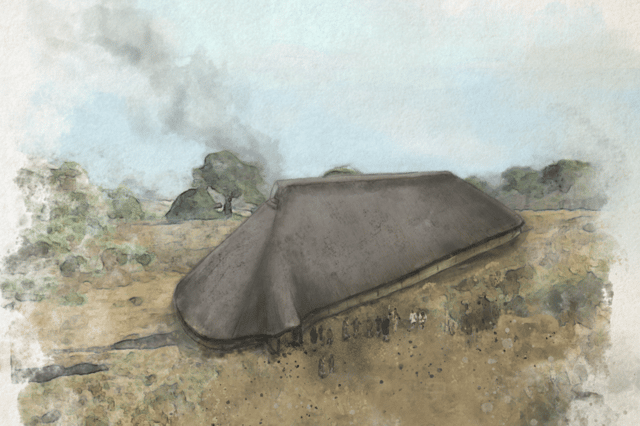
The structures - the largest some 35m long and 9m wide - were built in cleared woodland near Carnoustie in Scotland by some of Scotland’s earliest farmers.
It is known immigrant farmers arrived in Scotland from the near Continent around the same time the hall was built, with a social and economic revolution unfolding as the Mesolithic way of life gave way to a new order. The timber hall at Carnoustie became known long before the Neolithic wonders of both Skara Brae and Ring of Brodgar in Orkney.
READ MORE: The New Stone Age - the immigrants from France who changed the face of Scotland 6,000 years ago
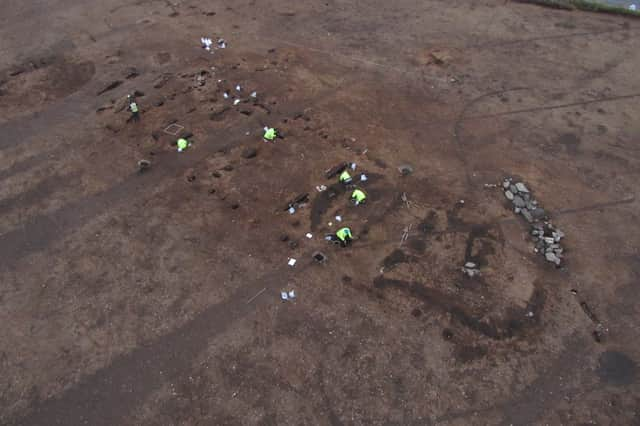
Around the Neolithic site, excavations by GUARD Archaeology found evidence of the deliberate deposition of stone artefacts and “tantalising traces of the beliefs and rituals” of the community that built the hall, which possibly served as a focal point for travellers.

Meanwhile, acorns and cereal deposits were found in the large hearth of the smaller hall, indicating feasting and meeting. Later evidence emerged of people camping outside the structures.
People continued to leave important items at the site well into the Bronze Age, with the ‘Carnoustie Hoard’ of a sword, a spearhead with gold decoration and a long pin wrapped in sheepskin earlier hailed for its importance.
Dr Beverley Ballin Smith, of GUARD Archaeology, said: “The Carnoustie halls, elevated and prominent in the landscape, were probably close to routeways where people may have congregated naturally at various seasons of the year.
“The availability of hazel nuts in autumn is a strong indicator that that season was an important one for meeting, feasting and celebrating. The Carnoustie timber halls may have been a focal point, their significance great enough to attract people from a much wider area.
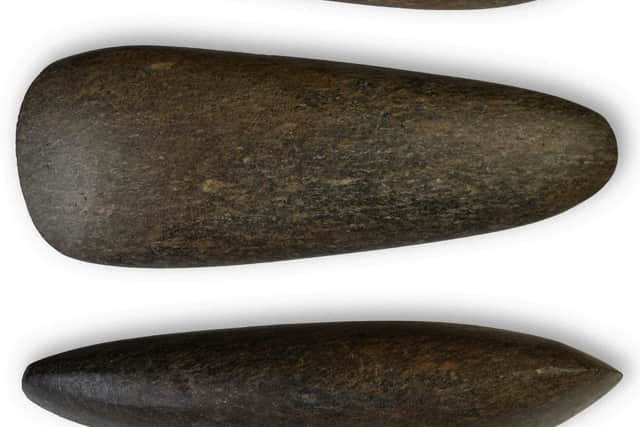
“We know from the materials found in the Carnoustie buildings that some artefacts came from distant places and represent deliberate deposition, such as fragments of Arran pitchstone, an axe of garnet-albite-schist and a piece of smoky quartz from the Highlands, while other materials were found more locally such as agate, quartz and chalcedony.”
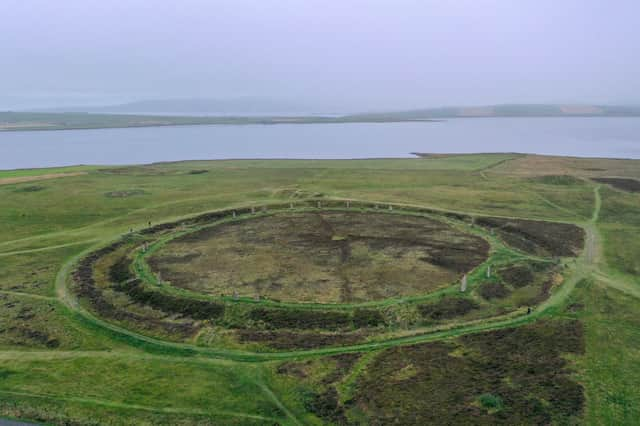
Alan Hunter Blair, who directed the fieldwork, said the Carnoustie excavation had produced “exceptional results”, including the discovery of the largest early Neolithic timber hall ever discovered in Scotland.
Described as “architecturally sophisticated”, the permanent structure, built from oak, measured 35m long and 9m wide. Its large roof was supported by paired massive timber posts and the walls constructed from wattle and daub panels supported by posts that were partly protected by its over-hanging roof.
The internal space was subdivided by more postholes and narrow channels marking partitions.
Dr Ballin Smith said: “This monumental timber hall, completely alien to the culture and landscape of the preceding Mesolithic era, was erected by one of the very first groups of farmers to colonise Scotland, in a clearing within the remains of natural woodland.
“It was fully formed, architecturally sophisticated, large, complex and required skills of design, planning, execution and carpentry.”
The discovery of a smaller companion hall made the site “exceptional” given that other Neolithic halls discovered in Scotland were all “discrete solitary structures within the virgin farmland” of the time. The smaller structure was still substantial, and measured almost 20m long and more than 8m wide.
After about 200 years, the halls were dismantled. A smaller hall was then built within the footprint of the larger hall around 3,800-3,700 BC, but this too continued to receive deliberate deposits of stone tools until about 3,600 BC.
The site continued to be revisited with evidence of people camping and gathering outside where the buildings once stood, carrying on the seasonal round of activities until around 2,500 BC.
From around 1,400 BC, during the Bronze Age, people had returned to this same site at Carnoustie, probably oblivious to its significance to earlier Neolithic communities.
A settlement was established here, comprising a single roundhouse, much smaller than the previous Neolithic halls. The Carnoustie Hoard was buried here during the late Bronze Age and included a sword within its wooden scabbard, a spearhead with a gold decorative band around its socket and a bronze sunflower-headed swan’s neck pin.
All were found wrapped in the remains of woollen cloth and sheep-skin.
The hoard had been deliberately buried in a pit within the midst of a late Bronze Age settlement sometime between 1,118-924 BC. The best preserved of these Bronze Age roundhouses was positioned over part of the foundations of the large Neolithic timber hall.
Dr Ballin Smith said the rich hoard of metal work suggested the occupants of the “otherwise very modest and unassuming” settlement were wealthy and had some status in the wider community.
She said: “Hoards such as this are rare, but a similar hoard of bronze swords and another gold decorated spearhead found in the 1960s just north of Dundee indicates a shared cultural practice amongst late Bronze Age households for burying wealth such as this for safekeeping. The reason as to why they never came back to recover these prized belongings, however, has been lost to the passage of time.”
The team discovered the last occupant of the Carnoustie site was a small field mouse. Investigation of the contents of the spearhead’s socket revealed a considerable amount of fresh-looking grass stems stained by the copper, suggesting a very small rodent, such as a field mouse, had set up house during the fairly recent past in the socket itself.
Comments
Want to join the conversation? Please or to comment on this article.