
The day Robert the Bruce's heart was 'found' buried in Scotland
As the 750th anniversary of Robert the Bruce’s birth is marked, the intrigue surrounding the last resting place of the warrior’s heart re-emerges.
In a simple lead casket in Melrose Abbey, the heart of Scotland’s great warrior king Robert the Bruce is said to lie.
The heart, which according to practice of the day was dipped in hot tar to preserve it, was first discovered along with three stone coffins by archaeologists in March 1921 .
It was found a again in 1996 with the find becoming a powerful expression of nationhood as Scotland moved towards devolution - and the press around the world lapped up the discovery.
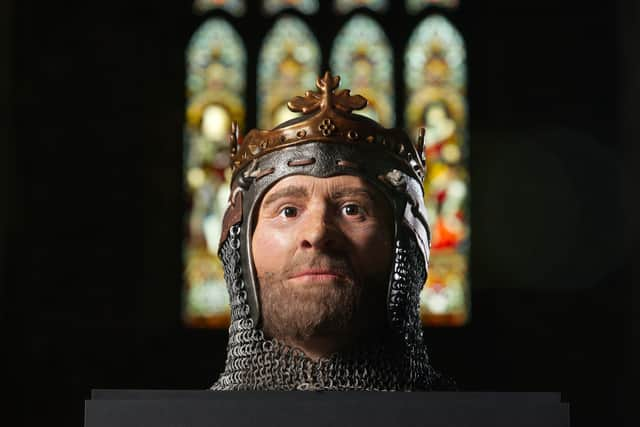

Indeed, Donald Dewar, the Secretary of State for Scotland at the time, said the discovery was “one of great significance and symbolism for the people of Scotland.
“The exciting and dramatic changes we see in Scotland today are, perhaps, a very appropriate extension of those events back in medieval times.” The find in 1996 also intextricably linked Robert the Bruce - best known for his defeat of the English army under Edward II at Bannockburn in 1314- to Melrose Abbey in the modern eye.

The King’s association with the abbey ran deep. He sent funds to help rebuild it after it was largely destroyed by the English during the Wars of Independence. It is said he always received a true Royal welcome within its walls, where ample supplies of food and drink were offered to him.
As the 750th anniversary of Robert the Bruce’s birth is marked this summer, Melrose Abbey is once more at the heart of the king’s story.
In 1921, The Scotsman recorded the find made at the abbey by archaeologists from the then Office of Works.
The newspaper said: “Within the past faw day they unearthed a number of stone coffins, and beside these was the heart in question.
“The discovery is regarded as of "great interest”. The heart-may possibly , be that of Robert The Bruce.”
The heart was enclosed in a cone-shaped leaded casket, almost nine inches in length, which had been soldered from top to bottom
The story added: “On the casket being opened in Edinburgh, it was discovered to contain a dessicated heart.”
When Robert the Bruce died at Cardross in 1329, he directed that his body should be interred at Dunfermline but that his heart should be sent to Jerusalem, so that it might make the pilgrimage that he never had.
But his heart was never to make it there.
Sir James Douglas - also known as Black Douglas - hung the heart of his friend and commander around his neck in a silver casked - and embarked on the voyage to the Holy Land to deposit it in the Holy Sepulchre. But Black Douglas died on August 25, 1330 while carrying out his friend’s final wish.
He was killed after he and his men came into contact with the Moors near Teba, a castle on the frontier of Andalucia.
The heart was brough back to Scotland and taken to Melrose Abbbey with it reportedly placed, according to popular belief, at the High Altar in the east side of the building.
But the heart found in 1921 was discovered in the Chapter House area of the abbey, to the north west. Doubt was cast on whether the heart found was Robert the Bruce’s and it was buried again in a new lead casket sometime later by the Office of Works, who removed the heart from the casket to photograph it.
It was found again in 1996 when HES carried out works at the abbey.

According to accounts, the team didn’t immediately know what the canister contained, but the moment it was unearthed they knew they had a significant discovery on their hands.
On opening the canister, they found a plaque commemorating the first discovery in 1921 alongside the original casket.
“As the casket was already damaged, they didn’t open it. Instead they used an endoscope to peek through a gap at the base. Inside was a small, prune-like object: the heart that had been reported 60 years earlier,” an article for Historic Environment Scotland earlier said.

Those in charge of the recovery of the casket earlier recalled “madness” surorunding the find, which was instantly linked around the world to Robert the Bruce.
“The Melrose Casket played heavily into the political climate of the time in a very similar way. With Scottish devolution just around the corner, the symbolism of Robert the Bruce was not lost on the public. Both they and the media seemed to take it for granted this was without a doubt the heart of the legendary King,” an earlier article for HES said.
Then Historic Scotland was unnwilling to assign an identity to the remains that had been recovered. It was, essentially, impossible to do so, not least given there were three recorded heart burials at Melrose with the practice relatively popular during the medieval period.
Meanwhile, the heart’s discovery in the Chapter House, rather than the high altar, would not necessarily indicate the status of the king.
DNA samples were offered by those who claimed to be direct descendants of Robert the Bruce.
But the fact that the heart had been dipped in tar to preserve it - essentially cooking it in the process - would have destoryed any DNA traces that remained.
In the end, in accordance with Scots Law and respect for the dead, the casket was enclosed inside a time capsule, and reburied in a private ceremony. This was deemed the most appropriate thing to do, regardless of whether the heart was indeed that of the warrior king.
Comments
Want to join the conversation? Please or to comment on this article.