
Inside the 'exceptional' metal detectorist finder fees paid out in Scotland - from items worth £10 to £80,000
Metal detecting is on the rise, with a number of important finds being duly rewarded.
Almost £140,000 has been paid to metal detectorists and other finders of Scotland’s ancient artefacts in the past year, it has emerged.
It comes as 5,844 chance archaeological finds were reported in 2024/25 to the Treasure Trove Unit (TTU), which has hailed a “year of exceptional archaeological discoveries and public engagement” with those seeking out the objects that tell of Scotland’s past.


The TTU records the found items, which are regarded as “ownerless property” under Scots law, with the unit processing around 6,000 objects in the past year.
The Crown, represented by the King’s and Lord Treasurer’s Remembrancer (KLTR) in Scotland, can choose to claim significant archaeological finds on behalf of the public so they can be preserved in museum collections for all to see.
Sums paid to finders during 2024/25 range from £10 for a stone spindle whorl found near Kirriemuir to £80,000 for the stunning Peebles Hoard made up of more than 500 Bronze Age items and discovered by metal detectorist Mariusz Stephen in the Scottish Borders in June 2020.
Other key finds include a James I demy coin from the early 1400s that was found at Kinross and valued at £4,500. The coin was then acquired by Perth and Kinross Museum.
A striking gold enamel and red stone finger ring found at Port Elphinstone in Aberdeenshire was valued at £3, 600 and will go on show in a museum in the North East. Meanwhile, an iconographic gold ring found at Edzell was valued at £6, 010.
Meanwhile, a beautiful medieval figurine of Madonna and child was valued at £300 and acquired by Fife Cultural Trust after it was found near Cupar. Finder’s fees awarded to metal detectorists and others who report artefacts are funded by the museum that wishes to acquire them.
Jane Ryder, chair of the Scottish Archaeological Finds Allocation Panel (SAFAP), an independent body that advises the KLTR on museum allocations and valuations, said: “This year’s report reflects the collaboration of finders, museums and heritage professionals working together to preserve Scotland’s archaeological legacy.
“The breadth and location of finds — from prehistoric tools to Victorian jewellery — demonstrates the variety and richness of our shared heritage.
“All of this is reflected in allocations to museums across the country, from Shetland and the Western Isles to Dumfries and Galloway and the Borders, making these treasures accessible to all.”
The finds are included in the annual report of the Treasure Trove Unit, which was shared at a recent event at the National Museum of Scotland. The total sum paid to members of the public in 2024/2025 was £138,651, compared to £84,533 the previous year.

The rise is due to the large sum paid for the Peebles Hoard, which was acquired by National Museums Scotland. Dating to 1000–800BCE, experts believe the treasures are capable of “transforming our understanding of Bronze Age Scotland” given they illustrate the country’s links to an international network of communities across the North Sea.
The hoard contains hundreds of elements from a complex set of objects, notably a complete sword in a wooden scabbard, alongside decorative fittings, straps and buttons.
Two rattle pendants, which would have been fixed to a horse or cart to make a noise when on the move, are the first to be found in Scotland. They are more commonly found in Denmark, northern Germany and northern Poland.
The hoard was acquired by National Museums Scotland and is undergoing extensive research and conservation work.
The TTU also worked on three excavations of finds, with the metal detectorists involved praised for their “excellent work” in quickly declaring their discoveries.

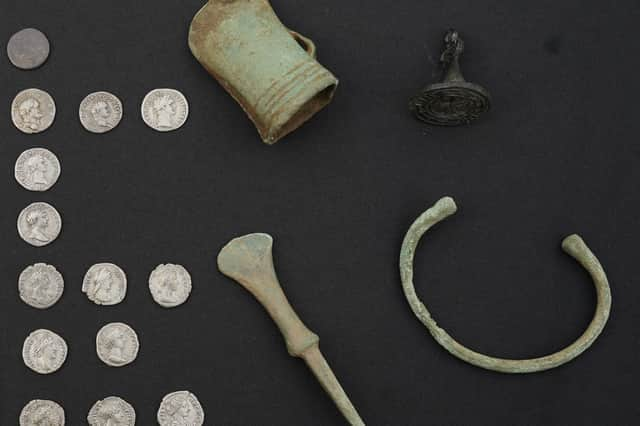
These include the Cappercleuch Medieval coin hoard found in the Scottish Borders, which was found by Keith Young and Lisa Stephenson, who described their discovery as a “find of a lifetime”. It is thought the unusual mix of Scots and English coins, some minted by King Henry V of England and others released during the reign of King James I and II, were left behind around 1460.
Overall, the number of finds reported to TTU was down on last year, when more than 7,400 finds were reported.
That number is attributed to the high-levels of metal detecting pursued during Covid lockdown and the delay in being able to get the finds recorded by TTU due to the pandemic.
The TTU annual report said: “As expected, detected and chance finds reported to TTU reduced slightly from the post-Covid high of 2023/24, but reporting over the last five years is still on an upward trajectory.
“We expect this to continue as there are new entrants to metal detecting and more sophisticated tools available, as well as greater public awareness.”
The report described 2024/25 as a “demanding, but very positive year” for the TTU and the SAFAP, particularly in addressing the backlog created by the pandemic. Overall, 6,000 finds were processed and recorded by the unit during the year.
As metal detecting increases in popularity, the TTU also held a number of outreach events across the country to explain its work and the rules governing the finding of artefacts.
John Logue, King’s and Lord Treasurer’s Remembrancer, said: “The Treasure Trove system ensures that objects of cultural significance from Scotland’s past are protected for public benefit and preserved in museums across the country.
“This work would not be possible without the dedication and expertise of the Treasure Trove Unit, whose efforts continue to safeguard and celebrate the story of Scotland’s past. This event and report reflect our commitment to transparency, collaboration and the continued stewardship of Scotland’s archaeological heritage.”
Culture Secretary Angus Robertson said the Treasure Trove played a “vital role” in protecting Scotland’s heritage.
“This report and the inaugural event showcase the incredible work being done to ensure that archaeological discoveries are not only safeguarded, but shared with the public through our museums," he said.
Comments
Want to join the conversation? Please or to comment on this article.