
Controversial statue of Dr Elsie Inglis looks set to be approved as family make statement on artwork


Dr Elsie Inglis is set to become the first woman to have a statue on the Royal Mile.
A controversial statue of pioneering midwife, surgeon and suffragette Dr Elsie Inglis looks set to be approved.
Designed by Sir Alexander Stoddart, the King’s Sculptor in Ordinary, the statue will be the first of a woman on the Royal Mile if it is granted permission by councillors.
A total of 237 letters of objection and 408 letters of support have been lodged with Edinburgh City Council over the artwork. Hundreds of people earlier signed an open letter calling for a rethink of the design.
The statue depicts Dr Inglis on a plinth wearing her uniform for the Scottish Women’s Hospital’s for Foreign Service, which she founded before setting up 14 hospitals across the battlefields of the First World War.
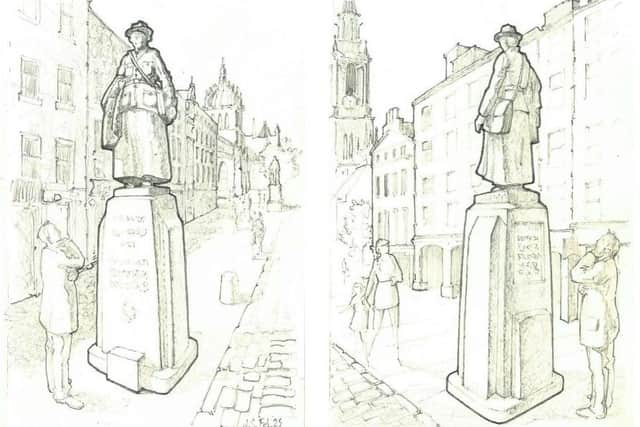
Critics claim the statue does not reflect the full character and achievements of Dr Inglis and her creation of maternity services in Edinburgh, including the founding of The Hospice off the Royal Mile, which offered care to the city’s poorest women.
A family statement said the statue showed Dr Inglis “in the uniform she was most proud of” and which represented her “greatest achievements”.
The family said it was “extremely honoured and appreciative” that Sir Alexander Stoddart had devoted his “time and considerable skill to creating an extraordinary tribute to Dr Elsie Inglis and all who served in her units”.
It added: “We also understand that no one monument will be able to please everyone. In Alexander's design, Dr Elsie Inglis is standing tall and proud, shoulder to shoulder, with the other historical figures represented on the Royal Mile.
“The classical design depicts her in the uniform of which she was most proud and represents the greatest achievement of her lifetime - the Scottish Women's Hospitals for Foreign Service.
“The style, which can be seen in other statues on the Royal Mile, is also in keeping with the surroundings. The location has been well chosen and has considerable historical significance at the site of the hospital she founded, staffed by women. “
The statue is due to be placed at New Assembly Close opposite the commemorative plaque at 219 High Street where Dr Inglis opened The Hospice maternity hospital in 1904.
The family statement added: “It was here that she honed the leadership skills that enabled her to become one of Scotland's leading suffragists and the founder of Scottish Women's Hospitals for Foreign Service.
“There are some who would like to see more of a focus on her work in Edinburgh, prior to WW1, however we would gently question the idea that recognising her wartime work diminishes her legacy in Edinburgh. The current proposal recognises her efforts both at home, and abroad, to further the cause for which she dedicated her life - women's suffrage.”
Campaigners are planning to launch a breastfeeding protest against the statue ahead of the meeting of the development management sub committee at City Chambers on Wednesday, October 1.
The family statement added that the breastfeeding protest “ran the risk of recreating narratives of womanhood that these brave and courageous Suffragists sought to change”.
The Proclaimers and author Val McDermid are among those who have publicly criticised the design.
Others have claimed that the sculpture should have been designed by a woman, with criticisms that Sir Alexander Stoddart was suddenly appointed following the early closure of an open competition.
Councillors have been recommended to grant permission for the statue, with a requirement that the size of the plinth is reduced.
Comments
Want to join the conversation? Please or to comment on this article.