
A love letter to Scotland's vanishing native dog breeds
A new book shines a light on the dog breeds shaped by Scotland over hundreds of years - and which now face an uncertain future.
From the Scottish Terrier to the mighty Deerhound, Scotland’s vanishing native dog breeds are celebrated in a new book, along with the owners who are, with passion and determination, keeping the bloodlines alive.
Peter MacQueen, author of Tails of Scotland, has traced the roots of the native breeds, shaped by “hill, weather and heather”, in a book which he describes as a “love letter with teeth” to the dogs whose character and physicality have been forged over hundreds of years.
Scotland has 14 native breeds and six of them are vulnerable: the Skye Terrier, Dandy Dinmont Terrier, Bearded Collie, Smooth Collie, Scottish Deerhound and Gordon Setter. Each breed has fewer than 300 puppies born every year.
READ MORE: Searched for dogs 2025: The most popular breeds of dog searched for online including the Cane Corso


Meanwhile, the iconic Scottish Terrier is on the KC’s ‘At Watch’ list after its lowest ever puppy count was recorded in 2023.
Mr MacQueen said: “For a small country Scotland has a remarkable number of dogs to her name. Fourteen native breeds survive and all have shaped the lives, landscapes and loyalties of this country in ways that are too often overlooked.
“Creating this book was an absolute joy - dogs have been a constant in my life with their honesty, humour, heart and hullaballoo - they have grounded me more times than I can count, and I know I am not alone in that sentiment, we are a nation of dog lovers.”

Mr MacQueen said the rarest recognised dog in Scotland was now the Smooth Collie, with only 29 puppies registered in 2024.

He added: “A friendly, intelligent and loyal dog this treasure of a breed deserves a place in the story of Scotland’s future, not just its past. I hope Tails of Scotland shines a light on these vulnerable breeds which need our attention now more than ever.
“Meeting dogs all the dogs and the faithful human packs that form around them, really was a true privilege – the skill, love and devotion of the dog community is astounding.
“The work of preservation breeders, dedicated breed clubs and amazing women and men from Tobermory to Pitlochry and Lerwick to Selkirk gives me hope that the future of our dogs is hopeful.”
In Argyll, Mr MacQueen encountered the work of the Scottish Terrier Emergency Care Scheme (STECS), a long-established, volunteer-run charity dedicated to the rescue, rehoming and welfare of Scotties across the UK.
Its work is now critical, given the breed was place on the the Kennel Club’s ‘At Watch’ list after just 406 puppies were registered in 2023 - a “staggering drop” since its hey-day in the mid 1930s through to the early 1940s, when the breed was the most popular breed in the country.
Numbers peaked again in 1947 when over 5,800 puppies were registered.
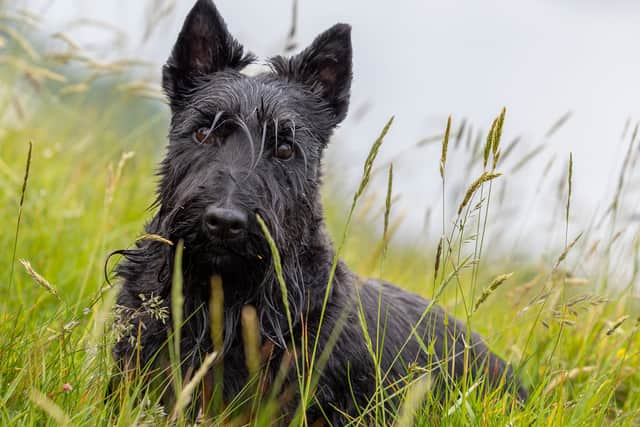
A breed hewn from the northeast of Scotland, the Scottish Terrier was bred “among the burrows and cairns of rural Aberdeenshire,” Mr MacQueen said.
“The harsh weather was a constant trial and vermin an inevitable foe,” he added.
“By the early 1800s, they were getting themselves noticed beyond their working role. Writers like Sir Walter Scott – who kept a proto-Scottie or Cairn-like terrier called Camp – helped to romanticise Scotland’s native terriers. Yet it wasn’t until the late nineteenth century that the dog we now know as the Scottish terrier truly began to take shape,” he added.
The Scottie was added as a piece to the Monopoly board in 1942. Meanwhile, the breed was also favoured by President Franklin D. Roosevelt, who travelled with his dog - called Fala - on official business. He was later cast in bronze at a memorial to the statesman.
“You can criticise me, my wife and my family, but you can’t criticise my little dog,” Roosevelt once said.
Mr MacQueen said the Scottie's decline in popularity was partly down to “fashion” but also that its stoic temperament could also be misunderstood in a “world that prizes eager affection and constant interaction.”
The exact origins of the native breeds often blended “folklore with fact”, with the Skye Terrier a good example of where legend holds the back story.
Some believe the breed began in 1588 during the Spanish Armada, when several small, long-coated canines swam ashore from shipwrecks off the coast of Skye and then found their way into local terrier stock.
Mr MacQueen added: “ What we do know is that by the 16th Century, small sturdy terriers were thriving in Skye and the nearby Highlands.
“These dogs weren’t pampered pets: they were hardy working terriers, fearless exterminators, or at least deterrents, of foxes, badgers and otters that were considered a pest by those who worked the land.
“Short legs and a long body gave them an agility boost underground, while a thick, flowing coat protected against brambles and biting vermin.”

He said terriers “earned their place” in the great houses of Skye, with Clan Donald said to have kept a distinguished line of long-coated dogs during the 18th and early 19th Centuries.
The legends of the Scottish Deerhound are also covered in the book, with their spirit “running deep in folklore," Mr MacQueen said.
The Cù-Sìth, a spectral hound, was said to roam the moors as an omen of death. It’s described in Gaelic legend as an otherworldly dog “as large as a small cow” hunting in eerie silence.
Clan legends, too, spoke of phantom deerhounds – the Grey Dog of Meoble, An Cù Ghlas Mheòbhail - was a deerhound that would appear when a member of Clan MacDonald in Morar was about to die.
Mr MacQueen wrote “But it’s their movement that leaves the deepest impression. A deerhound moves like it remembers something more ancient than the ground beneath it – there is no hurry, no tension. Just a stride as smooth and elegant as a river, even when loping over tussocky ground. They are unfathomably fast, truly built for the terrain of a Scottish wilderness.”
Tails of Scotland by Peter MacQueen is published by Black &White Publishing on October 23.
Comments
Want to join the conversation? Please or to comment on this article.