
Exclusive:Smoke flare used in helicopter training exercise linked to Scotland's worst wildfire
The wildfires in Moray and the Highlands in the summer are believed to be the largest on record.

A smoke flare used in a helicopter training exercise is believed to be linked to one of Scotland’s largest wildfires on record, The Scotsman can reveal.
The pyrotechnic was thrown out of a helicopter above an estate bordering Moray and the Highlands during a search and rescue training exercise towards the end of June.
Several sources told The Scotsman the flare started a fire by accident that was initially put out after a matter of hours. However, due to dry, windy weather conditions they said embers smouldering in the ground reignited and a wildfire took off, spreading across multiple estates for over a week.


The blaze, which has been referred to as the Carrbridge wildfire in official statements, is one of two wildfires that blighted flora and fauna across Moray and the Highlands during the summer. The second fire began about a week later around Loch Allan, in the north of Dava moor in the Strathspey area of Scotland.
Together, the two fires have been described as the biggest wildfire incident in Scotland’s history.

Landowner membership organisation Scottish Land & Estates (SLE) estimates the fires combined affected 29,225 acres (11,827 hectares) - an area almost 50 times bigger than Holyrood Park in Edinburgh.
Colin McClean, land manager of the Cairngorms National Park Authority (CNPA), said he had never seen anything on such a scale, with fears thousands of animals died in what were described as “biblical” wildfires.
The Carrbridge wildfire was first reported to police on Friday, June 20 - the same day the helicopter had been in the area for the practice search and rescue mission.
Bristow Helicopters Ltd, the company operating the helicopter, confirmed a fire started by accident as a result of a flare being released during the training exercise.

A spokesperson for the company said: “We can confirm that during a required search and rescue training exercise in the afternoon of Friday, 20 June 2025, Bristow helicopter crews deployed a smoke signalling device as part of standard procedures.
“The smoke was used in accordance with established training protocols essential for preparing crews for lifesaving operations.
“Regrettably, this led to a small fire on Cawdor Estate moorland. Cawdor Estate were notified immediately and responded, bringing the fire under control.”
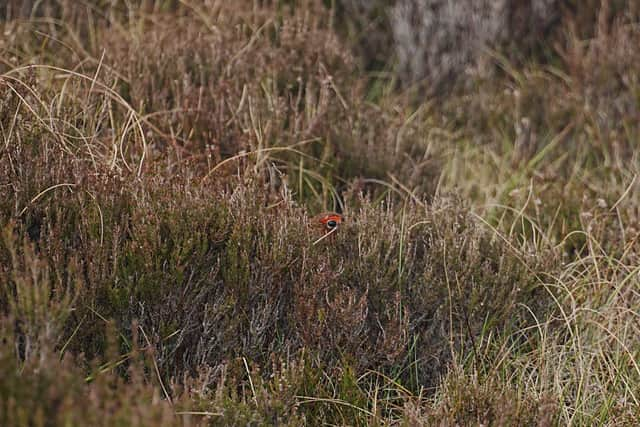
Cawdor Estate was contacted for comment. According to police reports at the time, flames “in the area of Carrbridge moor” reignited on multiple occasions over 11 days before being fully extinguished.
SLE said the Carrbridge fire alone ended up covering some 12,9335 acres (5,234 hectares) in total, of which 11, 683 acres (728ha) was moorland and 1,250 acres (506ha) was woodland.
Witnesses to the blaze said smoke drifted for 40 miles across the Moray Firth for over a week.
The wildfire saw a huge response from estate workers and rural businesses in helping put out the flames. More than 100 people assisted the Scottish Fire and Rescue Service (SFRS) across both wildfires.
One of those included a former gamekeeper from Grantown who told The Scotsman: “The Carrbridge fire was set off by a smoke flare. It was put out, but it reignited and was raging for a while after that.

“It was unbelievable how much it smouldered into the ground and because of the mounds smouldering, it was very difficult to put out.”
SFRS recorded the Carrbridge wildfire as accidental.
The incident report, which gave details on when the fire was first reported, said it started at Lochgorm, near the B9007, and damaged an area of about 8m squared over a period of about five hours until it was put out.
Keepers on the ground who were involved helping put out the flames said with the high winds in the following days, the fire took off again, crossed the B9007 and into neighbouring estates Muckrach and Lochindorb.
In a Freedom of Information request, obtained by The Scotsman, the SFRS said while the smoke flare being the cause of the Carrbridge wildfire was not certain, it was “one that could be reasonably supposed given the evidence available”.
HM Coastguard, involved in the training exercise, declined to comment.
Police Scotland confirmed both wildfires were investigated and “no criminality was established” for either. The news comes as the SFRS issued an extreme wildfire warning last week for the first time in September since 2020.
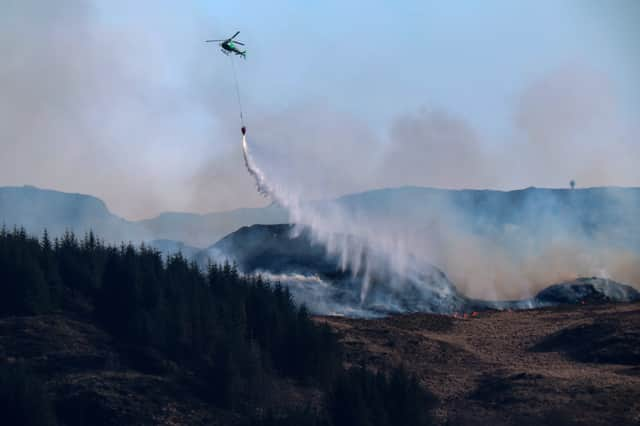
The warning covered all of Scotland throughout Friday and followed a very high warning, which has been in place since Wednesday. The alert was the 13th wildfire warning this year, which the SFRS says is the most in recent times.
Crews said Scotland had faced an "unprecedented scale" of wildfire risk in 2025 and urged "extreme caution".
Last week, Scottish Conservative Tim Eagle called for a dedicated wildfire response unit to be set up in Scotland, following the rise in incidents reported this year.

Speaking in Parliament, the Highlands and Islands MSP said close to 600 wildfires have been recorded in the Highlands over the past decade. He said the wildfires in late June across Moray highlighted the need for urgent action to be taken.
Mr Eagle said: “The Highlands has always been an area affected by wildfires, but they are becoming increasingly frequent and more intense.
“The ones at the end of June across Moray were incredibly intense and my thanks go to all the land managers, our fire and rescue service and our local communities for the incredible resilience they showed while they were brought under control.
“However, I now believe we cannot continue just rely on people stepping up in local communities when these incidents occur. The time has come for a dedicated national wildfire response unit to be set up.”
Earlier this year, SLE published a report saying there were “key gaps” in the SFRS wildfire response capability.
The organisation made recommendations, including investment in a fleet of at least 50 SFRS all-terrain vehicles equipped with fogging units, enhanced authority for SFRS commanders to deploy aerial support quickly, urgent improvements in wildfire training and communications for frontline crews and to established a Scotland-wide Integrated Fire Management Strategy.
Comments
Want to join the conversation? Please or to comment on this article.