
Scottish island completes next step to become first for underwater tunnels
The new report has looked at preliminary lines for two desired underwater routes.

Islands hoping to become the first in Scotland to establish inter-island underwater tunnels have moved one step closer to their goal.
Communities in Shetland renewed a campaign earlier this year for subsea links to be built between the archipelago’s mainland and the northern isles.


Campaigners argue the development would be more cost-effective than replacing the fleet of ageing inter-island ferries and improve quality of life for islanders.
Two potential routes to the islands of Yell and Unst have been examined by experts, with fresh research on the potential links published today.
The new pre-seismic report identified preliminary lines for the final routes to be assessed.
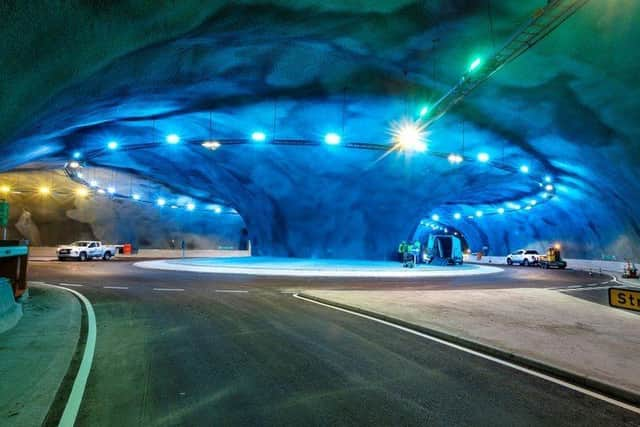
The next stage — a full seismic study — will provide the detailed geological data required to identify which alignments are feasible and to refine potential routes.
The pre-seismic work was carried out by Norconsult, the international engineering consultancy responsible for the design of all subsea tunnels in the Faroe Islands, as well as many of those in Norway.
The report reviewed previous geological studies, carried out between 2000 and 2002, which included seabed surveys and geological mapping. These earlier studies identified potential challenges, including sediment layers, rock quality variations, and fault lines.

Bluemull Sound, between Unst and Yell, has complex geology, with ridges and troughs in the bedrock and variable sediment depths. Meanwhile, Yell Sounds shows deeper rock structures and significant fault zones - regions in the Earth's crust where rocks have fractured and moved relative to each other. The report said the most promising alignment would be likely under neighbouring Bigga Island but would need more research.
Members of the Unst and Yell Tunnel Action Groups said the new research “sets out the groundwork for the crucial next step - seismic surveys”.
Joint chair of the Unst Tunnel Action Group, Alec Priest said: “We are delighted to have completed this important step in the process. It shows how the money raised by our communities is being used, and gives everyone the chance to see how the project is progressing.
“Seismic surveys are the next crucial stage. They will give us the detailed data on the seabed and rock structures that we need before any firm decisions can be made about alignments and help refine costings for potential fixed links.
“Thanks to the amazing response so far, the majority of funds are already in place for consent support work and the seismic surveys. Just a small funding gap remains, which we hope to fill through continued community effort, local business support, and upcoming events.”
Residents in North Yell previously told The Scotsman about the social and economic benefit the tunnels would bring for the islands.
Shetland Council currently runs ferry services to nine islands, carrying around 750,000 passengers each year on 12 vessels at a cost of about £23m per year.
The average age of the fleet is 30 years old, with four of the vessels approaching 40. Costs have risen sharply in the past decade, and some routes are struggling to meet demand for vehicle places.

Alice Mathewson, joint chair of Unst Tunnel Action Group, said replacing the ferries will be “extortionate” as new terminals for the new vessels will also have to be built.
She said figures quoted by three companies from Faroe and Norway involved in undersea construction said a tunnel from Yell to Unst would cost about £40-50m and for Yell to the mainland it was £70-80m.
Comments
Want to join the conversation? Please or to comment on this article.