
Scotland looks to 'mountain rescue style' model to tackle rising wildfire risk

Rural groups and ministers said there is a gap in training in how to tackle the increase in wildfires in Scotland.
New mountain rescue-style teams are being explored by the Scottish Government to tackle the rise in wildfires across the country.
The groups would consist of volunteers with trained wildfire wardens to support local efforts and help with coordinating the emergency response.
The announcement was made in the Scottish Parliament by agriculture minister Jim Fairlie on Tuesday.
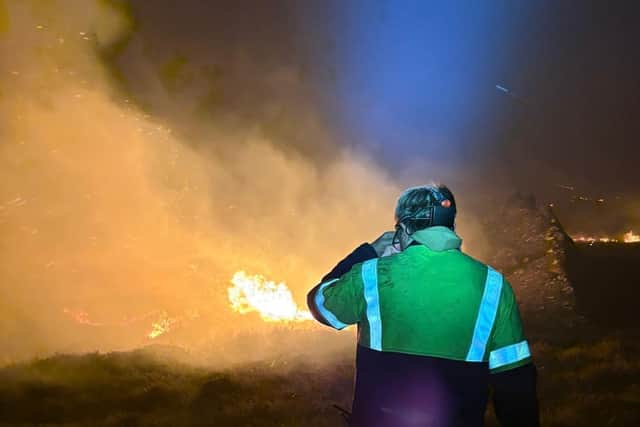

It comes after the first ever Scottish Government-led wildfire summit took place last month in the Cairngorms National Park.
The meeting heard different voices sharing their experiences and what they learned from wildfires this summer that have been described as the worst in Scotland’s history.
The minister said a gap in multi agency training was identified and a “mountain rescue style model” could assist by giving appropriate training in the same way a mountain rescue team would be given.

He said the Scottish Fire and Rescue Service (SFRS) has invested £1.6 million in wildfire response assets, including personal protective equipment, all terrain vehicles, fogging units and drones, with further investment currently being considered.
It comes after a report completed earlier this year by estates membership organisation Scottish Land and Estates said there are “key gaps” in the SFRS wildfire response capability for the increasing risk in wildfires.
The document made recommendations, including investment in a fleet of at least 50 SFRS all-terrain vehicles equipped with fogging units, enhanced authority for SFRS commanders to deploy aerial support quickly, urgent improvements in wildfire training and communications for frontline crews.
While stakeholders at the summit said different parties found “common ground” on how to respond to wildfires, the Scottish Government was accused of having a lack of representation for other parts of the country.
Scottish Conservatives Finlay Carson said there was no invite representing Dumfries and Galloway despite “one of the largest wildfires in the UK” happening in Galloway earlier this year “accounting for nearly a quarter of all the land burned across the country.”

Beatrice Wishart, Scottish Liberal Democrat MSP for Shetland, and Scottish Conservative Jamie Halcro-Johnston, who represents the Highlands and Islands, both quizzed the minister on what is being done about the wildfire response for islanders given they, too, had no seat at the table.
Mr Fairlie responded confirming the conference “did not look at a specific island issue because this is a national effort” and “not just about islands.”
A total of 241 wildfire incidents have been recorded in Scotland alone this year, according to the SFRS.
There was a sharp spike in incidents in April, with 109 recorded in that month alone.
Meanwhile, fires that ravaged parts of Moray and the Highlands in June and July were described as the largest in Scotland’s history, with flame lengths reaching 20 meters and jumping up to 750 meters.
The area of the UK burnt by wildfires by April this year was already higher than the total for any year in more than a decade, according to the Global Wildfire Information System, which has recorded burnt area since 2012.
According to a report by the SFRS for the first two quarters of 2025/26, there were 179 deliberate fires set across the Highlands this year so far — a 40 per cent increase from last year and the highest number in four years.
In response to the figures, SFRS area commander Lynne Gow said: “We’ve seen an increase in deliberate fires across the Highlands, and a number of these are linked to outdoor and wildfire activity, particularly during periods of dry weather earlier this year.
“These incidents are mainly caused by human activity such as campfires, discarded cigarettes and barbecues, which, combined with dry conditions and peat soil, can spread rapidly. While some fires are started deliberately, others can quickly get out of control.
“We’re working closely with Police Scotland, the council and community partners to target hotspots, engage with young people, and raise awareness about the dangers of deliberate fire-setting and careless outdoor burning.”
Comments
Want to join the conversation? Please or to comment on this article.