
'Remarkable' discovery of ancient plant in northern Scotland not seen in 50 years
The plant is distinctive and can be recognised by its highly symmetrical, architectural structure.

High on a ravine ledge in the north Highlands, a plant typical of ancient woodlands has been officially recorded for the first time in more than five decades.
Herb-paris has been confirmed growing in upland birch woodland in East Sutherland, extending its known range into territory where, until now, it had gone unrecorded.
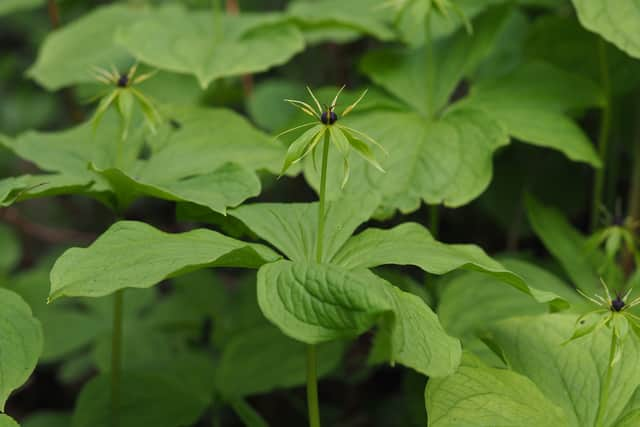
The plant is distinctive and can be recognised by its highly symmetrical, architectural structure. It has a single upright stem topped by a whorl of typically four, but sometimes three or five, egg-shaped leaves arranged in a cross.


From the centre of this leaf whorl, a solitary flower emerges, featuring narrow yellow-green petals and eight prominent golden stamens, which matures into a single, dark blue-black berry. The plant is often used as an indicator of ancient, damp, chalky woodlands.
It was a gap in the record, rather than the discovery itself, that brought the plant back into focus. The plant was originally spotted by James Rainey, a botanist and ecological consultant, seven years ago, however it was not reported to the Botanical Society of Britain and Ireland (BSBI) until last summer. Since then, an official report of the discovery has been making its way through the society’s rigorous processes of checking and validation.
A BSBI member noticed the absence of the Sutherland sighting from official distribution maps, prompting a retrospective check.
Fortunately, a photograph taken at the time allowed experts to confirm the identification without the need for a return expedition to the ledge where it clings on.
Matt Harding, BSBI’s Scotland officer, said: “This is the first record of Herb-paris from East Sutherland.
“There is a record from 1923 at a location just over the border in West Sutherland, but nothing else across the whole of north Scotland since 1971. So this really is a remarkable find and shows that there is still a lot we have yet to find out about the plants that grow in the wilder parts of northern Scotland.”
BSBI said herb-paris is declining in lowland ancient woodlands across Britain, especially in the north, due to the loss of appropriate habitat.
Researchers said the plant was well adapted to traditional woodland management techniques such as coppicing - cutting trees or shrubs down to ground level during the dormant season - and has declined since such practices were widely abandoned in the 19th century.
Herb-paris usually disappears from woodlands following clear-felling and tends not to colonise new sites.
Professor Mick Crawley, the BSBI’s vice-county recorder for East Sutherland, said: "I’m delighted, what more could you want from a new vice-county record.”
The BSBI is the leading charitable organisation promoting the enjoyment, study and conservation of wild plants in Britain and Ireland.
It hosts a diverse community of botanists who provide data and science to help address biodiversity loss and climate change; and disseminate information to drive a passion for plants.
The organisation provides opportunities for involvement through a range of participation projects, surveys, events, training opportunities and the production of books and other resources.
It’s database holds over 60 million plant records, making it one of the world’s largest biological recording databases.
Comments
Want to join the conversation? Please or to comment on this article.