
'Rare' find in Highland bothy reveals secrets of its past


The find offers rare physical evidence of a hidden whisky-making operation in one of Scotland’s most inaccessible landscapes.
A centuries-old whisky bothy, concealed for generations in a remote ravine beneath a Highland munro, has yielded fresh evidence of Scotland’s illicit distilling past.
Archaeologists uncovered part of a copper still in one of five bothies on the Ben Lawers National Nature Reserve that are connected to the clandestine production of whisky during the early 19th century. It is the only bothy on the site to have turned up evidence of a still.
The discovery was a tapered copper alloy collar, believed to have been abandoned during a hurried escape from excise officers. Experts believe the fragment formed part of a small illicit still used when smuggling and illegal distillation flourished across the highlands.

Archaeologists say the object, known in Gaelic as An Gearradan, connected the lyne arm to the head of the still. The identification was assisted by a reference in an early 20th-century Gaelic dictionary illustrating the component as part of a traditional poit-dhubh, or ‘black pot.’
The stone bothy in which it was found had long been suspected to have links to illicit distilling, according to National Trust for Scotland (NTS), whose team carried out the dig.
However, the excavation uncovered a series of unusually well-preserved features that only reinforced its purpose. These included a carefully constructed hearth and evidence of burning and a substantial stone-capped drainage system running beneath the floor.
The bothy lies concealed beside a branch of the Lawers Burn, tucked into a bend in the stream where it would have been shielded from view both upstream and downstream, a location researchers said was chosen with care.
Ben Lawers is the highest mountain in the central highlands and gives its name to the surrounding nature reserve, which is owned and managed by the NTS.
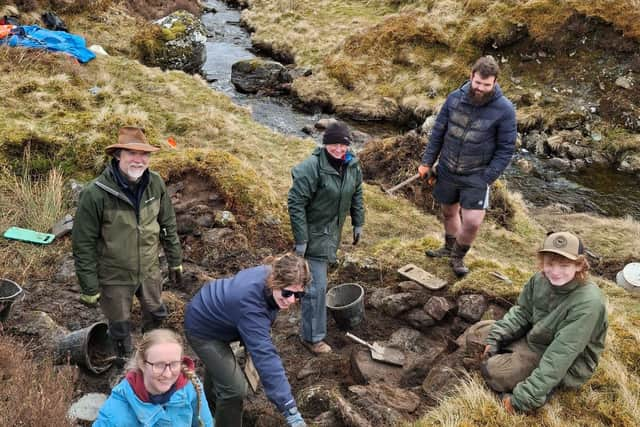
Derek Alexander, head of archaeology at the NTS, said the site illustrated the “battle of wits” that developed between Highland distillers and government excise officers after private distillation was outlawed in the late 18th century.
“If the still had been found by the excise officers, the still would’ve been taken away and destroyed,” he said.
“The fact that we’ve found this connecting piece here suggests the still was dismantled in a hurry and its components whisked away by the smugglers as they dispersed. The connecting piece may have been forgotten in the rush and left behind.
“Distillers of illicit whisky would’ve travelled light and left little trace of their activity, and so a find like this is especially rare and exciting. It gives us a glimpse into an activity that was once rife in the hills of Ben Lawers and which was seen by many as an act of community resistance.”
In the 1780s, unlicensed private distillation, which had existed in Scotland for centuries and on which many Highland tenants relied, was declared illegal. Rather than pay the tax, distillers and smugglers went to great lengths to evade the excise officers, moving their illicit stills and hidden bothies into upland areas to avoid detection.
The latest excavation forms part of The Pioneering Spirit project, supported by The Glenlivet, which aims to uncover forgotten sites connected to illicit whisky production across Scotland. Since its launch, archaeologists have identified around 30 former distilling sites on NTS land, including locations at Ben Lomond, Torridon and Mar Lodge Estate.
A complete copper still from Cortachy, part of the Angus Folk Museum collection, is now displayed at House of Dun, where visitors can also explore a newly created 3D model showing how such apparatus once operated.
Comments
Want to join the conversation? Please or to comment on this article.