
Exclusive:Single helicopter to be on standby in Scotland to tackle wildfires, fire chief confirms
Critics have said one helicopter is not enough to reassure communities.
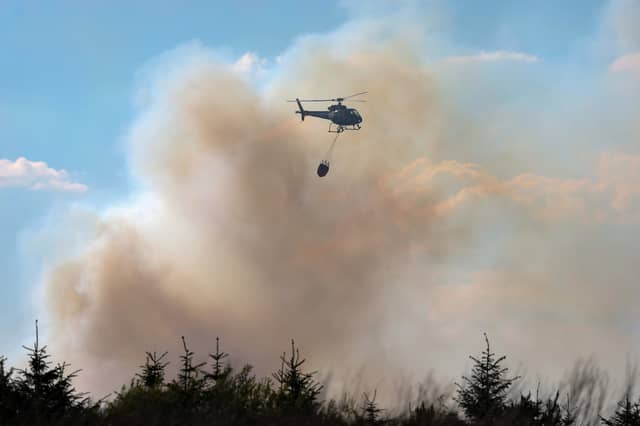


A single helicopter will be on standby to tackle future wildfire incidents in Scotland, The Scotsman can reveal.
The news comes after justice secretary Neil Gray announced earlier this month that standby aerial support would be made available to tackle wildfire emergencies, but failed to confirm the number of helicopters that could be made available during high risk periods.
The Scottish Fire and Rescue Service (SFRS) has now confirmed that one helicopter would be on standby in Scotland until the end of the financial year.
It is still unclear what arrangements will be made thereafter, as peak wildfire season approaches.
Deputy assistant chief officer Kenny Barbour said: “When there is an increased risk of wildfire and a Wildfire Danger Assessment is published, the SFRS will have an ability to place a commercial helicopter on standby.
“This will help reduce delays, however, any deployment will remain subject to operational need, weather conditions, and the decision of the Incident Commander.
“The arrangement, which is in place until the end of the financial year, will strengthen our ability to respond quickly and effectively to serious wildfire incidents, particularly in remote or difficult to access terrain. Helicopters will support and not replace firefighters on the ground by dropping water where it can have the greatest operational effect.”
Aerial water bombing was a key part of the effort to deal with a major blaze in the Cairngorms National Park this summer, but helicopters were not available until about 36 hours after the fire broke out. The wildfire, which burned near Aviemore for almost five weeks, forcing the evacuation of Nethy Bridge, was one of 58 incidents in Scotland this year.


Land managers, including the RSPB Scotland, whose Abernethy Estate was heavily impacted by the blaze, made multiple calls for aerial support before helicopters were readily available to douse the flames. The Cairngorms National Park Authority (CNPA) said the aerial support was "invaluable" for waterbombing hard-to-reach areas during the extensive fire.
While fires are possible year round, the high risk period tends to run between March and May. However in the last two years, the Dava moor and Carrbridge wildfires, which, combined, have been dubbed the worst wildfire incidents in Scotland on record happened in June and July 2025, while the Cairngorms fire started in August this year.
Confirmation that one helicopter will be on standby for wildfires comes after Scottish Conservative MSP Finlay Carson challenged Mr Gray earlier this month on the level of resources to be freed up to tackle the issue.

"This incredible revelation means it was hardly surprising Neil Gray wasn’t forthcoming when I challenged him on this issue,” Mr Carson said.
“The fact that only a single helicopter will be able to be on standby exposes how savage SNP cuts have left fire and rescue services cut to the bone.
“Communities who have been impacted by devastating wildfires will be deeply alarmed that the necessary support will still not be available.
“SNP ministers must urgently work with the fire and rescue service to ensure more helicopters can be on standby and to give reassurance that they are not simply hoping for the best like they did this summer.”
Landowners and gamekeepers have argued that while aerial support can be of help, land management on the ground to prevent wildfires from spreading in the first place is essential to tackle the rising risk.
Some argue “rewilded” land in wildfire-prone areas where no heather burning is used to make fire breaks can increase risk to local flora and fauna.
Cairngorms National Park resident Calum Campbell, who worked as a gamekeeper for four decades, said managing vegetation on the ground through grazing and muirburn is important to prevent extensive damage from flames spreading.
“Scientific studies prove unmanaged heather of 20+ years dries out the underlying peat,” he said.
“This old heather can carry anything from 10-15 tonnes per hectare (ha) of fuel load and will exceed this amount in many cases, compared to 2-4 tonnes of fuel per ha on managed heather moorland.
“This old heather burns hotter and with more intensity, it proves to be more dangerous and is more difficult to extinguish, it is more likely to set fire to peat.”
Mr Campbell, who assisted dousing flames in the Dava and Carrbridge fires, said both were started on unmanaged areas for grouse shooting but spread to grouse moors.
“The difference with the Dava fire was it had a gale force 40 mph wind pushing it along, covering more ground at an increased pace. It burned for four days.
“The Cairngorms wildfire started on RSPB Abernethy reserve where all traditional land management was abandoned something like 38 yrs ago. Sheep and deer were removed, no heather burning to improve the quality of nutrient rich heather which benefits wildlife and livestock which all helped reduce the fuel load.
“Nobody living on this land.
“This fire did not have a 40 mph wind at the outset otherwise it would have been even worse. But this fire burned for five weeks.”
RSPB Scotland said the charity has been looking at what it can do different to prevent further wildfire damage at its Abernethy Estate, including ensuring tracks through the forest work as fire breaks.
A spokesperson for the charity said: “Across our reserves we have been taking measures to prevent and prepare for wildfires for some time including visitor engagement and management, restoring habitats to make them more resilient, and ensuring training and equipment for firefighting is in place.
“The wildfire which significantly impacted our Abernethy nature reserve has additionally highlighted what we can do differently and what actions we can build on to improve our preparedness in future. This includes continuing and increasing the habitat management which helps make the landscape more resilient, such as cattle grazing and wetland restoration, and ensuring tracks through the forest are more effective as fire breaks.
“While the wildfire and its impacts have been devastating, a positive outcome has been people from many different land use backgrounds working tirelessly together and we hope we can continue to strengthen these relationships going forwards, with support from Scottish Government, as we all face the growing threat of wildfires.
“Helicopter support was vital in tackling the blaze. We will await to hear further information about what the arrangements will be in future.”
Justice Secretary Neil Gray said: “This month, I announced that SFRS will now place helicopters on standby when a wildfire danger alert is issued. The Scottish Fire and Rescue Service has noted that this will strengthen its ability to respond quickly and effectively to serious wildfire incidents.”
Comments
Want to join the conversation? Please or to comment on this article.