
SNP ministers issue long-awaited decision on controversial powerline on Scotland's most visited island
Community groups have said they fear the upgrade will attract more windfarm applications.

Controversial plans to upgrade a powerline stretching across Scotland’s most visited island have been given the go ahead.
SSEN Transmission, the developers behind the grid infrastructure upgrade, lodged plans to improve the overhead line between Skye and Fort Augustus.
These were objected to by Highland Council in 2023 and the decision has been sitting on ministers’ desks ever since.
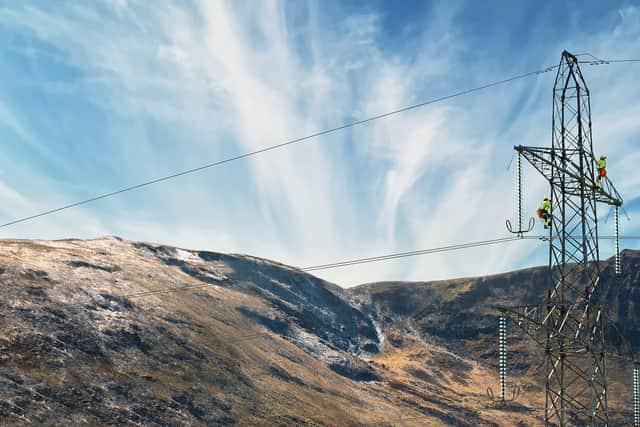

The Scottish Government confirmed on Monday that SSEN Transmission’s plans to replace the “outdated infrastructure” have now been approved.
Community groups on Skye, who have called for a pause on further windfarm developments on Skye, said they were disappointed by the move.
Residents have argued it could be seen as “a presumption from the Scottish Government that all the windfarms proposed for Skye will be built.”
There are currently some nine new windfarm developments for the island that have either been approved, are in planning or to waiting to be extended or repowered, including one which is due to go under inquiry later this month.
SSEN insisted the existing, single circuit overhead line is fast reaching the end of its operational life, with its replacement “critical” to maintaining network reliability and security of supply for homes and businesses in Skye and along the line’s route, and in the Western Isles, which is currently supplied by two subsea electricity distribution cables.

'We are deeply concerned' - Calls to freeze Net Zero projects with eyes on Skye for windfarm inquiry
The company said the power line is currently “operating at its capacity limit, preventing the connection of new renewable electricity in the area” and that its replacement will have a greater capacity for new renewable electricity generation.
Dr Andrew Robinson, a spokesperson for the Skye Wind Farm Information Group (SWIG), which has over one thousand members, said: “We are deeply disappointed to learn that the Scottish Government have today granted planning permission for the Skye Reinforcement Overhead Line.
“The Highland Council objected to the plans in November 2023. As the local planning authority, such an objection would normally trigger a public inquiry, but, instead planning consent has been given and the council’s objection ignored.
“This is a failure of democracy.
“The power line brings with it pylons, quarries, trenches and giant substations at Edinbane and Broadford. The two workers camps proposed either side of Broadford village, housing up to 800 workers are only needed to build the power line and the substations.
“These should have been included in the original planning paperwork for the OHL but instead have been salami sliced into separate applications.”
The group has argued SSEN’s upgrade to the current infrastructure “will be much larger, at a size only necessary to take the electricity from all the wind farms proposed for Skye.”
Dr Robinson added: “Other options to build a smaller scale line, replacing the existing infrastructure and allowing some extra capacity for smaller scale community owned wind farms were never properly considered.”
Industry bosses have long spoken about their frustrations with the Scottish Government’s delays when consenting on projects, including the powerline upgrade.
Earlier this year, Scottish ministers committed to a new 52-week decision making period on priority applications for transmission infrastructure.
Rob McDonald, managing director of SSEN Transmission, welcomed the Scottish Government’s decision for Skye after what has been about a two hour wait for the company.
He said: “We trust that the Scottish Government’s new guidance, setting out a 52-week determination period, will see future projects progress in line with the acceleration needed to achieve the country’s clean power mission.
"As we now move to the delivery phase of the project, we are committed to working constructively with local communities and businesses to minimise and mitigate construction impacts, alongside maximising the economic, infrastructure and job opportunities this investment will bring."
Highlands and Islands MSP Jamie Halcro Johnston said the move showed a decision made by the council, who local communities elected, was “overruled by Scottish Government officials in Edinburgh.”
The Conservative politicians said: “This is a story repeated across the Highlands and Islands where, time and time again, local democracy is ridden roughshod over and all just to meet SNP renewables targets.
“It is part of a concerning pattern of centralised decision-making that suits the government in Edinburgh and large energy companies, but which sidelines local communities.
“Highland Council’s rejection of the project last year reflected the very real concerns of those living in the affected areas.”
A Scottish Government spokesperson said: “This project will replace outdated infrastructure to ensure security of energy supply to the residents of Skye and the Western Isles, and increase provision of renewable energy to the system.
“Ministers have decided the benefits of protecting the security of electricity supply for around 32,000 homes and businesses, as well as providing additional capacity to connect renewable generation projects means that consent should be granted to this application.”
Comments
Want to join the conversation? Please or to comment on this article.