
Scottish ministers' commitment to new guidance could see fish farms prosecuted for poor welfare

While demand for salmon continues to grow, pressure mounts to keep the welfare of farmed fish in check
The Scottish Government has committed to introducing robust welfare guidance for farmed fish which could see businesses penalised for not adhering to it.
Animal campaigners have argued current guidance for fish welfare is too vague, making it easy for fish farms to cover up poor conditions or treatment of the animal.
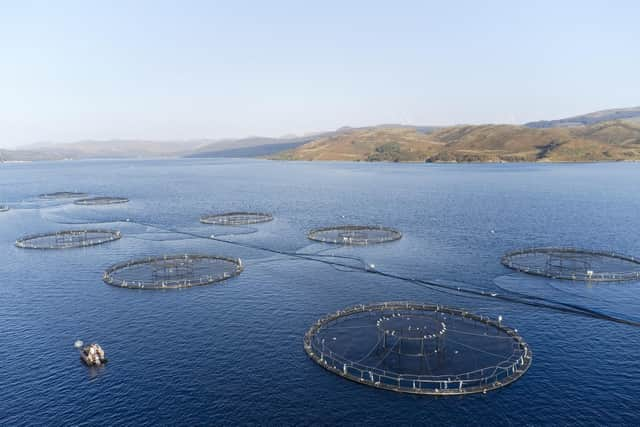
Undercover footage on some Scottish fish farms has prompted welfare concerns, with activists claiming there is overcrowding in sea cages, aggression, fin damage, and increased susceptibility to diseases. They also argue lice infestations are a major problem, causing painful lesions and requiring treatments which can themselves also negatively impact the fish.


Animal Law Foundation (ALF), a legal charity looking into neglected areas of animal law, said no prosecutions have been brought for welfare breaches on Scottish fish farms, and no official care notices under the Act have been issued.
Rural affairs secretary Mairi Gougeon confirmed the Scottish Government’s commitment in a letter to the Holyrood’s Rural Affairs and Islands Committee last week.
She said: “A number of options for progressing standards of farmed fish welfare have been explored.
“Following this review, we intend to introduce official guidance under Section38 of the Animal Health and Welfare (Scotland) Act 2006 as a pragmatic step in the progression of farmed fish welfare standards.”

The development comes after the Committee published a report earlier this year with recommendations following its inquiry into salmon farming in Scotland.
Some of the recommendations included giving more power to the Fish Health Inspectorate, or other relevant bodies, to limit or halt production at sites which record persistently high mortality rates.
Calls have also been made to improve Scotland’s Aquaculture website, which has been described as out of date and difficult to navigate, for transparency and accessing data.
Details on what exactly the official guidance will be is yet to be given.
The commitment comes after two years of the ALF calling for more stringent guidelines that are enforced in practice.
The charity said there are currently three pieces of legislation that protect fish: the Animal Health & Welfare Act 2006, the Welfare of Animals (Transport) (Scotland) Regulations 2006 and the Welfare of Animals at the Time of Killing Regulations (Scotland) 2012.
The only official guidance in place under the legislation relates specifically to the welfare at the time of slaughter.
In other stages of the fish’s life, campaigners argue the law currently lacks guidance on how to meet requirements, such as “avoiding unnecessary suffering” that without guidance is hard to define.
The Scottish Government said the new guidance will compliment the official guidance relating to time of slaughter, which was passed earlier this year, and apply to other stages of production.
ALF’s executive director, Edie Bowles, said: “This is a huge step in giving practical effect to the legal protections that exist and protecting millions of fish more effectively. We are glad to see the Scottish Government taking the welfare of fish seriously and responding to repeated calls for clear, enforceable welfare standards.
“We look forward to working with the government to produce robust and workable guidance.”
The move saw backing from SNP Highlands and Islands MSP Emma Roddick who previously talked about speaking to fish farmers who are committed to high standards but find it challenging to know what is legally expected of them without official guidance.
Ms Roddick said: “We are pleased that the Scottish Government has finally recognised that official guidance is needed to protect farmed fish and cleaner fish throughout their entire lifecycle.

“This guidance must clearly explain what the welfare laws mean to assist farmers and enforcement agents alike – it should never have taken so long to ensure that the welfare laws that protect fish are understood and enforced in practice.
“There is, however, much more work to be done to protect the welfare of fish in Scotland, not just the salmon that are being farmed, but also the cleaner fish that are used to remove the sea lice.”
Salmon Scotland, the voice of the Scottish salmon sector, insisted welfare standards are already up to scratch.
A spokesperson for the organisation said: “Scotland’s salmon farmers already operate to world-leading welfare standards, as well as strong regulation, with regular farm audits and inspections taking place.
“Survival rates, which are voluntarily published, are at record highs, and more than £1 billion has been invested in innovation, veterinary care, technology and stock management to continually improve welfare.
“We support clear, evidence-based guidance that recognises these high standards and helps ensure Scotland remains a global leader in responsible, sustainable farming.”
Meanwhile, Prime Minister Sir Keir Starmer’s trade visit to India this week saw Scotland’s salmon market benefit from a new free trade deal.

Tariffs on salmon exports will be cut from 30 per cent to zero.
Tavish Scott, chief executive of Salmon Scotland, said the move paves the way for exports worth tens of millions of pounds every year, creating inward investment and jobs in Scotland.
India is the world’s third-largest fish market, with domestic use reaching nearly 12 million tonnes in 2021 — up 120 per cent since 2005.
Although most fish eaten in the country is currently locally sourced, imports focus on premium seafood in major cities such as Delhi and Mumbai, with Scottish salmon falling into more high-end market.
Mr Scott said: “With tariffs set to fall from 30 per cent to zero, Scottish salmon can reach a whole new market while boosting growth at home.
“We’re working closely with the UK Government and Indian partners to make sure our premium salmon reaches more tables across India – supporting coastal communities and showcasing the UK’s top food export.
“This is a real chance to strengthen ties between our two countries and share Scotland’s world-class produce with a growing market.”
Salmon Scotland said there has been a recent boom in the Asian market. The organisation said exports to China were up 60 per cent last year and volumes to Taiwan more than doubled – contributing to record international sales of more than £840 million.
Comments
Want to join the conversation? Please or to comment on this article.