
Land Reform Bill: What is changing on land ownership? How has rural Scotland responded? Criticisms?
Previous Land Reform Acts introduced ‘right to roam’ and made significant changes to the community right to buy

It has been years in the making, but Scottish ministers finally published their long-awaited, yet highly disputed, set of land reforms they hope will create fairer and more transparent landownership in Scotland.
After a series of marathon debates that involved almost 400 amendments being lodged, the Land Reform (Scotland) Bill was passed on Wednesday night, with 85 supporting, 28 in opposition and nine abstaining.
The paper has received significant criticism from key groups in rural Scotland, including estate membership organisation Scottish Land & Estates (SL&E). Leading lawyers have also described the Bill as “junk law”.
Dedicated land campaigner Andy Wightman, who is in favour of radical land reform and author of the Who Owns Scotland blog, described the Bill as “the latest in a series of policy failures”.
Community land ownership campaigners welcomed some aspects of the legislation, but insisted the provisions do not go far enough to achieve its aims of diversification.


What is current land distribution like in Scotland?
There is not yet a complete and definitive register of who owns every part of the country.
The largest landowner in Scotland is the public. Some 11 per cent of the land is under Crown Estate and public ownership - equivalent to around 857,000 hectares (2,117,693 acres) - according to the latest official figures.
The data showed in 2022, the latest figures available, some 3 per cent of land is registered under community ownership, which amounts to about 472,688 acres. Meanwhile, about 2.5 per cent was owned by third sector/NGOs such as the National Trust for Scotland, John Muir Trust and RSPB.
According to Mr Wightman, about 83 per cent of land in Scotland is privately owned. The former Green MSP said half of that land is owned by just 433 people and companies, with green capital investors becoming increasingly dominant.
Mr Wightman’s analysis shows hereditary peers own less land than previously recorded, while the number of private investors who specialise in financially lucrative “green capital” schemes, including forestry projects and carbon credit initiatives, has surged.
Exeter-based financial firm Oxygen Conservation, for example, recently acquired the 10,000-acre Kinrara Estate after purchasing the 15,000-acre Dorback Estate earlier this year, adding to its portfolio of more than 50,000 acres across 13 sites in the UK.

The largest private landowner in Scotland is Danish billionaire Anders Povlsen, with more than 89,000 hectres (220,000 acres) across 13 estates. Land campaigners claim the second largest is investment firm Gresham House, which is now owned by a private equity firm headquartered in New York, through the partnerships the body controls, owning around 73,500 hectares (181,700 acres) across the country.
Other large landowners include the Church of England, which reportedly bought up some 32,000 acres of forestry in 2014, mainly in Scotland.
What is land reform and what is included in the newly-passed Bill?
Land reform timeline
Scotland has had two Land Reform Acts over the past two decades.
In 2003, the Land Reform (Scotland) Act 2003 created the community right to buy rural land, established the crofting community right to buy - even without a willing seller - and gave the public statutory rights of access to most land and inland water in Scotland - the “right to roam”.
The Land Reform (Scotland) Act 2016 expanded transparency of land ownership, strengthened community right to buy powers, including for neglected or abandoned land, and established the Scottish Land Commission - a public body to drive further land reform.
The new Bill
The latest Bill is split into two parts.
The first part of the paper aims to change the concentration of land ownership by strengthening community involvement and ownership.
The paper’s provisions strive to break up “large landholdings” - bigger than 1,000 hectares/2,470 acres - as well as give communities a greater say in what happens on privately-owned land and increase opportunities for community buy-outs.
The Bill includes a requirement for a "transfer test", which would ensure the sale or transfer of a “large landholding” cannot be completed without owners first applying to ministers for a decision on whether to sub-divide the land into "lots".
Under the legislation, ministers would in turn notify community groups, offering them the chance to buy the land.
The Bill would also require owners of “large landholdings” to give more detail on what they are doing with their land under new Land Management Plans (LMPs). This includes demonstrating how the land will be managed, engaging with local communities, and contributing to national goals like net-zero emissions and biodiversity. Failing to do so could result in land owners being fined up to £40,000.
Ministers said the aim of such a penalty is to encourage more transparency in land ownership. But critics have said the “punishment” is “totally unjustified and out of proportion”, pointing to no other business owner or property requiring such regulation.
The second part of the Bill deals with agricultural and environmental uses of leased farm land. The legislation aims to modernise how new small landholdings are created and operate, protecting their rights and helping new entrants and the next generation of farmers to get access to land.
The Bill includes a clearer tenant’s right to buy land under certain tenancies with a registration of interest. New statutory procedures and notice requirements under a fresh resumption regime could also be applied when a landlord wants to resume (take back) part or whole of a 1991 Act tenancy.
The Bill will also see the development of a Land and Communities Commissioner to oversee, investigate and report on some of the legislation’s key aims.
What are the criticisms of the Bill?
Legal problems
Legal experts have warned the Bill has been badly worded in parts, with claims of vague language, cross-referencing of multiple Acts and placing much of the detail into future secondary legislation rather than within the Bill itself.
Don Macleod, head of land and property at law firm Turcan Connell, called the Bill "junk" and “an appalling mess that deserves no place on the statute book of any Parliament”. He said the ambiguity in the legislation, for example over the definition of a "large landholding", could make the law impossible to implement.
Last month, in “an unlikely but united alliance”, Mr Macleod, who works on behalf of landowners, and Mr Wightman, two figures at opposite ends of the land reform debate, were in agreement over “serious practical and legal challenges” in the Bill.
Mr Wightman said: “This Bill will do next to nothing to reduce or have any influence on the pattern, whether concentrated or otherwise, of private landownership in Scotland.
“MSPs can pass all the stage three amendments they like to vary the scope, criteria, qualifications and definitions of parts of the Bill, but it will make no meaningful difference to the distribution and ownership of land in Scotland.
“The complexity and administrative changes in the Bill would be worthwhile if they led to significant change. But they won’t.
“I said at the beginning of this process that it would be irresponsible of Parliament to impose new, complex, legalistic and bureaucratic mechanisms on the people of Scotland that will not deliver the outcomes that ministers say that they will. That is just making bad law. I stand by that today now the Bill is passed.”
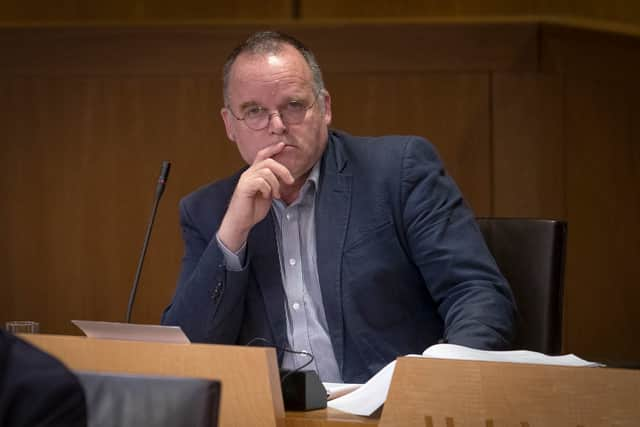
Patrick Colquhoun, assistant chief executive of Luss Estates, which owns almost 50,000 acres of land around Loch Lomond, said the legislation could lead to an "infringement" on property rights.
Mr Colquhoun, who is also vice-chairman of SL&E, previously said he feared the definition of a large landholding could be reduced in future, with the Government already being pressed to reduce that down to 500 hectares.
Rural sector against it
SL&E said the quoted “large landholding” threshold “is arbitrary” and too broad — sweeping in many holdings which may not present the issues the Bill aims to address.
Even the Parliament’s own net zero energy and transport [NZET] committee highlighted the absence of a clear, evidence-based rationale for the threshold, and a lack of a clear definition of a “large landholding”.
Both parties also pointed to issues with “lotting”. The NZET committee warned at stage one the measures as drafted would fail to achieve the Scottish Government’s stated aims and could deter much needed investment across rural Scotland.
SL&E claims these provisions would be counterproductive to Scotland’s priorities for climate change, nature restoration, food production, housing and community sustainability by inhibiting the ability to deliver on these targets. The organisation pointed to evidence from BiGGAR Economics showing scale is a key driver of the delivery of these benefits within the timescales required.
Confor, a membership organisation that promotes forestry and wood-using businesses, echoed lotting concerns, saying the process would “risk severely undermining the scale at which woodland creation and sustainable forestry management can take place”.
Stuart Goodall, Confor’s chief executive said: “Fragmentation of landholdings would make it more difficult to deliver the large-scale projects necessary to achieve Scotland’s woodland creation targets, and will increase costs, reduce efficiency and threaten investment in the sector.”
The National Farmers Union Scotland (NFUS) has called for the threshold for “large landholdings” to be increased to 3,000, a figure previously noted in the Bill, to “ensure family farms are not unnecessarily captured” and to “remove the lotting proposal from the Bill until full modelling and impact assessments are completed”.
The NFUS also called for the Land and Communities Commissioner to remain advisory rather than regulatory. Meanwhile, Community Land Scotland (CLS) said the large landholding figure was too high or too loosely drawn, meaning the Bill may fail to address some of the larger more influential landowners.
So, who supports the Bill?
The Scottish Tenant Famers Association (STFA) said the Bill would “secure a more resilient tenanted sector in a rapidly changing rural landscape”. STFA chairman Christopher Nicholson said the legislation “ensures a level playing field for tenants by addressing the current barriers facing tenants undertaking environmental diversifications”.
He said the new “lotting” rules “should put an end to the current practice of private ‘off-market’ sales of large estates, often to speculative green investors, with no opportunity given to tenants or other occupiers to purchase all or part of their holdings.”
STFA backed the idea of a Land and Communities Commissioner.
CLS said it welcomed the “lotting” provisions, saying the policy was “one of the most potentially impactful interventions within the Bill”. The organisation said prior notification for sale of “large landholdings” was also “an important step forward for increasing oversight and knowledge of land transactions in Scotland”.
CLS said future legislation should include “further scrutiny” of land ownership and “establish a public interest test on buyers of land in Scotland”.
However, a statement from CLS read: “While we welcome many of the mechanisms within the Bill, we must also recognise that it does not go far enough to meaningfully intervene in the land market and change the fundamental inequality of landownership in Scotland.”

Rural affairs secretary Mairi Gougeon insisted the new law would bring in “substantive changes”. She said “responsible land owners will have nothing to fear” and the passing of the Bill marked “a watershed moment”.
“The measures in this Bill show that change is possible, that we can build a better future, allowing communities to breathe new life and new opportunity in rural Scotland,” she said.
What has been the political reaction?
Scottish Conservative’s Tim Eagle said rural Scotland would be “deeply concerned” about what lies ahead.
The MSP for Highlands and Islands said: “This is the latest example of an unworkable and devastating piece of SNP legislation that will severely damage rural Scotland, just like previous land reform bills.
“SNP ministers had a perfect opportunity to listen to the concerns of those who drive our economy in rural Scotland throughout this debate, but typically decided they know what’s best.
“There is no doubt, not just in my mind, but the minds of experts in the field, that measures imposed by the SNP will have the opposite effect to what they claim, and will damage rural businesses and reduce the land available for rent.”
Other parties argued the reforms did not go far enough.
Scottish Labour’s Rhoda Grant said: "We support any improvements to Scotland's land management, but this weak Bill is largely tinkering around the edges. The only significant change is to introduce untested lotting provisions and to take steps to stop off-market sales."
Scottish Greens’ Ariane Burgess said ministers had shown a "lack of ambition to deliver the real land reform that is so vital".
The next stage is for the Bill to head to Royal Assent. In the meantime, there is an opportunity for legal challenge, which The Scotsman understands is being considered by some parties.
Comments
Want to join the conversation? Please or to comment on this article.