
How one country's decision to 'close for maintenance' made it more popular and forged bonds for life
In a place where the land has always shaped life, the Faroe Islands’ answer to overtourism is quietly radical: close the gates, pick up a shovel and belong, if only for a weekend.

The Faroe Islands have long been known for having more sheep than people.
Less familiar is their growing struggle with a different kind of wanderer in the hills: tourists.
In recent years, the 55,000 residents of the North Atlantic archipelago have watched visitor numbers swell to almost three times the size of the local population.
From cruise ship passengers to hikers and photographers, around 130,000 tourists now arrive annually, many drawn to the islands’ steep mountains and treeless, rolling landscapes.


While the surge has brought economic opportunity, the islanders have witnessed environmental strain in areas often far from where most Faroese people traditionally travel.
Concerned about erosion and long-term damage, the Faroese authorities decided on an unusual response.
Rather than charging access fees or limiting numbers, the country launched a scheme called “Closed for Maintenance, Open for Voluntourism.”
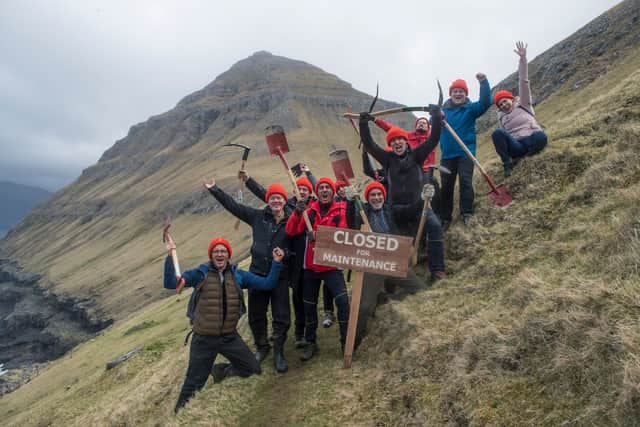
For one weekend each spring, some of the islands’ most popular sites are closed to regular tourists and reopened only to a select group of “voluntourists”.
Around 80 international participants are chosen to provide labour for two and a half days in exchange for food and accommodation, supplied by local communities and businesses.
Since the initiative began in 2019, the country’s tourist officials said demand has been overwhelming.
Tens of thousands of people have applied to take part, with around 15,000 applications submitted last year alone.
The work varies depending on what is needed and the location. Voluntourists may be repaving or building footpaths to cope with rising hiker numbers, erecting stone cairns to guide walkers, or restoring ruins and heritage sites.
They are divided across a number of projects and coordinated by local groups, including tourist offices and farmers.

“When Faroese people used to go into nature, it was to collect seabird eggs, to gather food or to tend their sheep,” said Alda Magnusardóttir Egilstrøð, who works for Visit Faroe Islands, the organisation that oversees the programme.
“It’s very new for us that people are walking all over the mountains for leisure. We never really thought mountains needed paths.
“Suddenly people were walking everywhere and we realised we had to do something.”

The scheme is funded by the Faroese government, which allocates 2,500 Danish kroner (approx £295) per participant to cover costs. Volunteers pay for their own travel and paperwork, but everything else is included.
“It means people come who might never have visited the Faroe Islands otherwise,” Ms Magnusardóttir Egilstrøð said.
Applicants range from students to retirees, with a strong interest from photographers, nature lovers and people who work in national parks.
“This year, about half of the applicants work in IT, which is an interesting development.”

While local buy-in to the programme was not immediate at the start, Faroese people are very much part of the initiative.
“It was hard to get locals onboard at first, but now they really love it,” Ms Magnusardóttir Egilstrøð added.
“Other countries argue about who should pay for maintenance. We’ve avoided that debate by bringing in hands, and farmers are often involved too.”
Beyond the physical improvements to the landscape, organisers say the programme’s real legacy lies in the relationships it creates.
Kristina Gry Berg, from Visit Eysturoy in Fuglafjørður, has overseen maintenance projects in her area.
“The best thing about this programme is the connection between people — between Faroese and visitors, but also among the foreigners themselves,” she said.

Groups are deliberately mixed, often with no two volunteers from the same country.
“It creates awareness, camaraderie and friendships between people who may never have visited each other’s countries before,” Ms Gry Berg said.
“People have met their partners through these projects and go on to see each other in their own countries as well as coming back to the Faroe Islands.
“You are not just a tourist and a local. You are people working on something that brings you together.”
Applications for 2027’s programme will open at the end of this year (2026).
Comments
Want to join the conversation? Please or to comment on this article.