
Highlands renewables debate set for Westminster and Holyrood after 11 politicians back 'urgent calls'

Momentum is building to put pressure on the UK and Scottish Governments to debate the future of renewable projects in the Highlands.
A convention calling for “urgent debate” on renewable energy projects in the Highlands has won backing from eleven politicians.
Some 57 community councils gathered in Inverness to encourage policy makers to take residents’ concerns to Holyrood and Westminster.
The packed-out convention on Tuesday was the second of its kind.
Read more: Scots living near new pylons would get £250 a year off household bills for 10 years under UK government plans


The event’s aim was to persuade policy makers to recognise the value of community councils and their role in local democracy and to push for “urgent debates” on Net Zero-related projects in the Highlands in the debating chambers in both Edinburgh and London.
Scottish Energy Secretary Gillian Martin and energy minister for the UK government Michael Shanks were invited, but both turned down the invitation.
Follow Hay’s Way updates via Katharine’s Instagram page and by signing up to her free Scotsman Rural newsletter here.
Eleven MSPs and MPs in attendance signed a statement backing the move, including Labour MP Torcuil Crichton, SNP MSPs Maree Todd Emma Roddick, Scottish Conservative MSPs Edward Mountain and Douglas Ross, Tim Eagle, Jamie Halcro Johnston, Scottish Lib Dems Angus MacDonald and Jamie Stone and Independent MSP Fergus Ewing.
The signed document included calls for the Scottish Government to undertake a planning inquiry commission to address the cumulative impact of all major renewable energy infrastructure developments and a pause on all applications until a clear national energy policy is in place and an economic impact assessment undertaken.
Conservative councillor Helen Crawford, who has led both conventions, said the community councils represented recognise the impact of climate change but “oppose an unjust and unnecessary industrialisation of the Highlands.”
Read more: 'New game, old rules': How Scottish communities should benefit from net zero project rush
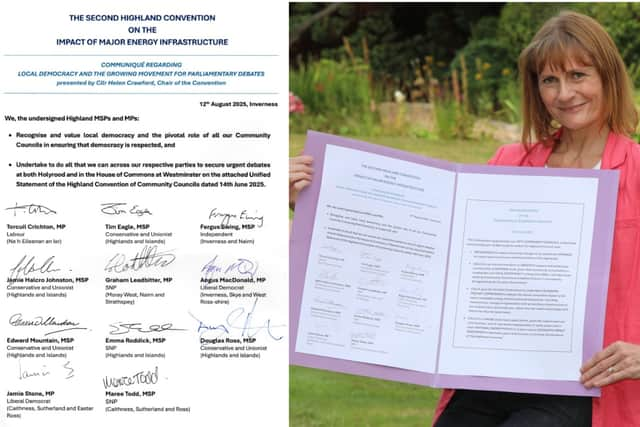
Speaking to The Scotsman after the event, Ms Crawford said: “The convention was a step forward for local democracy.
“I’m delighted that this important communique, which I drafted after listening to community councils for many months, has been signed cross-party by 11 Highland MPs and MSPs.
“That’s a significant cross-party commitment to respect local democracy and get the convention’s unified statement debated urgently in both Holyrood and Westminster.
“It’s now up to our MPs and MSPs to secure those debates. And to fully address the need for a pan Scotland Planning Inquiry Commission so that the full cumulative impact of all of these major energy applications can be assessed, rather than the current piece meal approach.
“And to pause while both Governments do their homework - and publish a standalone, holistic national energy policy.”
It comes after John Swinney responded to a letter signed by 40 different community groups across Scotland calling for a moratorium on major renewable developments.
The first minister rejected these calls, saying there is “a pressing need to increase our renewable generation capacity”, with electricity demand expected to increase.
Last week, the UK Government announced those living near new pylons, including Scots, would receive £250 off energy bills each year for a decade under UK government plans.
The Department of Energy Security and Net Zero is launching a consultation into proposals included in the Planning and Infrastructure Bill to provide payments to households affected by the new pylon developments.
Households within 500m - a third of a mile - of new or upgraded electricity transmission infrastructure could receive a discount of up to £250 via their electricity bill every year for ten years, totalling £2,500. The discounts, which would be assigned to the home, and applied to the occupant, could be provided in instalments of £125 every six months.
Campaigners have branded the offering “an insult” saying the figure is not adequate when it comes to compensating residents having to live near such developments.
Comments
Want to join the conversation? Please or to comment on this article.