
Hay's Way: An island that held me like a local and the legacy of Stuffy the Squirrel

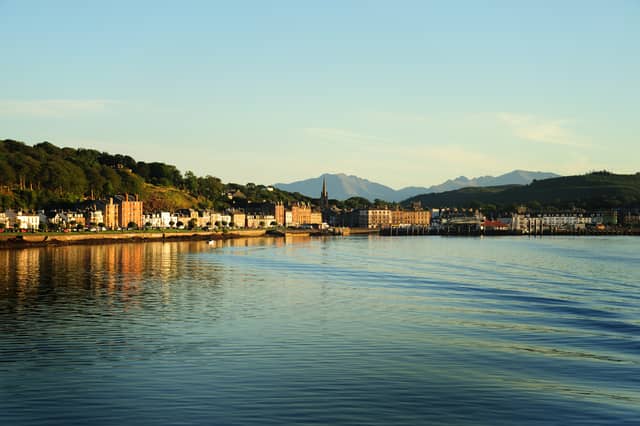

There’s no welcome like a Bute welcome, writes Katharine Hay
Sitting shoulder-to-shoulder with session musicians, squeezing away at an accordion lent to me by a local man named Robbie, was one of my first experiences on the Isle of Bute. After several days on the island, I realised it was also a quintessentially Bute experience.
The Anchor Tavern, a pub in the village of Port Bannatyne, was bought by the community in 2022, saving it from ruin. It is the village’s only pub, and the people who rescued it now sit there together and drink together too.

A favourite haunt for locals — among them a circle of loyal, gifted musicians — it also draws sailors fresh from the sea, one elbow on the bar, swapping stories of weather and travel. One attempted to chat me up when I arrived, but before long an instrument had been thrust into my arms and I was folded into the evening’s session all night.

A visiting musician from London, Alex Hungerford, who is part of a band called Canada Hill rocked up and rocked he did, playing Dylan classics and a portfolio of Blues. Coincidentally, the island’s main town of Rothesay backs onto a hill called Canada Hill, historically famous as the vantage point where locals watched emigrating relatives sail for Canada. It offers breathtaking panoramic views of the Firth of Clyde, Kyles of Bute, and Ayrshire. I never found out if Alex’s trip to the island was deliberate given the landmark but it could well have been just down to serendipity. Bute is that sort of place.
Perhaps not, though, if you are Frankie the red squirrel.

Otherwise known as “Stuffy”, thanks to his current taxidermied state, the unfortunate rodent that lives in a glass frame in Bute Museum met his end in 2005 outside Mount Stuart, the vast Victorian Gothic mansion that remains one of the island’s most popular attractions. In the early 18th century, the palace was built over a period of 21 years by the 3rd Marquess who, at the time, was considered to be one of the richest people in the world. Built with 117 rooms, a full-size chapel and a marble swimming pool, you can see why.

Still, Frankie’s death was not entirely in vain. His discovery helped spark efforts to discover and protect Bute’s long-rumoured but then confirmed red squirrel population. Despite no further sightings for almost two decades, local wildlife photographer John Williams captured an image of a living squirrel in 2022, proving the species still survived on the island. The sighting prompted the creation of the Bute Red Squirrel Project, an initiative aimed at helping the native population recover. Crucially, Bute appears to remain free of invasive North American grey squirrels.
Dr Rebecca Synnott, one of Ireland’s leading scientists working in the field of red squirrel genetics, obtained a grant to run a two-year project in 2025 and 2026 to study the genetics of Bute’s red squirrels.
“We used hair tubes to collect samples of red squirrel hair,” Dr Paul Unwin, the president of Bute Museum, tells me. He said the hair follicles yield enough DNA to answer questions about the relatedness of squirrels, both within woodlands and between the different woods.
“The analysis can also tell us about the origins of our squirrels and if they are carrying diseases.
“From the genetics project we will get recommendations about the practical conservation measure we can take to help our red squirrels thrive.”
The project founder, Dr Malcolm Newdick, said the motivation is to find out whether something is holding back Bute’s red squirrel population.
“Are they all close relatives perhaps, because they are descended from just a few squirrels that have arrived on Bute?” he said. “Are they trapped in isolated patches of woodland, unable to cross the open ground between the woods? Or maybe there simply isn’t a wide enough range of food sources to allow the population to expand.”
The red squirrel craze is an echo from the Victorian ages when bags of them were bought at markets to repopulate woodlands with the native breed, Dr Unwin tells me. Some Victorians, he added, simply kept them as fashionable pets.
Pulling into the ferry terminal at Rothesay on either MV Argyle or MV Bute, “one driven by Captain Pugwash, the other Jack Sparrow,” a local tells me, it is difficult to shake the sense that Bute remains suspended in that era with the eclectic architecture lining the town’s front. Even the terminal is home to an 1899 Victorian toilet block where the men’s facilities are widely celebrated as the most beautiful public lavatory in the UK. The chamber of green-marble urinals and intricate ceramic floors make a pleasant attraction despite the unglamorous purpose they serve.

But to fixate on Bute’s Victorian charm would be to miss out on a richness to the island’s culture that doesn’t only come from an aristocrat’s legacy or ornate pissoir.
Nestled among the wall of Victorian architecture than lines Rothesay seafront sits Café Tazza, painted an unapologetic shade of baby pink. Inside, the Syrian café serves traditional home baking and all-day breakfasts fragrant with Za'atar.

Over the past decade, Bute has welcomed more than 100 Syrian refugees fleeing the civil war under Bashar al-Assad. Many have since established businesses, raised families and settled permanently on the island. Figures published last year showed that among the roughly 125 Syrians living on Bute, 17 babies had been born to those families.
Although the fall of Assad’s regime has revived hopes of returning home for some, many islanders told me the Syrian community is now simply part of Bute itself—no longer newcomers, but locals.
Back in The Anchor, Robbie tells me the accordion he leant me belonged to his late wife and that it had not been played in years. We bumped into each other again at another session in Rothesay a couple of days later where we sang together. It didn’t take much for me to feel like a Bute local myself.
Comments
Want to join the conversation? Please or to comment on this article.