
Hay's Way: A walk through the villages of Loch Lomond under a tourist eclipse
Hay’s Way continues along the banks of Loch Lomond through villages lining one of the country’s busiest tourist spots.

The only pub in Arrochar had stopped serving food by the time I had set up camp in the village.
It was about 7.30pm on a dreary, wet April evening, the kind where the rain seems to hang in the air rather than fall.
I’d hoped it was early enough to find somewhere to eat, having not stocked up on supplies. Luckily, after walking down the side of the poorly-lit A83 through the village, I spotted a takeaway place open until 9pm.


“There’s not a lot going on round here,” the woman behind the counter said to me as I sat waiting for my fish supper. The nearby Loch Long Hotel certainly didn’t give the impression anyone was in when I walked by it, eyeing up somewhere for next morning’s breakfast.
Arrochar is where I have reached on Hay’s Way, my ongoing walk around Scotland as I document rural life. The village sits to the west of Loch Lomond and at the tip of Loch Long. Nestled among the high, looming mountains of the Arrochar Alps, it is a popular location for climbers and hill walkers given its road and rail links. The Arrochar & Tarbet train station was featured in a 2023 ScotRail advertising campaign because of its picturesque and peaceful location, one local told me, with a twinkle in his eye.

But in the same breath, the man, who was born and bred in the area, lamented times gone by in the place he grew up.
On a stretch less than a mile long between the village’s filling station and a former bank building, the resident said there are more than two dozen holiday homes, at least.
The old RBS branch is now a holiday let and the Post Office was closed and relocated to the village hall, where it functions as a pop-up service just once a week.
“There are only 29 pupils in the school now,” he added, shaking his head.
A report released earlier this year confirmed Arrochar’s school roll is 46 per cent down compared to what it was in 2021/22. The decline reflects a broader pattern of shrinking school rolls across rural Scotland, where young families are becoming fewer and farther between.
The proliferation of Airbnbs and second homes in Scotland’s dramatic, scenic locations and how that can slowly chip away at rural resilience, is certainly not unique to Arrochar. It is a pattern well established across many parts of the Highlands and islands. Even in the more populated region of Fife, walking through the seaside town of Elie in winter has a ghostly feel. It is estimated that between Elie and neighbouring Earlsferry, as many as three quarters of properties are either second homes or holiday lets.

On my way to Arrochar, I camped in a village that felt livelier, though its energy was heavily dominated by tourists moving through it.
Luss, a conservation village on the banks of Loch Lomond, is home to some 120 people. One of its car parks accommodates 250 spaces alone. The village expects some 750,000 visitors a year, a number that feels almost implausible until you see the steady stream of coaches and cars arriving daily from the A82 and its roaring traffic running up the west side of the loch.

I camped in Luss campsite for several days and worked from hotel lobbies and the village hall. At one point, to make the most of being near facilities before heading further into the depths of Argyll and Bute, I took myself off to the Luss General Store in the hope of finding some staples and new shoelaces. A ‘general store’ it was not, but rather more a boutique and deli boasting luxury items, gifts and upmarket produce. A separate Village Shop stocked basic food supplies behind piles of tartanised tourist tat.

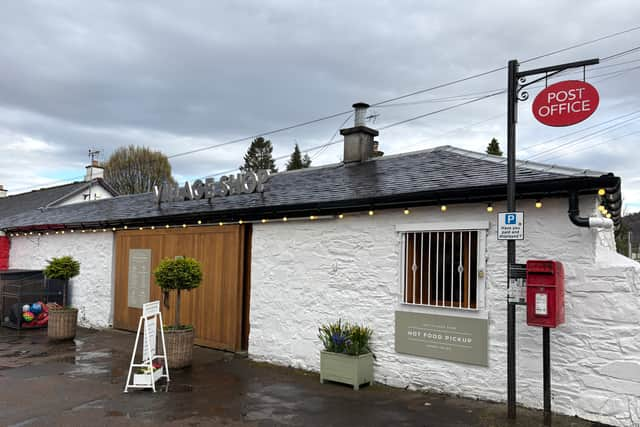
There was something faintly ‘toy-town’ about Luss. The careful preservation and regular flow of tourists gave it a quality that felt almost performative as a place.
The Loch Lomond Arms, a 17th-century coaching inn, stood out for offering a more authentic experience. Its traditional furnishings, cosy fireside seating and intimate library felt largely untouched by time. Luss’s church, too, anchored a sense of community. Unlike many properties in the Church of Scotland portfolio that have been sold off or converted, the place of worship still holds regular services. While it was built in 1875, the church stands on an ancient site dating back some 1,500 years that is associated with St Kessog, who is said to have preached there before being killed by Druids in 520. His legacy made Luss a major centre of pilgrimage, drawing worshippers from far and wide to his shrines.
Between the pilgrims, wayfarers like myself, busloads of tourists and whatever other visitor it may be, I did wonder what it was like being a resident in Luss.
Walking through the quaint streets past houses in immaculate condition, to the point where they almost didn’t seem lived in, I found local resident Duncan Taylor sat outside his house enjoying the sun.

Well-dressed and surrounded by his two Dandie Dinmont terriers, it almost looked as if he were part of the show.
I asked the gentleman if the number of people walking past his house on a daily basis bothered him.

“Not at all,” he said, with a big smile on his face.
“They help keep me and my family in business.”
His father, the late artist and poet C John Taylor, set up the gift shop branch Highland Art in the village which has stayed in the family. Another branch was set up on the Isle of Seil, but has since closed.
As I stood there enjoying his company, the sun warming our faces, Mr Taylor pointed south along the loch and told me that the ospreys were doing well this year. On the topic of wildlife, he recalled an anecdote from a few years back about a brazen Chinese tourist fishing freely from the loch—taking away a bucket with eels and all—despite local regulations. Mr Taylor also spoke about the fact that his two curly-haired pooches share a vet with the Malinois guarding Trident at Faslane some 10 miles down the road.
However much a place might be tartaned up for visitors, it’s that kind of local knowledge and storytelling that always wins for me.
Comments
Want to join the conversation? Please or to comment on this article.