
Golden eagles set to fly high above Scottish moorlands once again after change in mountain hare policy
Across Scotland, golden eagles trained for falconry have effectively been grounded for the last five years after mountain hares were given protected status

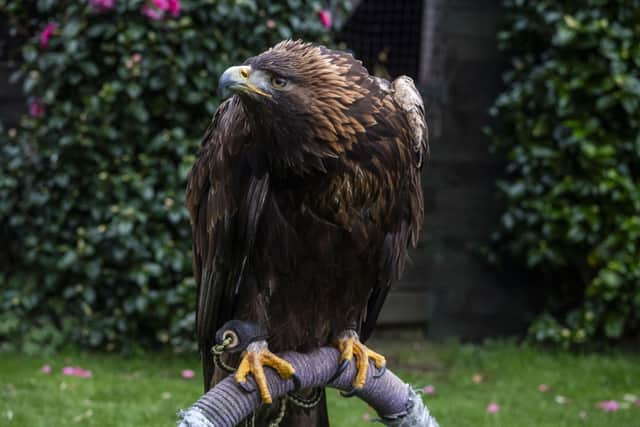
It has been five long years since Floyd, a 20-year-old golden eagle, last soared over Scotland’s upland heather moors.
Instead, the great raptor has been confined to his aviary and the lowlands while his natural hunting grounds became a no go area following the 2021 ban on hunting mountain hares.
For Floyd and his falconer, John Hunter, the legislation was devastating. Mountain hares — known as “blue” or “white” hares of winter — are the golden eagle’s prime quarry. But a sudden change in the rules meant that flying in the high uplands became too risky: a single stoop for the now-protected mountain hare could land Mr Hunter, a former policeman, on the wrong side of the law.


The ban, primarily pushed through by Scottish Green MSP Alison Johnstone, was intended to protect the native mammal, long associated with sporting estates and controversy over large-scale, unregulated culls. Campaigners argued that the thousands killed annually were unsustainable; estates countered that management was necessary to control the tick-borne louping ill virus in grouse and protect fragile habitats.
Yet the legislation also ensnared a small handful of Scotland’s falconers, who suddenly faced prosecution if their captive birds caught a mountain hare while out on the hill.
Inspired by Ken Loach’s 1970 film Kes, Mr Hunter has flown birds with his brother Neil, also a former policeman, for decades. “When you take on an eagle, it’s decades of commitment,” he said, explaining that Floyd could end up living well into his 40s.
“It was a real killer for us that, almost overnight, we were no longer able to fly our birds up on the moors.”
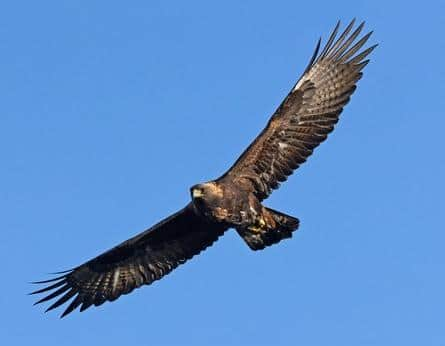
The move has meant across Scotland, golden eagles trained for falconry have effectively been grounded for the last five years.
“The area around us isn’t really suitable for Floyd to fly,” said Mr Hunter, who lives in Cockburnspath, Berwickshire. “When exercising him, I had to stick to lowland ground to make sure there were no blue hares. Other than keeping him fit, he just became like a garden ornament because he couldn’t fly as he should.”
Relief, however, is finally in sight for Mr Hunter and the few dozen who practise the niche discipline in Scotland.
Barry Blyther of Elite Falconry in Fife began petitioning almost immediately after the ban, arguing that mountain hares should be permitted to be hunted under licence for falconry — a practice recognised by Unesco as an Intangible Cultural Heritage of Humanity across 24 countries, including France, Germany, Croatia, Hungary and Mongolia.

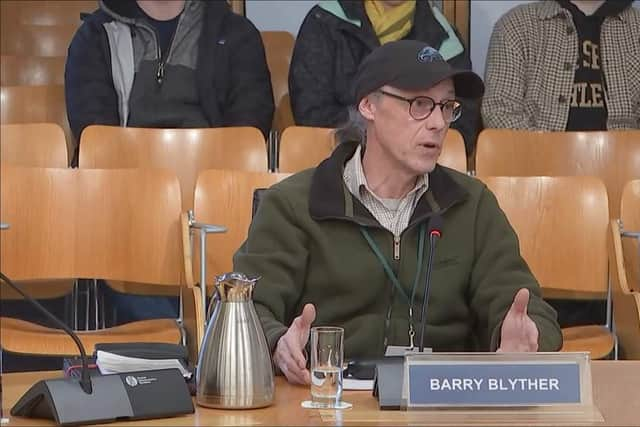
After a five-year campaign, an amendment to the Natural Environment Bill was made in January. The Bill is expected to receive Royal Assent in the coming weeks, after which the details of a new licensing regime specific to falconry and mountain hares are due to be finalised.
The small u-turn has been welcome, but for falconers swept up in the ban, the experience has been existential. The legislation exposed a curious paradox: under the Animal Health and Welfare (Scotland) Act 2006, keepers are required to allow captive animals to “demonstrate behaviour natural to the species”. For a golden eagle, that means open, wild, mountainous terrain — the kind found in the Cairngorms. But to do so risked criminal conviction.
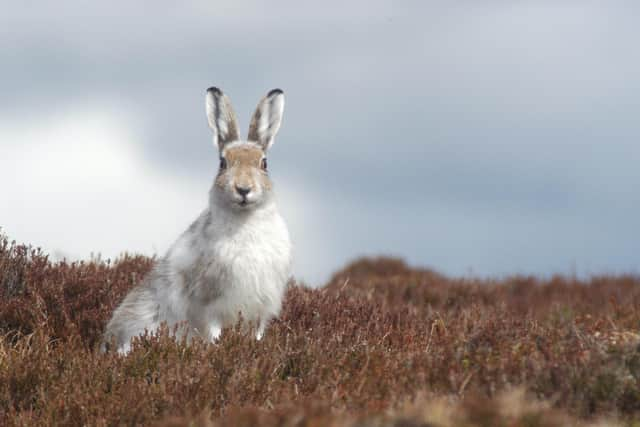

“The ban put me in an impossible position,” says Mr Blyther. “I was failing in my legal duty to the bird.”
The 58-year-old, who has been supported in his campaigning by his wife, Roxanne, has worked with birds of prey for more than 40 years. His business spans conservation, research and filming for programmes including the BBC’s Springwatch, Chris Packham and National Geographic. Owing to that work, he secured a licence in 2024 to hunt mountain hares for photography, science and education. But he continued campaigning so that every falconer — including Mr Hunter — could return to the uplands without fear of criminality.
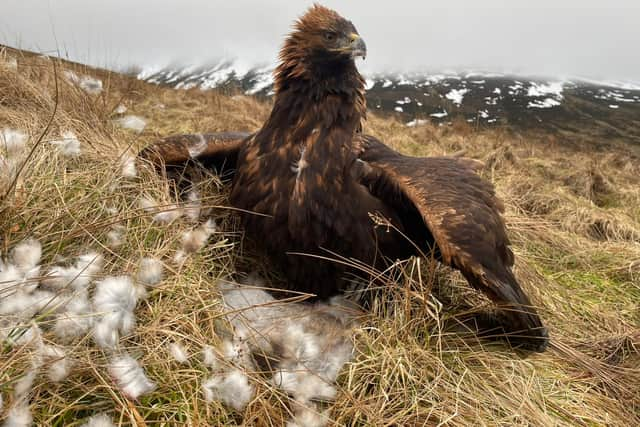
Among the raptors in his care are two golden eagles: Stanley, a 21-year-old male, and a 27-year-old female who he hasn’t named.
“I don’t tend to name some of them because a bird of prey doesn’t need you,” he said, suggesting that in the falconer-bird partnership, it is the human who occupies the more submissive role.
“It doesn’t need you for food, comfort or company. But through training it learns that all the good things in life happen around you. That creates an obligation. You have to take the bird to the places where those good things can happen — you’re putting it back into its own domain, and you exist there in a kind of servitude.
“Once the bird is trained, you have to uphold your side of the bargain. If you don’t, that bird simply doesn’t need you. So it’s immensely humbling every time it chooses to come back. It’s the most glorified form of birdwatching there is.”
To see his eagles grounded for years, unable to fulfil that compact, was, he said, “heart-breaking”.
“Watching them lose condition and motivation in aviaries for years — it was awful. Stanley, out of boredom, started pulling feathers from his back. It was awful. How would anyone feel if their dog were shut in a shed and not allowed out for years?
“You can’t repurpose a golden eagle. Trying to fly them on low ground when they’re built for mountainous terrain and enormous wind speeds - up to 90 miles an hour - and minus temperatures simply doesn’t work. They’ll just perch on a stone wall and won’t understand. But if I took them back to their proper habitat, I was risking everything.”

For Mr Blyther, falconry has defined his life since moving to Scotland from England in 1996 for access to the moorlands.
“Falconry isn’t a hobby — it’s a rage that burns inside you. When you’re not flying, you’re thinking about flying; when you’re not thinking about it, you’re wondering how to do it better for the bird.
“You have this bird that, although domestically bred, is completely wild. It brings an intimate, one-on-one relationship in the most remote places this country can offer.
“My whole life has been falconry and my business. Seeing all of that taken away in a stroke — I wasn’t prepared to sit down and watch it happen.”
While the practice has been recognised by the Scottish Government in its decision to support Mr Blyther’s petition, falconers said ministers made “a massive error” in initially “rushing through” the measure at stage three without fuller stakeholder engagement at the time — a process heavily criticised by various rural groups and shooting organisations that warned of potential unintended consequences. The chairman of the Scottish Gamekeepers Association at the time said “this is how we make bad law.”
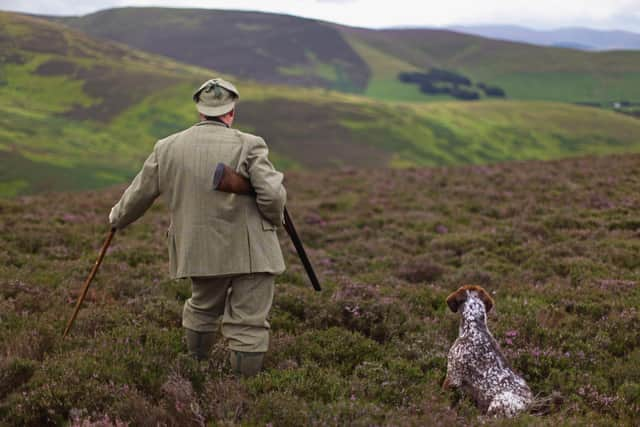
Currently, licences to kill mountain hares can be obtained for specific reasons, such as disease control or protecting young trees. But in his campaigning, Mr Blyther insisted that using eagles to hunt their natural prey encourages natural selection and has minimal impact on mountain hare numbers. He described the historic practice as an “excellent conservation tool.”
“Golden eagles and mountain hares have evolved side by side for millennia,” he said.
“The eagle takes the weak — the old, the sick, the slow. The strongest survive and breed. It’s natural selection. And just like wild eagles, ours are only successful about 15 per cent of the time, so it has a miniscule impact on mountain hare numbers.”
Any surplus is kept to feed the birds of prey throughout the year - a preference among falconers to ordering in food sourced from elsewhere.

The population of mountain hare in Scotland and their conservation status is disputed. The numbers are known to fluctuate in cycles of five to 15 years, influenced by weather, parasites, predation and habitat, researchers have said.
Until 2018, estimates relied largely on annual gamebag returns from keepers which was deemed an imperfect method but consistent. NatureScot later introduced new counting methods, including asking gamekeepers to carry out night-time surveys, though widespread monitoring fell away after full protection was introduced. Limited data suggest hares entered a natural down cycle around 2018, with some signs of recovery more recently.
Earlier claims of dramatic population collapse — including a reported 99 per cent decline in some areas including the north east of Scotland — conflicted with gamebag data, according to the Game and Wildlife Conservation Trust (GWCT). Subsequent evidence, including the 2019 Werritty Review and newer datasets, suggested mountain hares often thrive on managed grouse moors, where numbers can be significantly higher than on unmanaged moorland, and that culling showed little clear long-term impact.
Conservationists have said changing land use — particularly increased woodland planting — may pose a greater long-term risk to the mountain hare, which relies on open moorland habitat, compared to controlled management.
Animal rights group OneKind, formerly led by Harry Huyton, who later advised the Scottish Greens and First Minister Nicola Sturgeon, had been heavily involved in pushing for the mountain hare’s protection. The charity’s current chief executive, Jason Rose, said the recent change in legislation was “deeply troubling” and “a step backwards for the protection of wild animals.”
He said the amendment “disturbingly means falconry itself can now be given as a purpose when sport or entertainment should never be a reason to cause animals to suffer.”
“It is disappointing that the minister responsible for animal welfare, Jim Fairlie, described the number of mountain hares likely to be taken as 'limited and insignificant'. Every individual animal is significant. Every mountain hare has a right to live free from suffering caused by human activity.”
Ministers said they welcome NatureScot’s new standardised counting method which is currently being rolled out to moors by the GWCT, as a first step in resolving the debate on trends in mountain hare numbers.
The Scottish Government said it will commence the provisions of the Bill “in due course.” If all proceeds as expected, by the start of the mountain hare season in October — which runs until February — falconers will be on track to be permitted to fly their eagles legally over the heather moors once again.
Back in Berwickshire, Mr Hunter is preparing Floyd for that moment.
“He’s been exercised every day so when I do get the chance to go, he’s ready,” he said.
“Being up on the moorland hills, seeing all the wildlife and witnessing a golden eagle flying where it naturally hunts — it’s tremendous.”
Comments
Want to join the conversation? Please or to comment on this article.