
Community twitching from excitement after extremely rare mammal spotted on nature reserve

The harvest mouse is said to be the smallest rodent in Europe.
It may be one of the smallest mammals in Scotland.
But the extremely rare harvest mouse has caused a lot of excitement among the community running the Tarras Valley nature reserve in Dumfries and Galloway.
A volunteer claimed to have spotted the tiny creature, widely believed to be Europe's smallest rodent with a body length of only 50–75mm, while handling a tree guard. Small woven grass nests, which harvest mice typically make, were an indication of their presence in the area.
They are listed as critically endangered in Scotland.


Now a collection of surveys are to be held in the area to confirm harvest mice have found a home on the 10,500 acres (4,250ha) reserve near Langholm.
Reserve manager Jenny Barlow said: “During a recent volunteer session doing some tree maintenance, we stumbled across some little woven grass nests in some of our tussocky grassland areas.
“They are usually a tell-tale sign of harvest mice as they use the long grass to weave nests to sleep and breed in.
“Shortly after this, one of our regular volunteers found what we suspected was a tiny harvest mouse snuggled up inside an old tree guard, which was such an exciting discovery.
“We didn’t get a photo unfortunately as it ran off so quickly so we were keen to do these surveys to officially confirm their presence.”
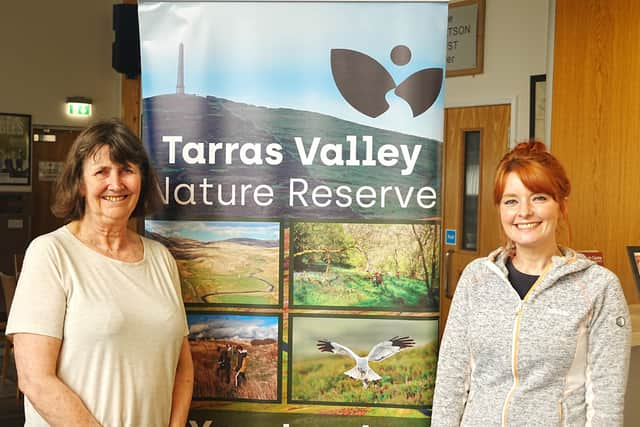
Tarras Valley is managed by the Langholm Initiative, a group that made history for completing the south of Scotland's largest community buyout in 2022.
The group has been working to develop the land, purchased from the Duke of Buccleuch, into a nature reserve.
The harvest mouse surveys will be held every Wednesday in February between 10 and 12pm to document “this wonderful little creature.”
Ms Barlow said the surveying is volunteer led and anyone can get involved.
She added: “It will be so amazing if we do have a nationally scarce species like this on the reserve, discoveries like this make our community land even more special as a haven for people and wildlife.”
There are said to be three types of outdoor mice in Britain: the wood mouse, also called the long-tailed field mouse and which is the species mainly spotted in the UK; the yellow-necked mouse, which is less common; and the harvest mouse, which is almost never found in Scotland.
Then there is the ubiquitous house mouse which thrives best inside and in the presence of humans.
A distinction spotted in the harvest mouse is its size, golden-brown fur and a prehensile tail for climbing. The field mouse is larger, with sandy-brown fur, large eyes, and a non-prehensile tail.
Harvest mice are considered "critically endangered" in Scotland due to a combination of habitat loss, intensive agricultural practices, and unfavourable climatic conditions.
These tiny rodents require specific, tall, dense grassy habitats—such as hedgerows, reedbeds, and field margins—which have significantly declined due to modern land management and development.
Comments
Want to join the conversation? Please or to comment on this article.