
Calls to revive St Columba's legacy in a new heritage route between Scotland and Ireland


Campaigners said the saint’s legacy in wider Scotland has been largely overlooked.
Plans have been launched to revive St Columba’s legacy with a heritage trail from Scotland to Ireland.
Campaigners on each Irish Sea are calling on both countries to link stories and places associated with the sixth-century saint, his followers and the spread of Christianity and Gaelic culture.
There are a handful of figures who can claim to have left such a deep mark on both Ireland and Scotland as St Columba.
Yet in the Highlands, where some of the most intriguing chapters of the missionary’s story took place, his legacy can be surprisingly hard to find.

Andrew Ferguson, an Inverness-based heritage consultant who has researched Columba’s story, believes the saint’s importance to Scotland has been badly overlooked.
“It is shocking that St Columba is not celebrated properly in Inverness or in Scotland as a whole,” he said.
“Columba’s connection with Iona is well-known of course, but otherwise his impact in Scotland is largely ignored. In Ireland they celebrate his legacy much more richly and we need to do that here.”
While Columba was the inspiration behind the world-famous Iona Abbey, Mr Ferguson said research shows the pilgrim’s connection also stretched further east, bringing Christianity and Gaelic culture into contact with Pictish territory, what is now eastern and northern Scotland.
According to accounts, he is said to have encountered King Brude, one of the most powerful Pictish rulers of the time, possibly at Craig Phadraig, a now forested hill overlooking Inverness. Columba also supposedly made it to Urquhart Castle, in the Great Glen, where he is said to have encountered another Pictish leader.
Born in Ireland, Columba, or Colm Cille in Irish, the saint’s role was also hugely influential for the spread of the Gaelic language throughout his homeland and Scotland.
“His mission was fundamental to the spread of Gaelic throughout the country,” Mr Ferguson said.
“Columba, as a religious leader, gave Gaelic real status, which is key to the early success of the language.”
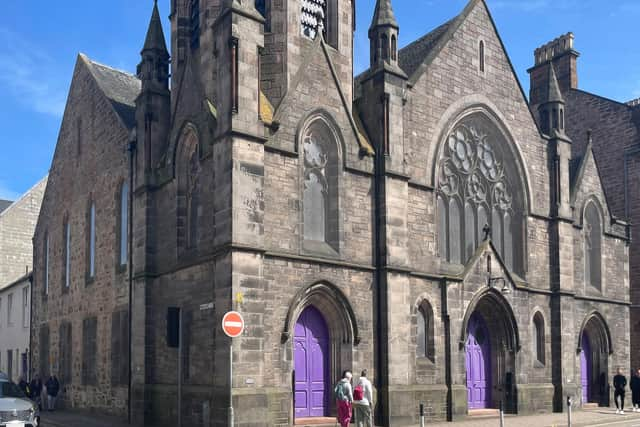
The new Gaelic culture centre in Inverness, Cultarlann Inbhir Nis, is considering developing a Columba display or memorial to celebrate his influence in the language’s culture.
Calls for a more established Columba project is being echoed in Ireland. Cillian Breatnach and Seimi Mac Aindreasa, senior managers at Belfast-based Irish-language broadcaster Raidió Fáilte, have been tracing the saint’s footsteps.
Mr Breatnack said a transnational pilgrimage and heritage route, supported by central funding, could bring together Gaelic communities and visitors interesting in Celtic history.
“There is a pilgrimage trail in Ireland and a lesser-developed trail in Scotland, but why not develop the whole thing?” he said.
“It’s a superb chance for the two Gaelic communities to come together and the religious communities to come together.”
Mr Mac Aindreasa said Columba's importance is often acknowledged without the saint’s full story being told.

“Colm Cille is a huge figure in the Catholic church but he is celebrated across all the Christian faiths. He is a massively important figure in Scottish and Irish history,” he said.
The broadcasters believe the connections are still poorly understood on both sides of the Irish Sea.
“We talk to a lot of people in Scotland and they know he came from Ireland but a lot of them don’t really know any more,” Mr Mac Aindreasa said.
He added: “It’s the story of one person and his band of followers and its brought people in Belfast and Derry and Donegal together. The Columba story could strengthen the relationship with Iona and Inverness and Scotland. We are all part of that legacy. It can bring people together in a cultural and linguistic level, as well as a purely historical level.”
Comments
Want to join the conversation? Please or to comment on this article.