
Calls to change Harry Potter train engine over wildfire fears
Plea for change from coal to liquid fuel in wake of increasing threats to protected habitats

A landowner has called for Scotland's renowned Jacobite steam train to be converted from coal to liquid fuel, warning that decades of lineside fires pose an increasing threat to protected habitats in the West Highlands as wildfire risk intensifies.
The appeal comes after a recent large-scale Cairngorms wildfire, described by land managers as “apocalyptic”, prompted renewed scrutiny of Scotland's approach to wildfire prevention. Estate owners and gamekeepers have warned that the country faces increasingly destructive fires unless further action is taken on wildfire prevention.


Paolo Berardelli, owner of the Great Glen Cattle Ranch near Spean Bridge, said methods now exists to eliminate fire risk posed by coal-fired steam locomotives without threatening one of the country's best-known tourist attractions.
The Jacobite service, which runs between Fort William and Mallaig and became internationally famous as the "Harry Potter train" after appearing as the Hogwarts Express in the Harry Potter films, attracts thousands of visitors each year. Its operator, West Coast Railways (WCR), said the attraction contributes £35 million annually to Scotland's tourism sector.
Read more: Cairngorms wildfire 'undoubtedly' started by humans, says Justice Secretary Neil Gray
However, Mr Berardelli, who is also chairman of the West Lochaber Deer Management Group, representing local estates and farmers along the route, said members had recorded more than 40 trackside fires since 2002, many of which they had helped extinguish alongside the Scottish Fire and Rescue Service (SFRS).
He claimed eight of those fires had caused significant damage to protected habitats, including Special Areas of Conservation (SAC), Sites of Special Scientific Interest (SSSI) and Special Protection Areas (SPA). The most recent, the Glen Mamie wildfire in April 2025, burned about four square kilometres, he said. Among the habitats affected were areas of Atlantic oak woodland, one of Scotland's rarest native ecosystems.
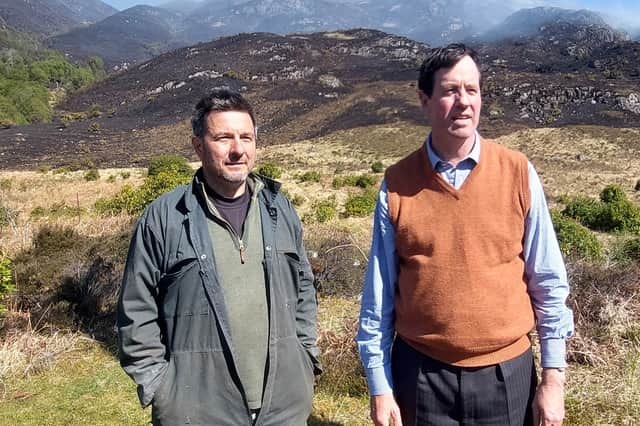
Mr Berardelli said he and other landowners had spent years raising concerns about the growing wildfire risk posed by the steam locomotive as hotter, drier conditions become more frequent, but believed the issue had attracted little attention because the affected area is sparsely populated.
"We completely understand the importance of the steam train to local and national tourism, but the fires have to stop," he said.
"There is a solution. But until someone's house is burned down, nothing is going to happen. The landowners in the area are being impacted."
Subscribe to The Scotsman for just £2 and bag yourself 2-4-1 tickets to the Fringe. Get yours today!
WCR said it already operates a range of fire mitigation measures, including using diesel rather than coal to power the locomotive during periods of high wildfire risk, which are typically in the spring and which, according to recent figures, are on the rise.
A recent Freedom of Information request published by the Scottish Conservatives showed there was just one wildfire warning issued in 2020, rising to 14 by 2025. There were no extreme wildfire warnings in 2020, compared with nine last year.
Read more: 'Harry Potter fans won't be happy': Jacobite steam train carriages turn blue
Network Rail, which owns the railway infrastructure, said there was no evidence linking Scotland's recent wildfires to railway operations. WCR also said it believed no wildfires had been caused by the Jacobite service so far this year. The train, however, did no run for several weeks in the spring and early summer months because of a long-running safety dispute.
Mr Berardelli pointed to a trackside fire in Cheshire earlier this month involving a steam locomotive that was being assisted by a diesel locomotive as part of fire mitigation measures. The blaze damaged railway infrastructure and disrupted dozens of services, after which temporary restrictions were introduced on steam operations in England.
The landowner said the situation only supported his campaign to convert steam locomotives from coal to liquid oil as way of allowing heritage railways to continue operating while virtually eliminating the risk of sparks igniting dry vegetation.
“North York Moors Railway has converted a steam train from coal to liquid oil to remove the fire hazard,” he said.
“This is obviously the way forward and I am lobbying for this to happen nationwide.”
Mr Berardelli also highlighted concerns over the unresolved issue of insurance for landowners and estate workers assisting with wildfires. Much of the frontline response in remote areas relies on private landowners, estate staff and gamekeepers volunteering both personnel and equipment.
Land managers say a lack of clarity over insurance arrangements is discouraging them from assisting during major wildfires. They argue it remains unclear who is liable if estate staff are injured or property is damaged while helping on neighbouring land, or who would pay if privately owned firefighting equipment is damaged during an emergency response.
Read more: Watch: Drone footage of Cairngorms wildfire as 'progress' made in tackling blaze
Last year, more than 36 estates, rural businesses and 110 land managers were mobilised during the Dava Moor wildfire, which, together with the Carrbridge wildfire, formed the largest wildfire incident in Scotland's recorded history.
James Shuttleworth, WCR's commercial director, said robust fire mitigation measures were already in place for the Jacobite train during periods of elevated wildfire risk.
"We take wildfire risk very seriously and stick to the established protocol with Network Rail, who we work closely with to reduce the risk," he said.
"The proof is that there have been very few fires in recent years. The frequency has dropped because we operate with diesel assistance, or diesel only, during periods of high risk, and it has worked."
A Network Rail Scotland spokesperson said: "We take our responsibility for safety and the environment very seriously and have a range of measures in place to minimise any risk of wildfires associated with steam locomotive operations.
"We carry out a daily risk assessment which incorporates weather conditions and advice from our qualified meteorologists. Our process is informed by an independent expert and uses the latest research and evidence on wildfires. Where conditions require it, additional restrictions on steam operations are introduced."
Comments
Want to join the conversation? Please or to comment on this article.