
Call for new fish farm law as former Sepa chief warns system ‘not delivering for anyone’
A parliamentary committee concluded last year that progress in the sector had been ‘unacceptably slow’


A former senior figure at Scotland’s environmental watchdog has suggested sweeping legislative reform of the salmon farming sector, warning that the current regulatory system is “not delivering for anyone”.
Anne Anderson, previously chief officer of the regulatory portfolio at the Scottish Environment Protection Agency (Sepa) and later an adviser to salmon industry bodies, said the next Holyrood term offered a “watershed moment” to reset the framework governing aquaculture.
She suggested an Aquaculture Bill be considered by the next Scottish government, describing it as a potential solution to addressing what she characterised as a fragmented and ineffective system.
The fish farm expert, who previously advised Salmon Scotland and Scottish Sea Farms, commented on the sector after what has been a decade of inquiries, consultations and incremental reforms that, she said, have failed to produce meaningful change.

Since the first major Holyrood committee investigation in 2018, successive reviews have returned repeatedly to the same themes—environmental impact, fish welfare and regulatory complexity—without resolving them.
A parliamentary committee that revisited the issue in 2024, and reported again in early 2025, concluded that progress had been “unacceptably slow”.
In a letter to the then rural affairs secretary, Mairi Gougeon, MSPs set out continuing concerns following a series of evidence sessions on the sector’s future. These followed a critical report published in January last year highlighting persistent problems including fish mortality and environmental pressures.
While acknowledging some “positive steps”, such as a commitment by the Scottish Government to introduce baseline welfare standards for farmed fish, the committee said it remained “particularly concerned” about mortality rates.
Campaigners have also raised questions about enforcement. Animal Equality UK, citing a freedom of information request, said that the Animal and Plant Health Agency (APHA) inspected just 21 of Scotland’s 213 active salmon farms between January 2023 and October 2025. None of the 20 sites with the highest mortality—together accounting for more than 10 million fish deaths—were visited during that period.
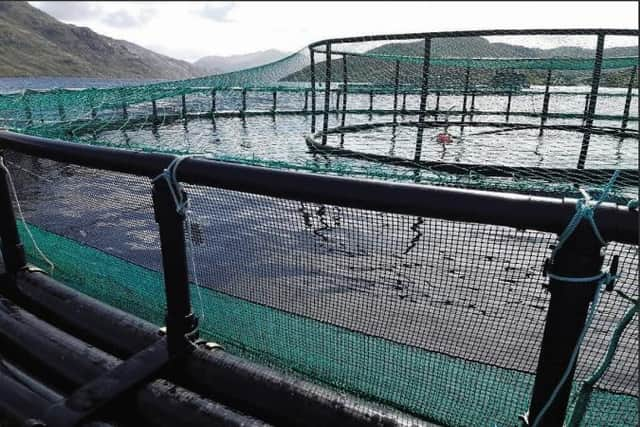
The Scottish Government states that unannounced inspections are a statutory requirement, yet only two were carried out between January 2023 and September 2025, both in 2024.
Abigail Penny, executive director of Animal Equality UK, said the system required “a complete overhaul”, describing current levels of scrutiny as “embarrassingly poor”.
Mrs Anderson, however, argues that the debate often overlooks the extent to which the sector is already “heavily regulated”, albeit ineffectively.
“There is heavy regulation,” she said, “but not in any way that reliably delivers the outcomes that in reality that the public expect, and I think that's quite key.
“There’s five different permits, permissions from the government agencies that are required. If you think about the complexity of that, no wonder there’s fatigue around the process itself.
“There’s confusion about who does what, which is what you see coming out of the parliamentary debate.”

Despite deep divisions over the future direction of the industry, Mrs Anderson said there was now an unusual degree of consensus about its current state.
“There’s frustration and dissatisfaction,” she said, “you can see from all parties.
“I think there's a strong level of convergence around the reality that the current system isn't delivering for anyone.
“Over this last seven, eight years, there has been attempts to put, in the simplest way, sticking plaster approaches to existing frameworks.”
Mrs Anderson warned against relying on incremental changes, pointing to the recent extension of Scotland’s marine planning zones from three to 12 nautical miles. While this allows operators to move into deeper waters, she argued that without embracing new technologies and a more coherent regulatory model, such changes risk “dragging long-standing issues further out to sea”.
“What’s needed is a fit-for-purpose, integrated approach to regulating high-intensity food production, with clear accountability and governance—possibly even in the form of a new, dedicated Aquaculture Bill,” she said.

“Why rule anything out at this stage? The issues facing the sector may be long-standing, but they are inherently resolvable if we remain open to alternative ways of achieving shared goals.”
The debate is set to intensify ahead of May’s Holyrood election. In their manifesto published this week, the Scottish Greens renewed calls for a pause on the expansion of salmon farms until stricter welfare and mortality standards are met.
Ariane Burgess, the party’s rural affairs spokesperson, said: “After years of scrutiny, reports and promises, many of the same concerns around fish welfare, environmental harm, weak enforcement and blurred accountability remain a serious problem.
“We know it is not a lack of evidence that has held progress back; what has been missing is the political will to stand up to a powerful industry and deliver the action needed.
“That means a pause on new salmon farms and expansions, stronger monitoring and enforcement, genuine transparency, and regulators finally having the power to act where standards are repeatedly not being met.
“The current model is failing to command public confidence and is storing up bigger problems for the future.
“If the industry is to have any long-term future in Scotland, it must be on the basis of far higher environmental and welfare standards being met, and for those who break the rules to be held to account.”
A spokesperson for Salmon Scotland said the sector has long argued for “not less regulation, but better regulation.”
The industry body pointed to Professor Russel Griggs vision for reform in his 2022 independent report to the Scottish Government in which he called for simplification and restructuring of how aquaculture is regulated.
“We hope that a new administration elected in May will take those proposals and make them happen.”
At the time Mrs Anderson moved from Sepa to work in the salmon industry, campaigners criticised the move, pointing to the wider concern about regulators moving into private sector groups. The fish farm expert said she felt it was important there was movement between the two for exchanging industry knowledge.
Comments
Want to join the conversation? Please or to comment on this article.