
Exclusive:Almost one million hens culled as avian flu sweeps across the south of Scotland in 'worst year yet'
Farmers in Midlothian and the Borders are counting the cost of the highly pathogenic strain of avian flu that has hit the area


Within days of discovering avian flu had arrived at the Stoddart family’s organic egg farm near Penicuik, all of their 7,000 or so birds had been killed.
The rapid spread of a highly-pathogenic strain of bird flu had left its deadly mark at Croft Organics at Halls Farm, with the birds killed in a mass cull to prevent further spread of the infection.
The business is one of multiple hit by seven outbreaks of bird flu reported in Scotland since December 18.

Almost one million birds have been culled as a result of the fast-spreading disease in the last month, which have been reported in all but one case in the Borders and Midlothian, with a concentration around Penicuik.
Three of the cases have been reported at farms owned by Glenrath, widely understood to be Scotland’s largest egg producer.
The company supplies over one million eggs a day across its multiple farms in the Midlothian and Borders area.
At Croft Organics, owner Scott Stoddart said he moved all their hens inside following news of the first outbreak at Glenrath’s Whim farm the week before Christmas, which lies around three miles away.
Within days, Mr Stoddart found five dead hens. Within less than 72 hours, he said there was a 95 per cent mortality across their four sheds.
“There’s nothing else that kills that quick,” Mr Stoddart said.
“We had a sample taken and we found out the next day which confirmed it.
“Then all the killing teams came in and within two days, all the hens were gone.”

Officials said the current strain of avian flu that is devastating farms was a “highly pathogenic” version. The disease is extremely contagious for birds, and can be spread by anything from a small garden sparrow to bird excrement being washed into pens by rainfall. Some farmers claim it can simply be spread in the air.
In the UK, chickens in sheds affected by avian influenza are killed under strict government-controlled welfare protocols. The process is carried out or supervised by APHA contractors and follows UK animal-welfare law.
The culling process involves whole house gassing, typically using carbon dioxide or inert gas, such as nitrogen.
The Stoddarts said even if some sheds didn’t appear to have been hit by the disease, all birds on one farm holding have to be exterminated as a precaution.
“And that was it, the farm was placed into lockdown,” Mr Stoddart said, whose business supplies more than 1,000 different retailers and private individuals, including shops in Edinburgh.
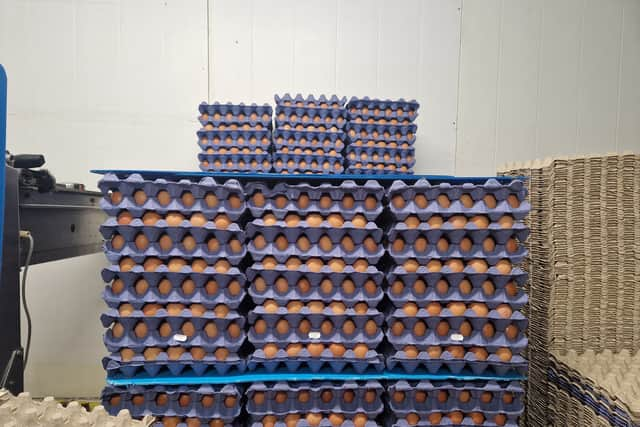
“We had about £10,000-worth of eggs - a week’s worth of eggs - ready to go at the door in the run up to Christmas, but we weren’t allowed to sell them.
“I had to spend £1,000 to get a skip in and smash them all into it because they were presumed contaminated.”
Official figures shared with Scotland on Sunday show that 968,000 birds have been culled in Scotland since December.
The figure is the highest number of bird culls carried out in the last five years.

The Stoddart family business has taken roughly a £100,000 hit because of three weeks of lockdown due to avian flu.
While Mr Stoddart has another egg shed being built in Fife for the business, it is still a few weeks yet before it can house hens.
In the meantime, the family business is having to buy in eggs from elsewhere to keep things up and running, which is costing them about £4,000 more a week than if they were producing them.
They have had to put prices up for the customer as a result.
“It’s a bit of a catch-22 situation at the moment,” Mr Stoddart said.
“Some people are still being supportive but others don’t want to buy from us just now because they aren’t the same eggs.”
Under government rules, he said doors to the egg sheds at Halls Farm have to be closed for a year until they can reopen an house hens again.
According to APHA rules, producers can restock sheds after 21 days provided they comply with the veterinary inspector’s requirements around secondary cleansing and disinfection.
Mr Stoddart, however, said the administrative and financial cost isn’t worth it for his farm. The need for a high concentration of disinfectant also brings added complications for an organic holding.
Farmers are given compensation for every live hen that has to be culled by government officials. It equates to a bit more than the market price for a chicken, which is about £7.50.
“We just about got our money back but there’s no income,” Mr Stoddart said.
“5,500 birds were killed. As for the others, we didn’t get compensation for because they were dead.
“We had three sheds of varying ages of hens but there was one shed with hens that were pretty much brand new. They had only been on the farm for about 6 weeks and they all had to be killed.
“We were unfortunate that we had everything on one site.”
While insurance can be available for poultry farmers against avian influenza, the service is limited, often expensive and hard to secure.
“It’s almost a no-go insuring against bird flu for us because of the enormous cost,” Mr Stoddart said.
“We’re talking near £100,000 for insuring what we’re doing here and we just can’t justify doing that.”
For Mr Stoddart’s father, David, who founded Croft Organics more than 20 years ago, he said the potential loss of customers because of the outbreak has been one of the hardest moments in his time as an egg producer.
“We’ve spent all these years building up a great customer base,” he said.
“To find ourselves sending a message to say we couldn’t supply them anymore was probably the toughest thing about all of this.
“This has been the first time we’ve ever had a break in sales. It’s the first time we haven’t delivered an egg in over 21 years.”
The latest outbreak in the area was reported on January 24 at Glenrath’s Easter Deans and Blairburn farm in West Linton.
At the firm’s nearby Whim Farm, some 76,000 chickens were culled before Christmas.

One employee at the site, who wished to remain anonymous, said the site, which is often identified as a major hub for the company’s egg production, included one shed with around 120,000 hens and another five sheds with about 60,000 in each, all of which had to be killed.
“This season has been really bad,” he said. “It’s the worst I’ve seen it.
“Usually they [Glenrath] can control it when it happens, but this time they haven’t been able to. Six sheds here and they all had to be gassed.”
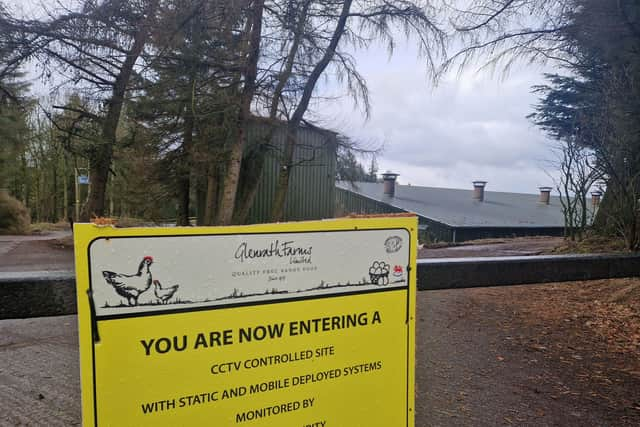
The site is currently under lockdown with security at the gates - a move that is part of a wider 1.8 mile (3km) protection zone and a 10 km (6.6 mile) surveillance zone enforced in the area in an attempt to prevent further spread.
Road signs warning of an “animal disease control ahead” are dotted about the country roads that lead to and from the shed sites.
“Our job now is to just clean,” the Glenrath employee said.
“We were grading the eggs for the supermarkets but there’s no need to do that at the moment as there are no eggs. There won’t be any coming out of here for a while.”
In a request for comment on the current shutdown, Glenrath said its affected farms are “under restriction” and referred to the Animal and Plant Health Agency (APHA) for further information.
Despite the losses at Glenrath, which is one of, if not Scotland’s biggest egg producers, government officials and the British Egg Industry Council remain confident overall egg supply remains unaffected.
However, egg farmer Scott Stoddart remains unconvinced.
“I think there will a shortage pretty quickly,” he said.
“I think it’s safe to say there have been over a million birds killed in this area.
“With the numbers culled, that’s a large chunk of eggs that just aren’t there anymore.
“They [Glenrath] can’t be far off providing half the eggs of Scotland.”

A few miles down the road in Penicuik, agriculture store Carr’s Billington has disinfectant containers outside the front door for customers to dip their feet in.

Staff member Freya Harrison, of nearby Carlophill Farm, said in the 12 years she’s lived in the area, the latest bout of avian influenza has been the worst she has seen.
“A lot of the customers coming in here have all got their chickens shut in sheds at the moment,” she said.
“I put these containers with disinfectant out because of what is going on at the moment so customers can dip the soles of their feet in.”
In the town’s Penicuik Storehouse, a cafe and grocer, staff said local egg supplies have been hit by the seasonal outbreak.

Shop manager John Phillips said: “We have to juggle a bit because of the supplies being affected lately.
“Normally we have two suppliers, including Croft Organics. But in the meantime I have had to bring in a previous supplier at half the quantities I used to have.
“So at the moment, I am trying to balance three different suppliers to make sure we have enough eggs but not too many. It’s just about working.”
The Scottish Government said it is working with poultry farmers, including affected farms, to minimise the possibility of new infections through the best possible biosecurity.
A spokesperson said: “These strict biosecurity measures ensure eggs and poultry remain safe for consumers and the risk to those with intensive exposure to infected birds is low.
“Whilst our first consideration is always animal welfare and human health protection, we are also working with industry to ensure egg supplies are maintained.”
According to APHA figures, a total of 3,461,013 birds have had to be culled across the UK from avian influenza since October last year.
Currently, the UK Government does not allow routine vaccination of poultry against avian influenza as a control measure for outbreaks. According to official policy, this because vaccinated birds could still become infected and spread disease without obvious symptoms, which could make detecting and controlling outbreaks much harder under current surveillance systems.
A cross‑government and industry “avian influenza vaccination taskforce” has been set up to explore whether vaccination might be a viable preventative measure in the future .
Comments
Want to join the conversation? Please or to comment on this article.