
Teachers 'cannot deliver' science lessons as lab technicians in Scottish schools report soaring stress levels
As increasing numbers of lab technicians report plans to leave their roles, concerns have been raised about the future of science education in Scotland’s schools.

Lab technicians should have a mandatory role in Scotland’s classrooms as a major survey of science teachers shows 70 per cent say they do not have the support needed to teach effectively.
The UK-wide poll of science staff showed Scotland has the highest level of reported insufficient classroom support of all four nations.
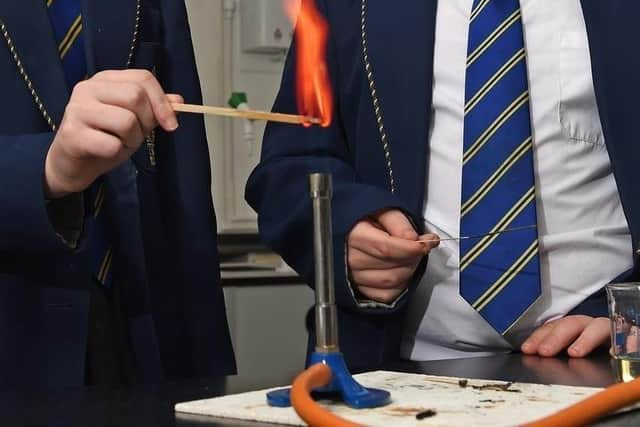

Teachers in mainstream state schools said lack of support staff was a significant barrier to effective teaching. They also cited issues with insufficient class time, challenging student behaviour, and the cost of consumables and chemicals in delivering science lessons.
Science technicians, who are vital to lab work, say they are considering leaving the profession due to low pay, lack of progression opportunities, and high levels of stress and exhaustion.
Vicky Thompson, a senior school technician, sits on the Royal Society of Chemistry Education Committee. She said the levels of reported stress in the Royal Society of Chemistry (RSC) report from the 2,000 teachers and technicians surveyed was no surprise.
Ms Thompson said there had previously been a template for how many technicians should be employed in a school depending on pupil numbers.
“We have becoming low hanging fruit because there is no statutory obligation for schools to have technicians in place,” she said. “They are ripe for the picking when savings have to be made.”
In previous years, a school might have had a senior technician with a staff of technicians reporting to them. Now, Ms Thompson said, one senior technician might be responsible for a cluster of four or five schools.
In some places, she said, savings had been made by making the role term time only, rather than 52 weeks.
“We're now in another period of curriculum improvement cycle and we need technicians involved in the conversation, so that we can be architects alongside teacher expertise to make sure that when they're bringing out new ideas, we can say whether they are entirely possible within the resources that we have, the finances that we have, and the capabilities, the training and the expertise that we have,” she said.
When asked what barriers they faced to run practical work in schools, more than half of teachers in Scotland said lack of equipment was a factor. Challenging student behaviour and poor pupil attendance were also barriers, as well as low levels of competency in literacy and numeracy.
When asked what factors present challenges to classroom teaching in science, 69 per cent of teachers in mainstream state schools in Scotland reported insufficient classroom support was a barrier - the highest out of all nations.
Last year 15 technician posts were made redundant from across 19 secondary schools in South Lanarkshire Council in science, technical and audio-visual.
Ms Thompson said: “Are we missing out on scientists of the future because we don't equip our schools with the staff that we need? “So I would want the government to make our role statutory.”
The survey found nearly a fifth of technicians intend to leave the profession by 2027 and a further 39 per cent are unsure whether they will stay in the job.
In 2023, 17 per cent of UK technicians cited high levels of stress and exhaustion as a reason for leaving their role – a 159 per cent increase in just two years.
The RSC commissioned the survey alongside peers from the Association for Science Education (ASE), the Institute of Physics (IOP), the Royal Society (RS), and the Royal Society of Biology (RSB).
Mark Jordan, head of education at the RSC, said: “We’ve seen first-hand the transformative power of practical science lessons in bringing the sciences to life for school students. And so, it’s incredibly disappointing to learn science teachers and technicians are up against so many challenges that can and should be prevented in delivering this important work.”
The Scottish Government was contacted for comment.
Comments
Want to join the conversation? Please or to comment on this article.