
Exclusive:SNP education secretary would consider root-and-branch change to school day to cut school violence
Education secretary Jenny Gilruth has spoken about violence levels in Scottish schools and how the government plans to tackle the issue

Education secretary Jenny Gilruth has said she would consider a root-and-branch restructure of the school day in a bid to tackle the rise in challenging behaviour and violence in Scotland’s secondaries.
Ms Gilruth, in an exclusive interview with The Scotsman, said a shift away from the existing pattern of six to eight lessons a day was something she “would be happy to raise” with local authorities.
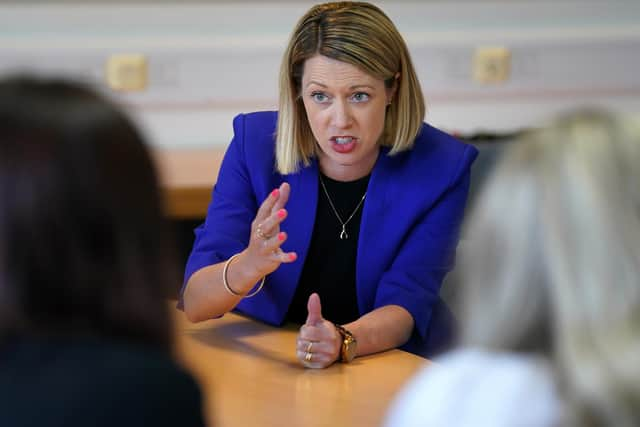

However, the Cabinet secretary warned against “demonising” young people and said school hours must also suit working parents.
Describing the school day as “challenging” for “many young people”, the former modern studies teacher said: “Having taught myself, watching young people arrive to school late is a feature sometimes over secondary schools, where they struggle to get up in the mornings.
“And I think we should reflect that.”
Some secondary schools in West Fife are expected to change their hours to finish before lunch on a Friday under a restructure planned for August at the start of the 2026-27 term.
Dumfries and Galloway Council had also been pushing ahead with plans for a four-and-a-half-day school week to "develop and enhance" education provision. However, the council is expected to now drop the move following a lengthy consultation in which a majority of parents opposed the plans.
Scotland on Sunday last week published a diary written by an experienced teacher in a Glasgow secondary who painted a stark picture of dealing with disruptive and violent pupils.
They described non-pupils entering the school to start a fight and claimed a pregnant teacher had been knocked over in the resulting scrum. School management, they said, were uninterested in recording or dealing with the incidents.
Ms Gilruth, who has been in charge of the education brief for the past two years, has now invited this teacher for a private meeting to hear their concerns directly.
Asked directly about concerns of rising violence in schools, Ms Gilruth said a complex network of factors were at play, including poverty, a rise in additional support needs (ASN) and the impact of the pandemic on young people.
Teachers canvassed by The Scotsman have said the structure of the school day fails teenagers who cannot cope with multiple transitions between classrooms, subjects and teachers every day.
Asked if a wholesale change in the school system is needed, Ms Gilruth said “it's not something I'd be against”, in discussion with local government.
However, she added: “We also need to remember that parents and carers go out to work, and we need to have a school day that works for them as well.”
Figures released under Freedom of Information showed a total of 91 serious injuries to Scottish school staff caused by violence reported in the latest year - three times the number seen ten years before and the fastest rise of anywhere in Britain. These injuries included fractures, dislocations and loss of consciousness.
The GMB union this week said some school support staff were being forced to wear protective clothing, having previously warned of an “epidemic of assault” and verbal abuse in Scottish schools.
Questioned about concerns about what has been described as an “inexcusable tide of violence” in schools, Ms Gilruth said “perspective” was vital.
Another teacher told The Scotsman they are working as de facto “body guards, prison guards and mental health nurses”.
“They shouldn’t be,” Ms Gilruth said, adding: “We also need to be a little bit careful that we are not demonising the next generation of children and young people.
“Whilst I accept there are challenges in our schools, our research tells us that the vast majority of children and young people in our schools are well behaved.”
She said violence existed in schools in the 1990s, when she was a pupil, “so we just need a bit of perspective here”.
“I think about these children and young people as quite a unique cohort,” Ms Gilruth said. “They lived through the pandemic, they lived through an age of austerity, and they're growing up in a very uncertain world.
“And all the evidence tells us, internationally, from the OECD [Organisation for Economic Co-operation and Development], that this generation are really struggling with anxiety so how we respond to that needs to be carefully handled.
“I don't accept that all of our schools are struggling with [the behaviour described in the teacher’s diary]. That's not been my experience of the last ten years working in schools, nor of my time in government.
“But I do accept there are individual examples of where really challenging behaviour is perhaps not responded to the way it should be.”
Ms Gilruth pointed to the fact this week the Scottish Government has launched its national attendance TV, radio and multi-media campaign to encourage parents to ensure their children go to school.
The Government also this week announced a continued £43 million investment in supporting children affected by poverty as part of the wider £1.75 billion Scottish Attainment Challenge, which has been running for the past decade.
The Cabinet secretary also pointed to the Additional Support for Learning Action Plan, which should complete by the end of March, and will include data gathering on the numbers of young people with ASN.
Ms Gilruth expressed concerns about the “normalisation” of food and clothing banks in Scottish schools and that head teachers were using school funds “routinely” to tackle issues of poverty.
The pandemic, she said, had left children with behavioural issues, but teachers should never be afraid to go to work.
Ms Gilruth said: “I, as a politician, don't want to fear that. So why on earth would I expect that of teachers? We need to be really clear about that, and where they do have anxiety, where there are concerns, I want them to be able to talk to their PT [principal teacher].”
Under her stewardship, Ms Gilruth added, the Government has set out the National Action Plan on pupil behaviour following data gathering and a variety of summits.
However, in a survey last month, fewer than 3 per cent of teachers surveyed by the Scottish Secondary Teachers’ Association (SSTA) thought there had been any improvement in pupil conduct since SNP ministers unveiled the action plan in August last year.
Ultimately, Ms Gilruth said, power to improve schools sits with councils.
“Part of the challenge for any education secretary is that statutory power sits with councils,” Ms Gilruth said. “So whilst all the ire may be with the education secretary - and mea culpa - the legislative power to change things rests with local government.
“So we need them to be part of the solutions. Our schools are quite independent from government, so we need to trust our head teachers - and they will have my full backing on behavioural issues.”
Comments
Want to join the conversation? Please or to comment on this article.