
Exclusive:Scottish Government should step in to help cash-strapped universities, says former St Andrews principal
Dame Louise Richardson is president of the Carnegie Corporation of New York

The former principal of the University of St Andrews says the Scottish Government should step in to save universities struggling to survive amid a major funding crisis.
Dame Louise Richardson, who headed up the prestigious Fife institution and later became vice-chancellor of Oxford University, said Scotland’s universities were “essential to the success of society”.
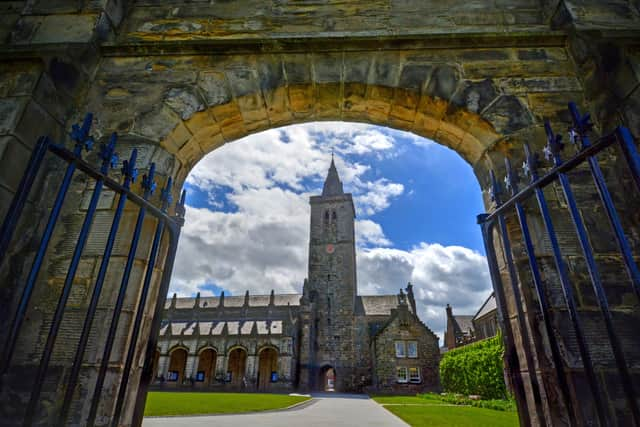

A number of Scottish universities have recently announced redundancies as financial problems plague the sector.
Dame Louise, who was principal of St Andrews University from 2009 to 2015, is in Scotland in her new role as president of Carnegie Corporation of New York, founded by Scot Andrew Carnegie in 1911.
She said: “Universities are so critical to society. They're the engines of the economy and important for so many people. This is something Andrew Carnegie understood - they are the engines of social mobility, but they're much more than that. They're guardians of the culture and generators of new ideas. They’re absolutely essential to the success of society.
“Scotland's tradition of higher education is so admirable. The fact that there were, for centuries, four universities in Scotland, is pretty impressive.”
Dundee University is cutting around 300 full-time jobs – down from an initial figure of 632 - as it tries to tackle a £35 million deficit. A £22m support package has already been approved for Dundee University by the board of the Scottish Funding Council.
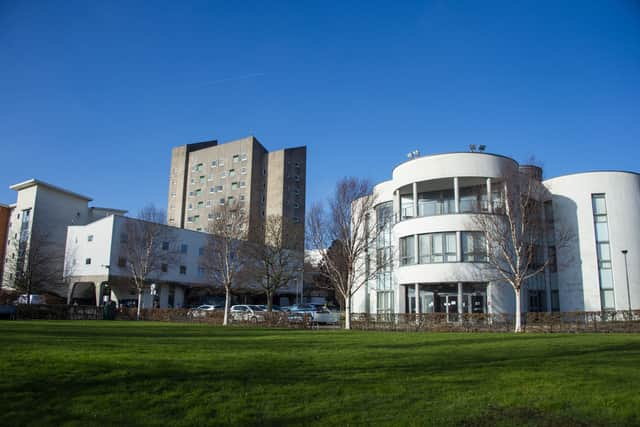
The University of Edinburgh is meanwhile looking to make £140m of cuts over the next 18 months, with 350 staff already believed to have taken voluntary redundancy.
Edinburgh University principal Sir Peter Mathieson last month said he could not rule out compulsory redundancies.
Dame Louise said : “Every university principal is going to want more government funding. No foundations are big enough to fill the gap in government funding in any sphere.
“So I hope the Scottish Government will, and indeed the British Government, figure out a way to maintain the calibre of Scottish higher education, just as I hope that American universities are not damaged by current political problems in the US.”
Leaders of the 26 Carnegie organisations worldwide gathered in Edinburgh this week to award the 2025 Carnegie Medal of Philanthropy Awards.
The biennial event, also known internationally as the "Nobel Prize of Philanthropy”, was held in Scotland for the first time in more than a decade. Philanthropists including Comic Relief co-founders Richard Curtis and Sir Lenny Henry were honoured for their philanthropic work, as well as Dr Carol Grigor, who has funded arts projects across Scotland, including the building of the Dunard Centre, Edinburgh’s new concert hall.
Dame Louise pointed to the Carnegie Trust for the Universities of Scotland fund set up in 1901 by Carnegie, which funded every student at university in Scotland at the time and still offers grants to students whose tuition fees are not eligible for government funding.
Philanthropist Andrew Carnegie, who was born in Dunfermline, became one of America’s richest men, after starting work in a cotton mill aged 12.
Dame Louise said: “At the time, it was about 1 per cent of the population. Now with nigh on 50 per cent of the population attending university, no combination of private foundations can fill the gap.
“We're finding that in the US at the moment, when the government is cutting back in various areas, there's a big call for philanthropy to fill the gap. And much as we would like to, the scale of government funding is so great that we can’t, collectively or individually.

“I think the best possible return on investment is investment in education. That's what Andrew Carnegie certainly felt. That was the tradition he brought with him from Scotland to America. And certainly, education has transformed my life and the life of so many others. “
Ahead of the medal ceremony on Wednesday night, the Carnegie organisations attended a meeting where they were addressed by former prime minister Gordon Brown, who spoke on the importance of civic spaces for communities to meet, as well as the dangers of polarising politics, something which Dame Louise said was a key focus of her organisation.
Although it is unable under its status as a non-profit organisation to take part in political lobbying, the Carnegie Corporation of New York is funding academics from Stanford University to do research on political polarisation - how it came about and how society could mitigate it.
Dame Louise said: “The other focus I've had since coming into my role has been to try and address the political polarisation that is really - this perhaps sounds hyperbolic, I was going to say - tearing America apart, but it is certainly causing so much damage and distrust in American society.”
She recalled living in Scotland through the 2014 independence referendum and the 2016 Brexit vote.
“There's nothing more polarising than a referendum,” she said. “I lived through the independence referendum here and the Brexit referendum when I was in Scotland. And that, of course, forces a binary choice, and people end up making a decision on a single issue that is actually influenced by all sorts of extraneous issues. So that, in itself, is deeply polarising.”
Dame Louise praised medal winner Dr Grigor for her “quiet philanthropy”.
“She has such a breadth and range of philanthropy, and she keeps it all very quiet,” she said. “She's so admirable in an age when so much philanthropy has become quite transactional and philanthropists are seeking public recognition.”
The Dunard Fund, which is chaired by Dr Grigor, has provided millions of pounds worth of grants to charities in the arts and heritage sectors. Recipient organisations include the Edinburgh International Festival, National Galleries of Scotland, Scottish Chamber Orchestra, National Library of Scotland and Britain's major opera companies, as well as the new concert hall.
Previous winners of the Carnegie Medal for Philanthropy include Dolly Parton in 2022, Michael Bloomberg in 2009, and Scottish businessmen Sir Ian Wood and Sir Tom Hunter in 2019 and 2013 respectively.
The Scottish Government has been contacted for comment.
Comments
Want to join the conversation? Please or to comment on this article.