
Scotland's universities urged to show 'mettle' in supporting asylum seekers with scholarships
Scotland’s universities already work to support people seeking asylum but a new report says they must work together

Scotland’s universities must show their “mettle” in pushing for improved visa processes to help academics and students fleeing conflict zones, a report claims.
Academic institutions offer scholarships and grants to people seeking asylum and refugees but a probe by the Royal Society of Edinburgh shows the work is fragmented.
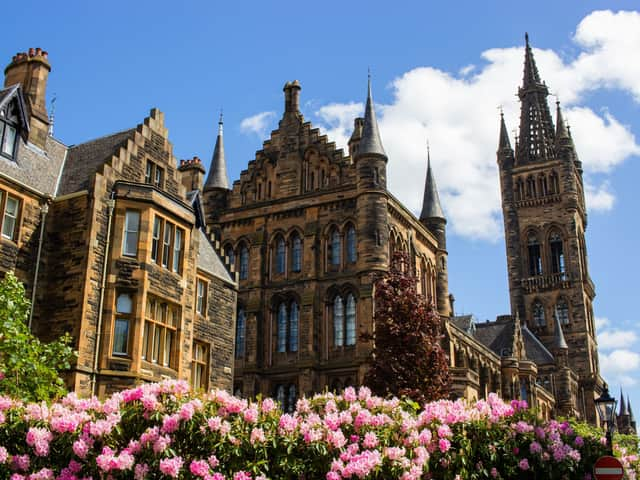

It makes a series of recommendations in a comprehensive probe into the sector’s humanitarian work.
Professor Jo Shaw FRSE, General Secretary of the Royal Society of Edinburgh, said: "Our higher education sector has the skills, expertise, knowledge, and determination to make a positive contribution in places where conflict is restricting education or destroying infrastructure.
“By pooling our collective will, we can offer whatever support we can.
"Supporting academics who are need of our help is a responsibility we in Scotland take very seriously.
“That is why the RSE felt it vital to convene the sector and create a space for collaboration, a space to share knowledge and expertise, where the stakes could not be higher.”
Among work carried out by various institutions, Glasgow University currently offers Sanctuary Scholarships for people seeking asylum, giving full funding for tuition fees, a stipend and university accommodation.
Some 20 were awarded in the last academic year, rising to 30 for 2025/26.
The University of Glasgow School of Medicine, Nursing and Dentistry has a long-running partnerships with the medical schools at Islamic University in Gaza and Al-Azhar University. Glasgow School of Medicine intended to host a visiting programme for Palestinian students in autumn 2024, the report adds, but was stymied due the closure of British visa centres and movement restrictions for Palestinians.
In August 2025, the university established the Humanitarian Response Fund (HRF) to provide enhanced support for displaced and conflict-affected students, supporting 27 students primarily from Palestine and Gaza.
Professor Rachel Sandison, Deputy Vice Chancellor (External Engagement) at the University of Glasgow, said the Sanctuary Scholarships help students find “stability, opportunity and a welcoming community”.
“As a University of Sanctuary, we are committed to ensuring that anyone from anywhere in the world with the drive, determination and desire to pursue a degree is empowered to do so,” Prof Sandison added.
St Andrews University offers 10 of these scholarships while Edinburgh University’s Education Beyond Borders gives 30 masters scholarships for forcibly displaced individuals with funding for tuition fees and stipend.
The Royal Society report recommends a Scottish higher education working group to coordinate a sector-wide response to conflict settings and offers to host the group.
It says there must be ongoing advocacy and dialogue within the Scottish HE sector with the setting up of an information sharing forum.
The report, A Space for Collaboration, also recommends exploring the allocation of grants directly to researchers or staff at international institutions in conflict settings.
It also suggests universities should push for improved visa processes to help at-risk academics and students to study and work in Scottish Institutions working with partners such as the Scottish Government.
According to data in the report, there were conflicts recorded in over 160 countries in 2024.
“The consequences for higher education are often significant,” it reads.
In Gaza, since October 2023, more than 100 university buildings have been destroyed including all four of its universities.
The report adds: “Many people, including those in HEIs, will experience displacement, serious injury, and the loss of life, colleagues, family members, and friends during a conflict.”
In Sudan, more than 100 universities have also been severely damaged and looted since April 2023.
In Ukraine, at least six HEIs have been destroyed and over 60 damaged since February 2022.
Prof Shaw added: “This is a challenge that the entire Scottish education community has the mettle to meet.
"The RSE is continually working on how to convene the sector and begin implementing the recommendations set out in the report, so that we maintain the momentum and make sure that this is the first step, not the last step, in supporting academics and institutions in conflict settings around the world.”
Comments
Want to join the conversation? Please or to comment on this article.