
New Scotland college and university funding analysis shows 'most colleges are not sustainable'

The stark financial position of Scotland’s universities and colleges has been laid bare in new analysis from the Scottish Funding Council.
The “horrendous” financial position of Scotland’s universities and colleges has been laid bare in “incredibly stark” new analysis from Scotland’s funding authority.
Colleges across Scotland could be insolvent by the end of this year without drastic action.
Meanwhile, the university sector’s operating surplus has plummeted by nearly £200 million from £210.8m in 2022/23 to £17.2m for the past financial year 2023/24.
It is predicted to fall even further by 2025/26 to a deficit of £12.9m.


The figures are set out in one of two reports by the Scottish Funding Council, which says universities ordinarily “take a cautious approach to forecasting, often resulting in better than anticipated results”.
However, the report now says: “This position has changed due to the current challenging financial environment and improvements on forecast will be extremely difficult to deliver.”
Mary Senior, Scotland official for the Universities and Colleges Union, said: “It is a horrendous dip.”
“The Scottish Government needs to do something significant in the Scottish budget this year,” she added.
“They have given £1.1 billion per year to the sector but they have given the same amount for over a decade while inflation has been sky high.
“It is dire and they need to urgently do something or otherwise this salami slicing - all these cuts through the piece - will continue while workload is spiralling.
“It is clear the marketised approach, which has to rely on commercial income and international tuition fees to prop up is just not working.”
Nine universities reported underlying operating deficits during 2023/24, with predictions this will increase to 10 in 2024/25 and 11 in 2025/26.
The colleges funding analysis find further substantial adjusted operating deficits are forecast over the next three years.
Some 22 - 92 per cent - of colleges are forecasting adjusted operating deficits in 2025/26, reducing to 21 colleges (88 per cent) in 2026/27 and 20 colleges (83 per cent) in 2027/28.
The report says: “These forecasts show that most colleges are not sustainable.”
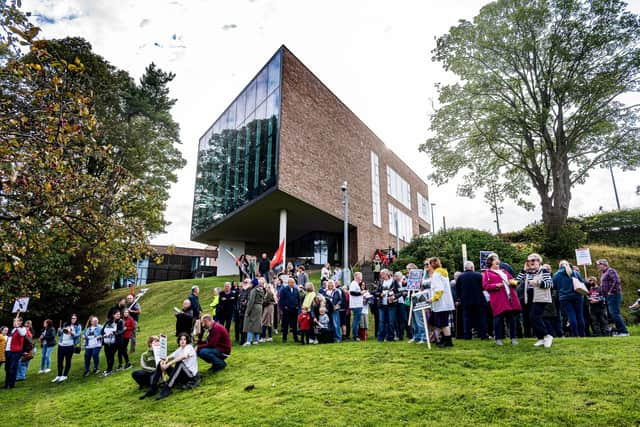
The reports consider the financial health of Scotland’s colleges and universities, providing detailed information at sector level on their operating position, cash balances, sources of income, expenditure, liquidity, cash flow, borrowing and capital expenditure.
Both colleges and universities continue to operate in an extremely tight fiscal environment, with downward trends in cash balances showing both sectors under pressure.
Gavin Donoghue, CEO of Colleges Scotland, called the report “incredibly stark”.
The sector body is also calling for investment from the Scottish Government at the next budget, saying flat-cash funding and inflationary uplifts are not sustainable options.
Mr Donoghue said: “The SFC highlights the imminent risk that a number of colleges may be insolvent by the end of this academic year, without urgent action from Scottish Government.
“Many colleges are clearly in a perilous financial position, and this must be quickly addressed through a significant increase in core funding.”
He pointed to the fact the report highlights that colleges are educating 12.4 per cent fewer students since 2021 and have reduced staff numbers by 8.7 per cent in a bid to balance the books.
“Colleges are Scotland’s skills engines, and important local community anchors which act as places of hope and opportunity to help move people out of poverty,” he added.
SFC Chair, Professor Cara Aitchison, said: “While these reports represent a snapshot in time, the trends we’re seeing indicate the serious implications of the tight fiscal environment in which colleges and universities are operating and the need for action to address the challenges they face.”
READ MORE: Children as young as 7 'can access porn' on Scottish council-issued iPads in Glasgow and Borders
The analysis sets out issues for both universities and colleges that include rising staff costs, unanticipated public spending cuts, an uncertain economy with rising inflation and high interest rates, and continuing high energy costs.
It also describes infrastructure pressures, exacerbated by the impact of RAAC, and says these are impacting on the delivery of high-quality learning, teaching and research.
Government net zero targets are also placing a burden on university and college income, as is the impact of UK government policies on maintaining international fee income.
Institutions are taking mitigating steps to try to adapt to challenges, such as staff restructuring, vacancy management, freezing of non-essential spend, reviewing course portfolios, curriculum rationalisation and consolidation, moves to online and blended learning, delaying capital spend and reviewing estates strategies.
Ms Aitchison said these steps were encouraging but warned that “difficult decisions” would have to be taken in the long term.
She said: “We are encouraged by the proactive steps being taken by institutions as they adapt and build in resilience for this changing environment, recognising that this may include difficult decisions to secure long term financial sustainability, which is a requirement of our Financial Memorandum.”
Scottish Conservative shadow cabinet secretary for education and skills Miles Briggs MSP called the reports “grim reading”.
He added: “The SNP has presided over more than a decade of decline that has put our iconic universities on the brink and our colleges at serious risk of closure.
“Unless they change their failing approach, this situation will spiral out of control.”
Universities are dependent on overseas students for income and the university funding report sets out a stark warning on this source of income.
It reads: “There is an increasing risk that universities may not meet their international student tuition fee income targets as this continues to be an area of significant fluctuation and risk due to the competitive nature of the international markets, UK visa and immigration policy and geopolitical changes.”
The number of students from the top 10 countries increased significantly between 2018/19 and 2022/23.
The largest increases in numbers over that period were from India with 10,075 students, Nigeria accounted for 8,130 and China at 7,600.
In percentage terms, the largest increases were from Nigeria (633 per cent), Pakistan (551 per cent) and India (466 per cent).
However, in 2023/24 there was a drop in the number of international students and the only countries showing increases were United States, Pakistan, and Canada.
Ms Aitchison added: “We continue to engage closely with Scottish Ministers on the case for investment in colleges and universities which are the drivers for economic growth, addressing child poverty, supporting the transition to net zero and delivering excellent public services.
“We are also increasing levels of engagement and monitoring activity for those institutions facing the highest risks to their financial health and are working with them to understand and assess plans to bring them back to a sustainable position.”
Higher and Further Education Minister Ben Macpherson highlighted the £1.1bn investment figure referenced by Ms Senior and added that the government has provided a 2.6 per cent sector increase in teaching funding to colleges and a 4.9 per cent increase to support college maintenance in 2025-26.
Mr Macpherson said: “These reports recognise the high levels of pressures on our colleges and universities which is why we are collaborating closely with the higher and further education sector to ensure a successful and sustainable future.”
Comments
Want to join the conversation? Please or to comment on this article.