
Inside the Glasgow school setting the bar for ensuring every child learns to read - and love reading

Glasgow has set a new standard that every pupil will leave primary having learned to read - and they’re relying on phonics
In the well-stocked, brightly-lit library, a group of pupils are rapt by a teacher reading.
At this Glasgow primary school, books are king - and every child is able to read, despite the school sitting in one of the city’s most deprived areas.
Christopher Devlin, head teacher of John Paul II Primary School, is a passionate advocate of the reading system phonics.
READ MORE:Scots universities in stark warning to Home Office over 'serious weaknesses' in student visa scheme
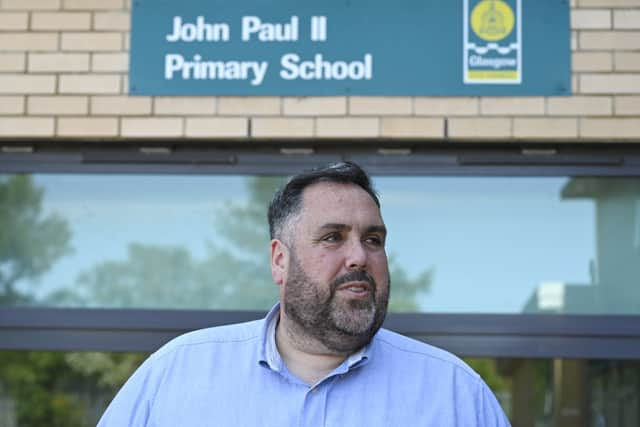

He introduced systematic synthetic phonics (SSP) to his school when he took over as head around five years ago and encountered pupils who were unable to read.
It turns out Mr Devlin was ahead of the curve.
New Glasgow City Council director of education John McGhee is now mandating every school in the city introduces SSP.
He wants to guarantee that all children leave primary school with solid literacy skills.
To do so, he’s relying on SSP - the system introduced in England by Michael Gove when he was education secretary.
It’s also used extensively by the New South Wales government in the Australian state’s classrooms.
“So there's now an expectation in every Glasgow primary school, we'll be using systematic synthetic phonics because it works and the evidence shows it works,” Mr McGhee said.
Before his appointment as director of education, he became head teacher of St Andrew’s Secondary School in Glasgow’s Carntyne in 2022.
Every associated primary school is sited in an area of multiple deprivation but at one school every single child left able to read and write, without exception.
From other nearby primary schools, Mr McGhee was seeing around 20 S1 pupils each year who could not read.
When he asked the primary head teacher her secret, she said SSP.
READ MORE:A barely audible 'guilty' marks the pinnacle of the Peter Murrell drama that has dogged the SNP
She had carried out her own research with Glasgow University and looked at the model used in Australian schools, as Mr McGhee then did.
He found from the Australian example that there was a second chance to catch pupils at secondary level and teach them phonics.
As a result, he put two primary teachers in his secondary school with one job - to teach those first year pupils phonics.
By Christmas, each of them could read - having started learning in August.

Mr Devlin is a passionate advocate of SSP. However, he said: “It’s not that phonics magically makes reading easy for everybody - it doesn’t.
“We recognise that when we are teaching phonics there are children who will struggle.
“They’ll need to practice, practice, practice.”
Mr Devlin was a head teacher in North Ayrshire when the Pupil Equity Funding (PEF) was set up as part of the Scottish Attainment Challenge programme.
Former teacher and now literacy consultant Anne Glennie was brought into the school to train staff on teaching phonics.
The impact on attainment in the school was “dramatic”.
He took up post at John Paul II Primary in the September after schools re-opened following the pandemic.
“It was an odd time to be arriving in a new school but at the end of that first year, and I hate to say it, but we had a child leaving here with very, very little reading,” Mr Devlin said.
“He wasn't able to read very well at all, so I made the conscious decision that we were introducing systematic synthetic phonics here.”
That included the staff receiving training and then supporting each other to ensure phonics is not just a primary one endeavour but woven throughout the school curriculum.
In a nutshell, the science of reading says children need two things to be able to read.
Firstly, to be able to decode - or lift the words off the page - and you need knowledge of language.
“If you have both those things, then you’re able to read,” Mr Devlin added.
Curriculum for Excellence outlines several systems for teaching children to read, such as alternative reading strategies that look at the shape of the word or the beginning and end of a word.
Mr Devlin said: “These are quite misguided in my opinion.
“With phonics, just about every child in our school can read.”
English is a complicated language to learn. There are around 50 sounds children have to learn in order to be able to read.
When Mr Devlin learned to read - and when he began teaching children to read - the tactic of choice was “word tins”.
Pupils were given tins of around 50 words to memorise. Once learned by rote, they would receive a new tin of new words, in what the head describes as a “gigantic memory test”.
“Adversely, to that is, if you can teach children to recognise sounds, how many more words can you unlock for the children?”, he said.
“If they're able to finger track and pick out any sounds, then you don't limit them to the 50 words or the 100 words or the 150 words that they can learn.
“They're able to use those sounds to decode anything.”
Another benefit of phonics, Mr McGhee and Mr Devlin claim, is that it erases barriers created by inequality.
Mr Devlin says the system “eliminates the element of chance”.
Castlemilk is an area of high deprivation but Mr McGhee says his parents are proud of the community and don’t recognise it as an impoverished area.
The school also styles itself as a “vocabulary rich” environment and has multiple reading initiatives on the go, such as “it’s twenty past one, let’s read for fun”.
Every day at 1.20pm pupils can choose to listen to a teacher reading for 15 minutes.
“It's about knowledge of language and love of literature and love of books, which ties the knot perfectly,” Mr Devlin added.
He fully agrees with Ms Glennie, who has advocated for the Scottish government to implement phonics use Scotland-wide.
“I can't tell you how highly I advocate for SSP,” Mr Devlin added.
“I will invite anybody to come and to see the practice of my staff, to see the impact it's having on children.
“I would wholeheartedly agree with Anne Glennie, who has brought various bills through parliament.
“And there's nothing better, actually, than the children being so proud of the fact that they're able to read.”
Comments
Want to join the conversation? Please or to comment on this article.