
Exclusive:How thousands of Scottish youngsters are 'written off' under SNP's 'perverse' school testing regime

Green MSP says scrapping some assessments could ease ‘crushing workload’ faced by teachers
SNP ministers have been presented with a dossier detailing how huge numbers of children are being written off at an early age in Scottish schools because of the “perverse incentives” created by the current testing system, it can be revealed.
The research, seen by The Scotsman, was commissioned by the Scottish Greens when they were in Government last year, and was carried out by Professor Mark Priestley and Dr Joseph Smith from Stirling University.
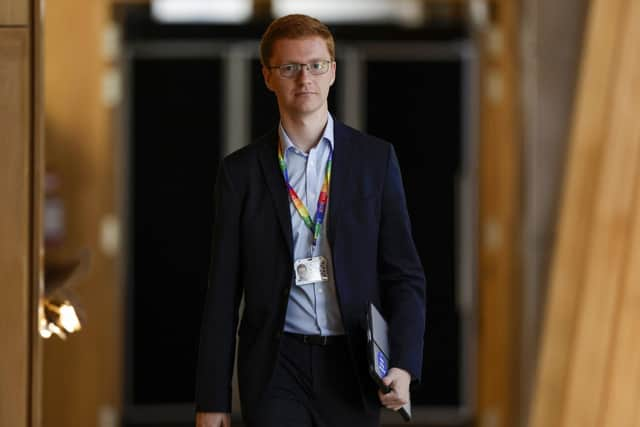
Ross Greer, the Greens education spokesman, said the paper showed how the Government could quickly ease the “crushing workload” faced by teachers, and save money, by abolishing the likes of Scottish National Standardised Assessments (SNSAs).
The research, based on focus groups, found that both classroom teachers and school leaders felt it was unjust that the local authority collected data on attainment rather than progress.
Schools are required to report on the percentage of that children were “on track” to reach an “expected level”, using tracking systems colour-coded as red, amber or green, based on their likelihood of hitting the expected grade.
One primary school depute head described a system that created “perverse incentives” which led to limited resources being directed away from those children who found school most difficult.

They said: “The amber children are where the gains are. The system itself is set up to write children off from a really young age and to put the very little support we have onto ‘amber children’ because you can you can affect your figures with those kids, but you can’t affect your figures with the ‘red children’.
“I've got a huge number of examples from this year of children who have made massive progress - particularly in P7 - but they haven't ‘made the level’.
“And really making the level from the start was always unfeasible. But the progress they made is huge. It's not registered anyway. It's not recognised anywhere and there's no reward.”
Teachers also complained about the “unnecessary work” created for teachers required to produce cohort-level data demanded by local authorities.
A particular concern among senior school leaders was said to be that too many different kinds of data existed in the system, and there was not always confidence that politicians understood the figures they were using.
A high school head teacher said: “The local government benchmarking toolkit that [elected councillors] use is a different data set than the data set that schools use.
“Which is a different data set again from the National Improvement Framework Toolkit... [But this] creates some confusion when talking about how schools are doing, because it very much depends which cohort you measure, when you measure them, and how, what you include.
“I think the most obvious example is - are you measuring National Fives or Level Fives? Are you measuring every leaver or only your S4 leavers, are you measuring the children that were in school in August or the children who are in school in December? Those all make a difference to the final figures.”
Another secondary head said: “The system is not fair because...you can do a First Aid qualification at Level Six. It takes five hours in school but it carries the same kudos in terms of the league tables as Higher Physics.”
They added: “And that's where in some authorities where I have worked, you can see the manipulation of data to make sure that schools don't look bad in final outcomes. That’s the bit I disagree with.”
The report highlighted how previous concerns about assessment arrangements under Curriculum for Excellence (CfE) led to the the introduction of ‘benchmarks’ at each level for assessment purposes, as well as the introduction of computer-based SNSAs, which test children in P1, P4, P7 and S3 in literacy and numeracy.
The professors wrote: “Following these policy decisions, Scotland has ended up with an educational accountability system which faces in two-directions at once.
“On the one hand, there is the original vision of CfE which aimed to avoid a prescriptive and tick-box approach to curriculum design and learner assessment, on the other there is the neoliberal governance model instantiated in the National Improvement Framework, which relies on hard numerical data to set targets and drive improvement.
“The problem, of course, is that CfE was not designed with such a governance model in mind.”
One primary depute said SNSAs “don't provide us with anything” and they would “remove” them and “invest significantly in some form of national moderation programmes”.
The paper concluded: “While it is necessary to collect meaningful data about the quality of the system, there is ample evidence (in Scotland... and further afield) that crude use of data to achieve narrow accountability goals has a major effect of generating perverse incentives.
“This will over time result in the development of performative cultures in schools, as stakeholders such as teachers and school leaders seek to generate the right sort of data.”
They added: “We see a situation where schools and teachers operate to fulfil arbitrary system demands, rather than the inverse – a system that exists to support and facilitate good educational practice in schools and classrooms.”
Mr Greer said workload reforms could be delivered by the Government now.
“Increasing teacher numbers is essential, but there are many no-cost steps we could take to ease the crushing workload of teachers currently in our classrooms,” he said.
“The work I’ve commissioned and presented to the Scottish Government lays out a range of options for immediate action, some of which would even save money.”
He added: “Abolishing the SNSA standardised tests alone would save £5-6 million per year. They are a clear example of how every level of government has added unnecessarily to teacher workload.
“The SNP introduced these unhelpful tests for children as young as four, but local councils and school management have all since tacked on their own layers of bureaucracy and reporting requirements.
“Reversing that administrative overload would be one of the simplest actions the Scottish Government could take to ease the pressure on teachers and demonstrate their commitment to a wider programme to get workload back under control.”
A Scottish Government spokesperson said: “The SNSAs are a helpful source of information for teachers when considering children’s progress in literacy and numeracy.
“Our survey of staff using the assessments in 2023-24 showed that the majority found the assessments helpful in informing future teaching and learning.
Comments
Want to join the conversation? Please or to comment on this article.