
UK Budget: Scottish business gives its verdict on the good and bad in Reeves speech
“It is clear the UK government doesn’t understand or accept the fact that you can’t tax your way to growth” – Sandy Begbie, SFE
Scottish business leaders have slammed Rachel Reeves’ tax-hiking Budget, warning that it fails to address the long-term challenges facing the economy.
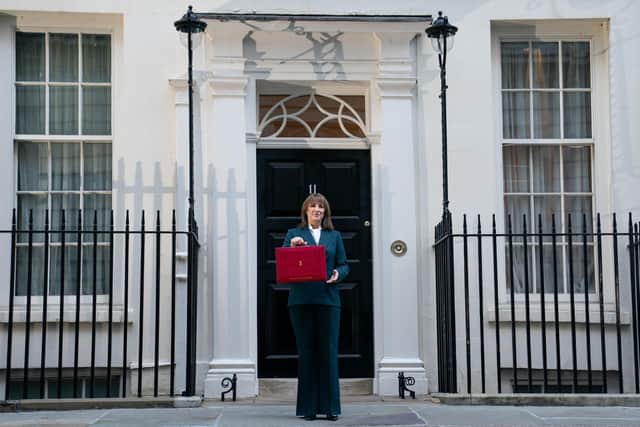
Delivering one of the most extraordinary economic statements in recent times, to a rowdy House of Commons, the Chancellor announced a series of tax rises amounting to £26 billion as she battles downgrades to economic growth forecasts that were leaked just minutes before she prepared to address Parliament. The measures contribute to a tax burden that will rise to a record high in 2030/31.
Sandy Begbie, chief executive of Scottish Financial Enterprise, which represents hundreds of financial service providers of all sizes, said Ms Reeves’ “tax and spend” Budget made economic growth less - rather than more - likely across Scotland and the UK.

“This Budget is essentially about four things,” he said. “Tax, which is at an all-time high. Borrowing, which is maxed out. Spending, which is also running out of control, and economic growth, which the Office for Budget Responsibility (OBR) downgraded for the coming years.
“It loads additional burden onto taxpayers and businesses while failing to address the long-term challenges facing our economy. It is clear the UK government doesn’t understand or accept the fact that you can’t tax your way to growth.
“Specifically, capping salary sacrifice will hit workers trying to save for their future, while expecting them to continue propping up the unfair, unsustainable and unaffordable system of public sector pensions and driving a further wedge between workers in the private and public sectors.”
Make sure you keep up to date with breaking news from across Scotland by signing up to our free newsletter here.

The Budget, labelled the “most damaging in living memory” by one leading chief executive, saw a raft of personal tax changes, including raising a projected £4.7bn through charging National Insurance on salary-sacrificed pension contributions, and £2.1bn through increasing tax rates on dividends, property and savings income by two percentage points.
The combination of measures unveiled or confirmed by the Chancellor means that tax as a share of the economy - the tax-to-GDP ratio - will “increase to an all-time high of 38.3 per cent” in 2030/31.
It follows a maiden Budget for Ms Reeves last autumn that led to damaging changes in National Insurance contributions and thresholds for nearly every employer in the UK.
Marc Crothall, chief executive of the Scottish Tourism Alliance, described the Budget as a “major setback” for Scotland’s tourism and hospitality sector.
“At a time when businesses are already at breaking point, the Budget adds further cost pressures and fails to deliver the targeted support urgently needed to protect jobs, rebuild confidence and maintain the viability of thousands of operators,” he said.
“The sector needed a Budget that reduced the cost of employment, strengthened consumer confidence and supported recovery. Instead, today’s measures risk making an already difficult outlook even more precarious.
“Scotland’s tourism and hospitality sector urgently needs a predictable, competitive and supportive fiscal environment. Today’s Budget does not provide that. Instead, it intensifies uncertainty and does little to create the conditions required for businesses to retain staff, invest, grow and deliver the world-class visitor experience Scotland is known for.”
Nimesh Shah, chief executive of audit, tax and business advisory firm Blick Rothenberg, noted: “This is one of the most damaging Budget statements in living memory and will leave a lasting impact for a generation.”
Some of the measures announced in the Budget were welcomed, including the Chancellor's decision to widen eligibility for enterprise incentive schemes. The Treasury is doubling eligibility for enterprise tax incentives, introducing a three-year stamp duty exemption for new UK listings, and maintaining a £1 million annual investment allowance. The doubling in eligibility for enterprise tax incentives should support scale-up activity.
David Ovens, joint managing director at Edinburgh-based investment syndicate Archangels, said: “The Chancellor's decision to widen eligibility for, and extend, enterprise incentive schemes is a clear demonstration of support for the role which founders and investors play in economic growth.
“The three-year stamp duty holiday for new UK listings is a positive step toward making London more competitive as a listing destination. However, the real challenge for Scottish scale-ups remains building sufficient scale and market traction to reach IPO [initial public offering] stage.”
The Chancellor also announced permanent lower business rates for thousands of retail, hospitality and leisure properties south of the Border, worth nearly £900m a year from April 2026. A £4.3bn business rates support package will cap rates bill increases for sectors hit hardest by revaluations from next April.
David Lonsdale, director of the Scottish Retail Consortium, said: “After last year’s Budget battering, Scottish retailers will be relieved the 2025 iteration appears to have little which will immediately make trading harder.
“The most significant announcement from a retail perspective was of a permanently lower business rate for most English shops; with stores seeing reductions of up to 10 or 20 per cent in their business rate. When allied to the recent Welsh Government announcement to reduce retailers’ business rates, there is now a real risk Scotland will become a substantially less attractive investment option from next April.
“The onus is on the finance secretary to seize the moment to reduce rates for all retailers in Scotland in her January Budget. If she flubs the chance, then Scotland’s retailers’ and high streets are likely to face the unwelcome consequences.”
Ritche Whyte, partner and head of corporate and business advisory at Scottish legal firm Aberdein Considine, said: “As well as the impact on exit opportunities for business owners, businesses and employees will be penalised by measures in the Budget, including the mileage charge for electric vehicles (from April 2028) and introduction of National Insurance contributions on pension payments above £2,000 (from April 2029).”
Comments
Want to join the conversation? Please or to comment on this article.