
Scottish office market bucking UK trend as Glasgow take-up hits eight-year high
“Glasgow and Edinburgh have both outperformed the wider UK regional market so far this year” – Angela Lowe, CBRE
Glasgow’s office market has recorded its strongest first half in eight years, according to new figures.
Property experts also noted that the Edinburgh market had held firm in the first six months of 2026, with the two cities’ resilience bucking the wider UK regional office market.
In Glasgow, first-half take-up of office space topped 309,600 square feet, up 18 per cent on the same period last year, according to CBRE's latest figures.
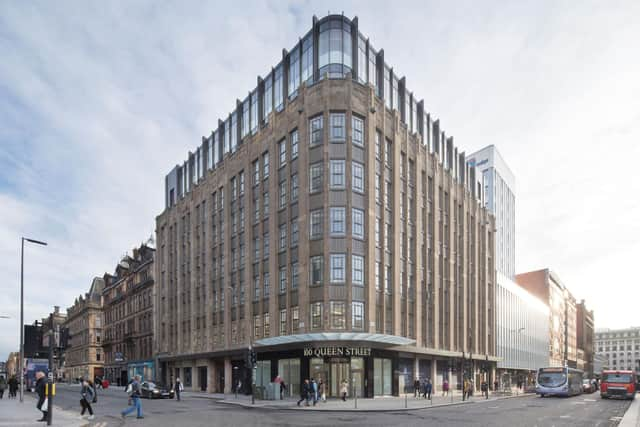

The momentum built through the second quarter, when take-up jumped 58 per cent year-on-year to 169,100 sq ft, marking the city’s strongest quarterly total in more than a year. The uplift was underpinned by the Home Office’s letting of 80,600 sq ft of refurbished space at 200 Broomielaw - one of the largest lettings recorded across the UK’s regional office markets in the second quarter.
The public sector was found to have accounted for the largest share of Glasgow take-up over the past year, at 28 per cent, followed by “business services” at 17 per cent.
CBRE said supply in the city remained tight. Availability fell 3 per cent over the quarter to some two million sq ft, but that is 19 per cent below the five-year average, with premium Grade A space making up just 18 per cent of what’s available.
No new office space has been completed in Glasgow so far this year, and only one scheme, providing 91,100 sq ft of space at 45 Waterloo Street, is currently under construction, the firm noted.
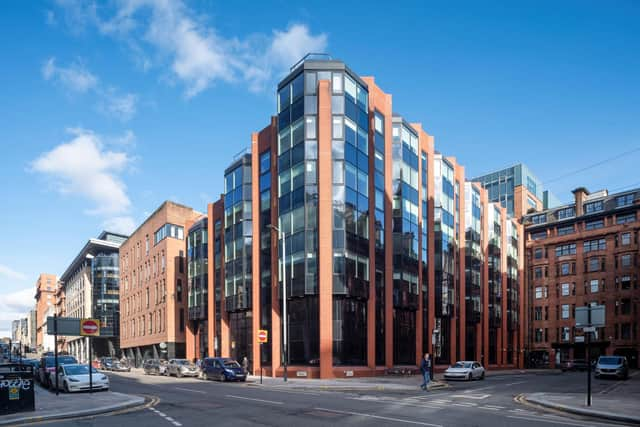
In Edinburgh, year-to-date take-up has totalled some 237,000 sq ft, up 2 per cent on the first half of 2025, led by a 21,900 sq ft letting at Saltire Court on Castle Terrace - a deal advised on by CBRE.
UK-wide, the regional office market saw take-up fall 15 per cent quarter-on-quarter, bringing first-half volumes to 2.2 million sq ft, which is 7 per cent below the same period in 2025, with limited pre-letting said to reflect “ongoing supply-side constraints” across the UK.
Sarah Hagen, director and head of office agency, Glasgow at CBRE said: “Glasgow’s office market is showing real momentum. The Home Office’s acquisition of 200 Broomielaw was a significant contributor, but activity has been broad-based, with demand also coming from the business services and professional sectors.
“The challenge remains supply. Despite the high-level supply picture, when you delve a little deeper, less than 2 per cent of Glasgow’s office stock is currently available as ‘best in class’ or Grade A space, and Lucent is the only prime building offering immediate occupation.

“With no refurbishment completions expected this year, occupiers are facing an increasingly limited pool of options until 45 Waterloo Street delivers almost 100,000 sq ft of best-in-class accommodation in early 2027,” she added.
Angela Lowe, senior director and head of office leasing for Scotland at CBRE, said: “Glasgow and Edinburgh have both outperformed the wider UK regional market so far this year, and the pipeline of activity coming through is an encouraging sign for the months ahead.
“A strong pipeline of occupier interest is currently under discussion that should convert into further take-up before year end, while more refurbished space is starting to come through in both cities, helping to ease the supply constraints that have held the market back and giving occupiers the quality of stock they're increasingly looking for.”
Recent research suggested that firms looking for new offices in Edinburgh were prioritising “certainty around costs and delivery” as demand grows for fully fitted-out space.
The second quarter of 2026 saw some 124,000 sq ft of office space transacted across the capital, with an additional 90,000 sq ft of so-called “regear” activity on top of this, according to the latest findings from property consultancy JLL.
Grade A and prime space accounted for just under half of all city-wide activity. Notable transactions included EY’s 38,000 sq ft sublease at Baillie Gifford’s 3 Haymarket Square development, where the firm will relocate from Atria One by the end of 2026.
JLL’s data suggests that occupiers increasingly favour fully fitted, “plug-and-play” offices as rising fit-out costs and construction uncertainty influence decision making. Fit-out costs in Edinburgh have seen significant cost inflation, property experts noted, driving businesses to reduce upfront capital expenditure by taking ready-to-use space.
Meanwhile, Aberdeen could see a new headline rent being set later this year after the city witnessed the best quarter for office take-up since before the pandemic.
Activity was boosted by one particular bumper deal - the relocation of CB&I Asset Solutions to Kingswells - alongside a flurry of other transactions completing between April and June, according to figures last week from property agency Knight Frank.
The firm’s analysis found there were 221,213-square-feet of office deals in the Granite City during the second quarter of 2026 - more than three times the 68,482 sq ft recorded in the first three months of the year and more than double the same period last year (102,412 sq ft).
Knight Frank, which was involved in more than two-thirds of the space transacted, said the latest Q2 figure marked the highest quarterly take-up since the final three months of 2019, before pandemic-related lockdowns and the subsequent shift to working from home reshaped office demand.
In total, there were 14 significant deals between April and June, according to the analysis, eight of which involved energy businesses and the remainder made up of technology, professional services and charity occupiers.
Comments
Want to join the conversation? Please or to comment on this article.