
Scotland’s private sector report card - mixed scoring as business confidence rebounds
“Our growth tracker data shows Scottish businesses continue to face challenges” – Judith Cruickshank, Royal Bank of Scotland
Scottish business confidence picked up in November despite private sector output cooling, a key survey has revealed.
While conditions remained challenging for many businesses last month, the latest Royal Bank of Scotland (RBS) regional growth tracker signalled a notable uplift in confidence regarding future output.
When asked about their expectations for activity over the year ahead, Scottish companies were “strongly optimistic” during November. Upbeat forecasts were often underpinned by plans of introducing new products and services and hopes of improved overall demand conditions, RBS noted.

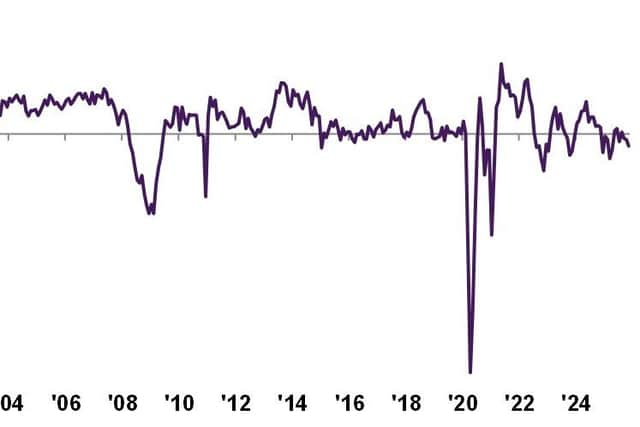
The headline tracker - a seasonally adjusted index that measures the month-on-month change in the combined output of the country’s manufacturing and service sectors - registered 48 in November, down from 49 the month before. Any reading below 50 points to contraction, while over 50 denotes expansion.
The bank said anecdotal evidence indicated that lower levels of new orders and economic uncertainty had driven the latest easing in output.
The monthly tracker is based on purchasing managers’ index (PMI) surveys that are available for more than 40 countries and also for key regions including the eurozone.
Make sure you keep up to date with breaking news from across Scotland by signing up to our free newsletter here.
Judith Cruickshank, Scotland board chair at Royal Bank of Scotland, said: “Our growth tracker data shows Scottish businesses continue to face challenges, as output and new orders both continued to contract in November and selling prices rise slower than input prices as businesses try to remain competitive in a challenging demand climate.
“Firms also reduced staffing, although to a lower extent than the UK-wide trend suggesting that the Scottish labour market remains relatively resilient.
“Business confidence, however, improved notably offering a reason to approach the coming year with cautious optimism,” she added.
The latest survey results highlighted a 14th consecutive monthly reduction in new orders placed with companies based in Scotland. The rate of contraction was found to be more pronounced than that seen in October, as well as stronger than the UK-wide average. According to survey panel members, reduced client spending and uncertain economic conditions resulted in fewer sales.
Despite registering the largest upswing in confidence of the 12 monitored regions and nations in November, Scottish firms remained less optimistic when compared to the UK-wide trend.
Workforce numbers, meanwhile, fell for the second month in a row across Scotland last month. Input from panel members linked the latest decline in employment to a drop in new orders and initiatives aimed at reducing costs. However, the rate of job shedding was identical to that seen in October and described as only marginal.
The decline north of the Border was the smallest seen of all 12 monitored UK regions and nations, and contrasted with a sharp reduction in headcounts across the UK as a whole.
Scottish private sector firms noted a fall in backlogs of work for a fourth straight month. The rate of depletion was said to be solid while survey respondents often mentioned that they were able to complete orders at a quicker rate than they received them. However, backlogs across Scotland were reduced at a slower pace than that seen across the UK as a whole.
Average input prices continued to rise rapidly across Scotland's private sector - which accounts for about half of the economy - in November. The rate of inflation accelerated to a seven-month high and was the second-sharpest seen across the dozen monitored UK regions and nations, behind Northern Ireland. Firms stated that higher costs largely stemmed from greater salary and wage expenses, but also supplier price hikes.
As has been the case since November 2020, charges levied for Scottish goods and services rose further in the penultimate month of 2025. The rate of inflation eased since October, and in line with the long-run average.
While many firms chose to pass on higher costs to clients, others noted that competitive market conditions and subdued customer demand had dampened overall pricing power. Nevertheless, output prices across Scotland rose at a faster pace than that seen at the UK-wide level.
Earlier this week, it was revealed that Scotland’s business investment had entered double-digit territory for the first time in two decades. However, industry leaders demanded “a plan of action which delivers” amid long-term economic challenges.
Releasing its latest Scottish Productivity Index, business body CBI said it was issuing a “clear call for all political parties to make 2026 the year Scotland gets its economy firing on all cylinders”.
Among the report’s key findings, business investment was found to have risen to more than 10 per cent of gross domestic product (GDP) - a measure of total economic output. It is the first time Scotland has exceeded its long-term trend in 20 years, in contrast to a fall across the UK as a whole.
The index assesses the nation’s performance across key productivity drivers including business investment, exports, research and development (R&D), digital infrastructure, skills and health, compared with other UK nations and international competitors.
Michelle Ferguson, director of CBI Scotland, said: “This year’s index shows that Scotland is not standing still - firms are investing more, digital infrastructure is improving, and we are building on real strengths in education and innovation. But it also underlines that these gains are not yet translating into the step change in productivity our economy needs.
“Too many businesses are still held back by weak export performance, falling levels of workforce training and the growing impact of long-term ill health on participation in the labour market.”
Comments
Want to join the conversation? Please or to comment on this article.