
Properties are hot once more after some turbulent years
The signs are good for buyers and sellers of homes throughout Scotland after a troublesome couple of years
Following a turbulent period in 2022 and early 2023, the Scottish property market, particularly Glasgow, Edinburgh and their surrounding areas, has shown remarkable resilience, marking 2024 as a year of stabilisation and growth.
After the tumultuous end to 2022, caused by the rise in interest rates and market uncertainty triggered by Liz Truss’s mini-budget, 2023 proved a more difficult year for the property market than hoped, with sellers hesitating to list and buyers finding themselves facing significantly higher mortgage rates than in recent years.
However, this year has seen more market stability, driven by falling interest rates and external factors such as a rise in population numbers. A recent report from the National Records of Scotland noted that in the past year to time of publication, Scotland’s population had risen faster than at any time since the 1940s, with the main driver of growth from individuals moving to Scotland from abroad and other parts of the UK.
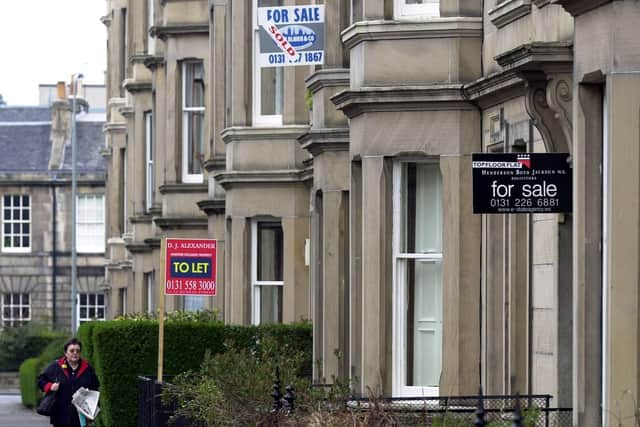

This increase in part is driving up demand in the first-time buyer market, which is then pushing up demand for the entire market.
The major estate agents in Edinburgh and Glasgow have almost uniformly noted that 2024 has been neither a classic sellers’ nor buyers’ market, in Edinburgh and the Lothians in particular. For the most part, there has been a steady balance of supply and demand, allowing home movers the luxuries of time and choice.
Edinburgh has long been a desirable location for property investment, and 2024 has been no exception. The average house price in the city reached £347,000 in September, a 7.7 per cent increase on the previous year. This growth outpaced the national average.
The Edinburgh rental market has also seen significant activity, with private rents rising to an average of £1,383 per month, a 13.1 per cent increase from the previous year. This rental price surge reflects the city's high demand for housing, driven by its robust job market and excellent educational institutions.

Glasgow has also had a positive year in the property market. The average house price has increased, although not as dramatically as in Edinburgh. The rental market in Greater Glasgow, however, has seen the largest increase in rent prices, with an annual rise of 22.3 per cent.
As we look ahead to 2025, a key factor in how the market grows will no doubt be influenced by the recent change to the Second Home Tax or Additional Dwelling Supplement, matching London’s recent 2 per cent hike, taking Scotland to 8 per cent and maintaining the 3 per cent gap between nations.
There is no doubt that this rise will greatly impact the rental sector in particular and has been met with widespread condemnation across the legal and estate agency community.
The Scottish Government's ongoing efforts to address housing affordability and supply will play a crucial role in shaping the market. However, with a 2026 Scottish election looming, housing policy is likely to be a key battleground on the campaign trail throughout the coming year, with Edinburgh accounting for almost one-third of Scotland’s councils declaring a housing emergency in recent months.
Overall, the Scottish residential property market has shown remarkable resilience in 2024, and the outlook for 2025 remains positive, despite the recent tax change.
Phil Harris is a Director, Shepherd and Wedderburn