
Ming Yang Scotland plan risks being caught in European security crosshairs
A week is a long time in geopolitics
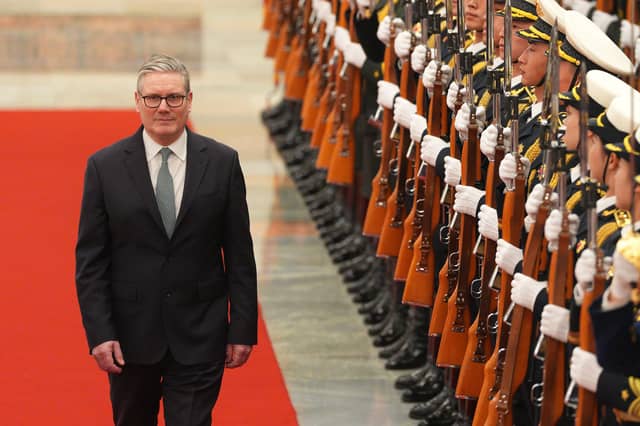


When Keir Starmer met Xi Jinping in Beijing last week on the first visit to China by a UK prime minister for eight years, the Chinese leader related a parable about blind men being presented with an elephant.
One touches its leg and thinks this is a pillow. Another feels its belly and thinks it’s a wall. Starmer explained Xi had told him this was how China is often seen by the outside world. It was time, therefore, for a more “sophisticated” relationship with China, the British premier declared.
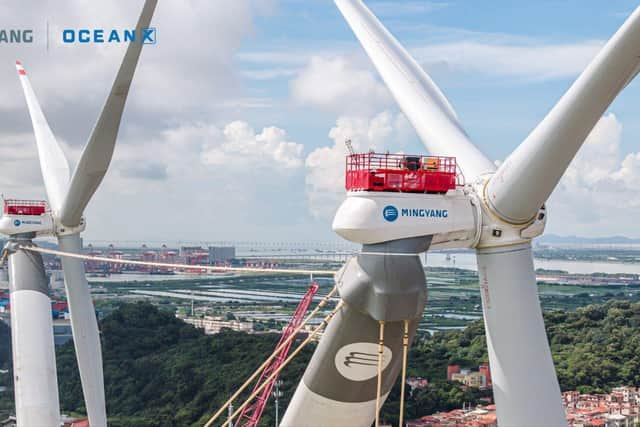
Easier said than done. For while allowing China to build its new mega-embassy in London removes a major source of bilateral friction, there is still an elephant in the room: whether to allow Ming Yang, the Chinese wind turbine manufacturer, into the UK’s critical energy infrastructure by building a £1.5 billion blade factory in Scotland.
It’s an issue that’s been on Starmer’s desk for almost a year, as I have written before. The expectation had been that a decision would come during his China visit.
I confess I thought the likelihood of a positive decision for the Chinese company had moved in its favour given how Canadian prime minister Mark Carney’s landmark speech at Davos signalled a new model for engagement with China while threading the needle on a Trumpian America.
But a week is a long time in geopolitics, and I’m now not so sure. Global events are moving so quickly it’s easy to see how the UK government may actually be swithering over how and when to make a decision – and one that stands the test of time.
I say this because of what book-ended Starmer’s China visit. On his brief stopover in Tokyo en route home, signs of how the UK is rapidly re-aligning itself with like-minded allies on energy security were on display as Starmer and his Japanese counterpart Sanae Takaichi signed a “strategic cyber partnership”. They also agreed to accelerate deployment of “innovations in offshore wind”. It is no coincidence that Japan is one of the largest investors in Scotland’s offshore wind sector, including Mitsui’s ownership of Port of Nigg and Sumitomo Electric’s subsea cable factory at the site.
Two days before Starmer landed in Beijing, nine European countries signed the “Hamburg Declaration” at a North Sea summit hosted by the German government in the Hanseatic port city.
This was no run-of-the-mill Euro-gathering. Recognising that Europe is “facing critical challenges to its security, economy, and energy systems”, including cyber threats and rising threats to offshore energy infrastructure, they pledged to ramp up cooperation on offshore wind. This involves the development of a fleet of joint offshore wind projects with anticipated capacity of up to 100 gigawatts (GW). For comparison, the ScotWind project in Scotland envisages capacity of 30GW. Plans include wind farms at sea directly connected to more than one country through interconnectors.
Who were the signatories? Belgium, Denmark, France, Germany, Ireland, Luxembourg, the Netherlands and Norway and, crucially, the UK. There could be no clearer sign of how the Britain now sees its energy security as being tightly bound to that of the rest of Europe.
Seen in the context of the security risks that critics of Chinese offshore wind turbines say are posed by manufacturers such as Ming Yang, and in light of the fact that Germany has already signalled its opposition to the use of Chinese turbines in its own energy system, the UK will surely have difficulty looking its European allies in the eye while allowing Ming Yang into the UK.
That will have been made all the harder with news this week that Brussels has launched an in-depth probe into a Ming Yang rival called Goldwind, over whether Beijing provided it with unfair subsidies.
Moreover, the fact that that the UK has no comparable antitrust stance when it comes to China looks like being exposed as a problem as the two sides start to move ever-closer in a post-Brexit re-alignment. Labour MP Liam Byrne, who chairs the House of Commons Business & Trade Select Committee, told Parliament this week of concern in Europe over how the UK’s “lackadaisical approach to policing Chinese competition risks deeper integration with Europe”.
Moreover, a report published on Tuesday by his committee on the UK’s approach to economic security called out the UK’s deficient approach to the issue. “We welcome the government’s new confirmation that its approach to economic security is framed around the ‘protect/promote/partner’ model, aligning the UK in broad terms with the EU.
“However, shared language is not the same as shared capability. Our allies in the EU, Japan and the United States are all creating a more disciplined model, characterised by much clearer articulation of risks, strategic dependencies and targeted policy interventions. The government … does not set out an equivalent prioritisation for the UK, nor does it identify which dependencies are unacceptable and must be reduced,” the committee says.
Ming Yang has worked hard to address security concerns, according to its UK chief executive Aman Wang. This includes forming a UK-based joint venture with Octopus Energy to handle cybersecurity issues.
It is also incumbent on the signatories in Hamburg – which, ironically, is also the location of Ming Yang’s European headquarters – to spell out how European turbine manufacturers can step up if Chinese participation in European offshore wind is indeed ruled out.
For its part, the Chinese company has a “Plan B” should a favourable UK government decision not materialise. Notably, in 2024, it signed a preliminary deal with an Italian company to build a turbine factory in Italy, which has prioritised four of its ports for offshore wind development. Watch this space.
Comments
Want to join the conversation? Please or to comment on this article.