
Let’s make Scotland’s transport future work for everyone
More must be done to give disabled people access to EV chargepoints
Stand and watch the traffic on any road in Scotland and you’ll see the change for yourself. Once a lesser-spotted breed, electric vehicles (EVs) are now a common sight on the country’s highways and bypasses.
Delivering his Programme for Government this year, First Minister John Swinney committed to introducing a new rural and island EV infrastructure grant, which will support the aim of having 24,000 additional public charging points by 2030. Meanwhile, Transport Scotland has announced £20 million in 2025-26 to encourage and enable more households and businesses with lower incomes to buy EVs.
These are welcome steps. But the EV transition must be fair – and right now, it isn’t.
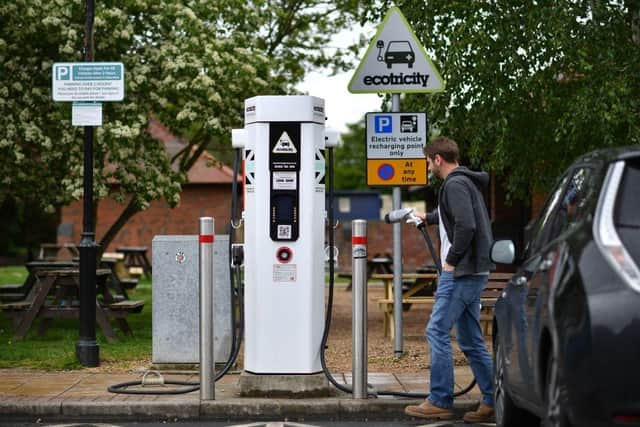

As manufacturers move production to electric, Motability Operations is working to ensure disabled people, including over 87,800 customers in Scotland, are not left by behind.
However, our recent EV Transition Tracker found that while 40 per cent of Scottish drivers feel nervous about going electric, the worry is even worse for disabled drivers, with 71 per cent believing they’ll only switch when they have no other choice.
The reasons are clear. For too many disabled people, public charging simply isn’t accessible.
Through a community of over 1,000 drivers on the Motability Scheme, we’ve gathered detailed, first-hand experiences of public EV charging across Scotland. The issues are widespread and persistent: bays that are too small for wheelchair users, charging cables that are too heavy, and instructions that are too difficult to follow.
It’s not just frustrating for users; it’s a barrier to independence. But fortunately, this is a solvable problem.
Almost three years ago, the Motability Foundation worked with the British Standards Institution to publish PAS 1899, a national accessibility standard for public EV chargepoints. It sets out minimum requirements – such as bay sizing, lighting, signage, and equipment usability – to ensure chargepoints are accessible to disabled people.
Positively, Transport Scotland is already using PAS 1899 to assess local authority requests for chargepoint funding, and a revised version of the accessibility standard is expected next year, following further consultation.
But here’s the issue: the standard remains voluntary. There is no legal requirement for charging providers to follow it. It is our view that PAS 1899 must be made mandatory, ensuring that every new public chargepoint meets basic accessibility criteria.
The charging network is growing rapidly – and if we don’t legislate now, we’ll lock in years of inaccessible infrastructure that will be costly and difficult to retrofit when the problem at hand is finally acknowledged.
It’s not enough to hit charge point installation targets. If people can’t use the infrastructure, we’re not solving the right problem.
However, the solution is within reach and by making accessibility a requirement, Scotland can lead the way in building an EV network that works for everyone and ensures that no one is left behind.
It’s time we build a system that enables every driver, regardless of their circumstances, to keep moving forward.
Gavin Thomson, COO & MD Scotland, at Motability Operations
Comments
Want to join the conversation? Please or to comment on this article.